November 2012

Mara Greenstone, President
Allen Mendelsohn and Larry Markowitz, Editor(s)

President’s Message

Mara Greenstone

Dear Colleagues and Honourable Judges,

Our annual Henry Steinberg Memorial Lecture was certainly a historic and memorable one for the Society when we had the privilege of welcoming Lord Reading’s great-grandson, Lord Alexander Rufus-Isaacs whose talk was both educational and entertaining. It was also very fitting on this historic occasion, that we were surrounded by many our Society’s Past Presidents.

By unanimous resolution of the Board, it was decided to make Lord Rufus-Isaacs an honorary lifetime member of the society, and he graciously accepted. We are thrilled to consider him as part of the Lord Reading family.

We were so touched to be presented with a special gift and family treasure… an original drawing of Lord Reading himself which graced the cover of Vanity Fair magazine in 1904. This special piece of memorabilia will certainly be cherished by the Society for many years to come:
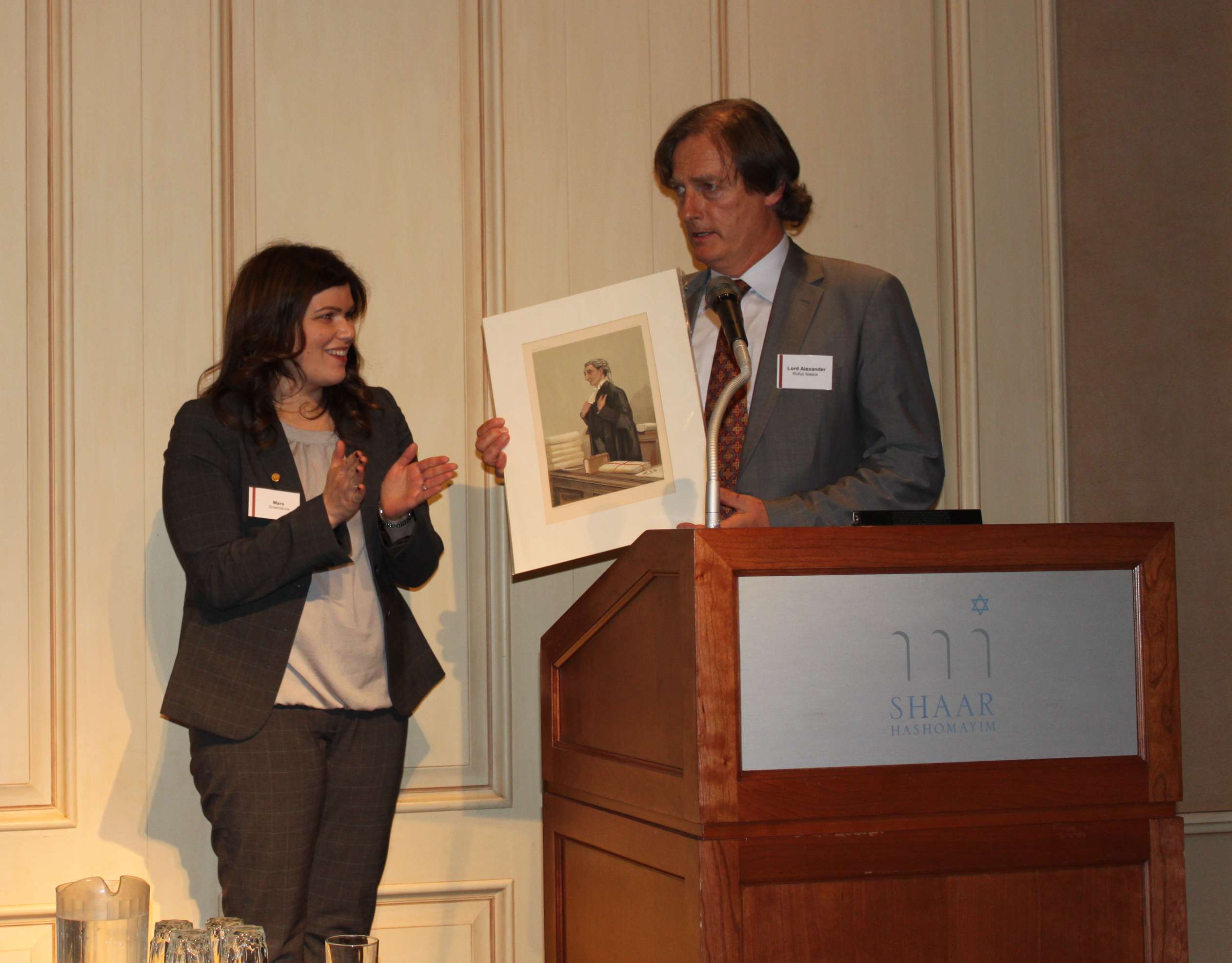
Thank you all for helping to make this special evening such a wonderful success.

On the occasion of our next lecture, being held on Thursday November 22, 2012, we are thrilled to welcome The Honourable Rob Nicholson, P.C., Q.C., M.P., Minister of Justice and Attorney General of Canada who will address us on the topic of “Standing up for Victims of Crime”.

Please note that for this one time only, the evening’s schedule will begin with cocktails, followed by the Minister’s speech, and then by dinner immediately thereafter.

I am happy to report that we have received certification for CLE credits. You can download the dinner invitation here, or register online here.

Special thanks to our generous sponsor for the evening, Robinson Sheppard Shapiro.

I look forward to seeing all of you on November 22nd.

Sincerely,

Mara Greenstone

Lord Alexander Rufus-Isaacs Addresses the Society on an Historic Evening

Allen Mendelsohn
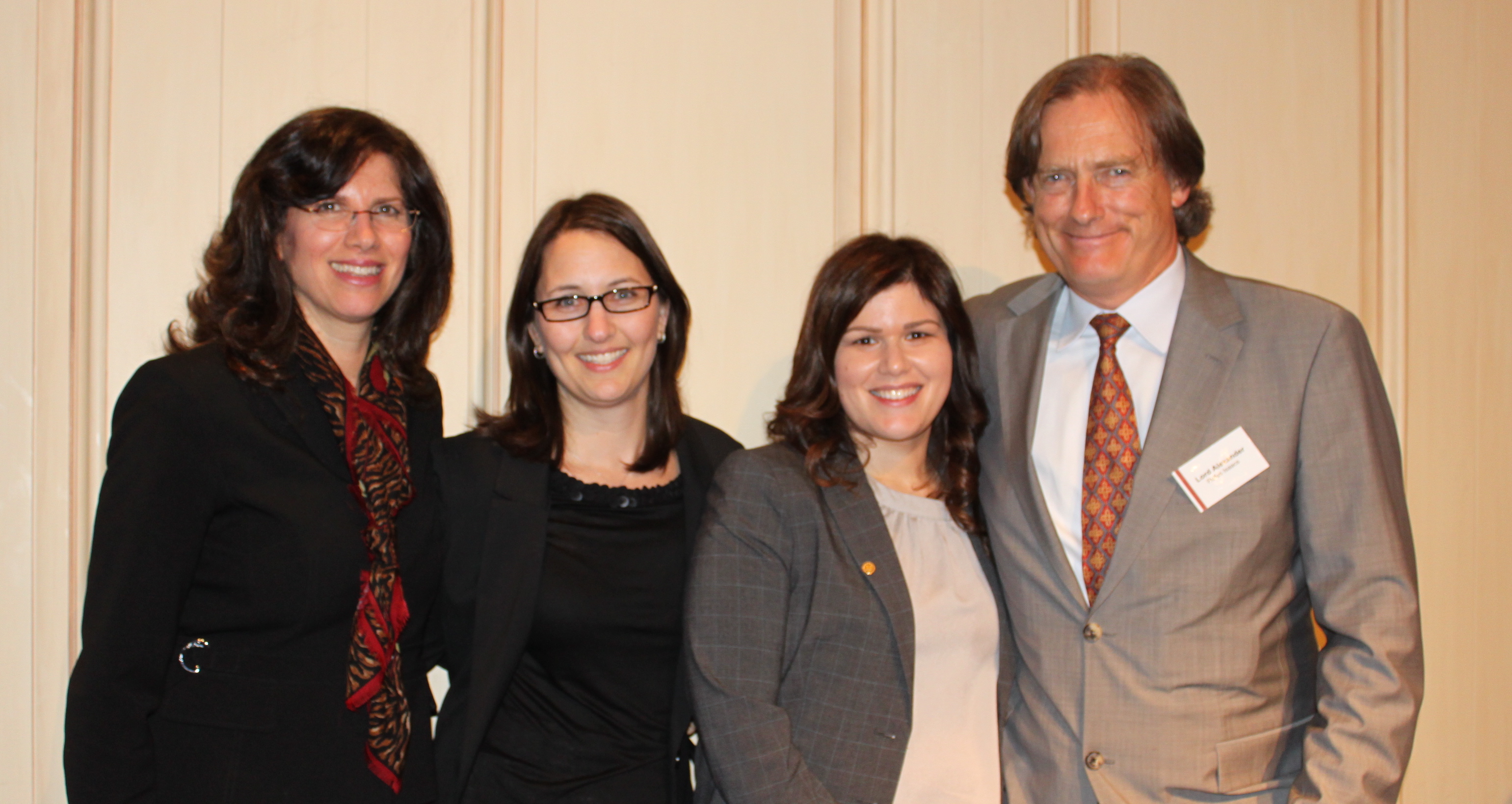
(Immediate Past President Robin Schiller, First Vice-President Heather Michelin, and President Mara Greenstone with Lord Rufus-Isaacs)

On the occasion of the Annual Henry Steinberg Memorial Lecture on October 18th, the Society was overjoyed to welcome a true member of the family, Lord Alexander Rufus-Isaacs, great-grandson of the Society’s namesake, Lord Reading.

Lord Rufus-Isaacs was introduced by Morris Chaikelson, who noted that “tonight we re-connect with our history”, on the 64th anniversary of the founding of the Society. He also led the enthusiastic crowd in a rousing rendition of dayenu.

Lord Rufus-Isaacs opened his remarks describing his transition from England to California. He learned how much law was a business in California, when they asked to see his book of business and he answered “what’s that?”

Lord Rufus-Isaacs discussion then turned to the substantive law of entertainment, covering three topics in particular. He first discussed the law of libel and defamation, and the differences between American and British law. He then turned to arbitration, and the importance of arbitration clauses in Hollywood contracts. Finally, he spoke of the “death of copyright infringement”, as the plaintiff’s bar in such cases has gotten very high.

He then spoke of his great-grandfather, first describing his “wild and reckless youth.” At the same time, his skills with money and bills of exchange led to him being very successful as a lawyer with the explosion of the commercial court.

While not really a politician, Lord Reading was part of a “rainbow coalition” of Irish, Welsh, Catholics and Jews who became part of the political scene when the Liberals came into power in 1909. Lord Reading did not particularly like being a judge, as he found the profession too solitary. He found his true calling working in the U.S. during World War I and as Viceroy of India, where he had frequent one-on-one meetings with Ghandi. Lord Rufus-Isaacs closed be describing his great-grandfather as having an “extraordinary career”, yet also having “great fun.”

The evening’s question period noted that Lord Reading was a spiritual man, if not so religious. Lord Rufus-Isaacs then presented a wonderful gift to the Society, an original Vanity Fair portrait of Lord Reading, a photo of which you can see in the President’s message above.

Lord Rufus-Isaacs appeared to be truly touched when named as a lifetime member of the Society, only the fourth person so honoured (joining Pierre Michaud, Rosalie Abella, and Lawrence Poitras). He was warmly thanked by Morton Bessner.

All in all, a truly historic evening that brought the Society’s past together with its present, and future.

Registering your Lord Reading CLE credits

Nancy Cleman

If you have not yet registered your CLE credits with the Barreau for the 2011-2013 period, or if you are having difficulty, the following instructions may be helpful.

When you fill out your personalized summary of hours attended, under the section Formations Structurées en milieu de travail you should enter the number 10004319, Lord Reading Law Society under dispensateur. Under Titre you should enter Formations exclusivement reservées aux participants invités if it is not already there; nothing under dates, and under Durée you enter the total number of CLE hours you have from LRLS.

Message for Lord Reading Young Bar Members

The AJBM is looking for Anglophone bloggers for their website. They won the award for “Best Law Library Blog” last year.

If you are interested in participating, please send an e-mail to youngbar@lordreading.org.

Lord Reading Careers Committee Notice

We continue to meet with very qualified students and young lawyers looking for employment. If you are interested in receiving CV’s of potential candidates, or if you know of any employment opportunities, please send an e-mail to careers@lordreading.org.

Invitation from the Institute for the Study of Global Antisemitism and Policy

The Institute for the Study of Global Antisemitism and Policy (ISGAP) is pleased to invite members of the Lord Reading Law Society to their seminar series on “Antisemitism in Comparative Perspective” taking place at McGill. The next seminar is entitled “Pragmatic Antisemitism and Anti-Zionism as Civic Religion: The Troubled Case of Belgium” and is to take place on November 27 at 5:30 PM, in Room 738 of the Leacock Building. For more information and details of future seminars in the series, please visit the ISGAP website.

Society Humour

News from the Mishpuchah

Mazel Tov

  • To Society Past President Casper Bloom on being named a recipient of the Queen’s Diamond Jubilee Medal. You can view the certificate from Her Majesty here.


October 2012

Mara Greenstone, President
Allen Mendelsohn and Larry Markowitz, Editor(s)

President’s Message

Mara Greenstone

Dear Colleagues and Honourable Judges,

I am so pleased that our first event was a great success and that we had a fantastic turnout to welcome François Rolland, Chief Justice of the Superior Court, on the occasion of our annual Alan B. Gold Advocacy Lecture. Mr. Justice Rolland addressed us on the topic of “Judging in a Diverse Society”. His presentation was enlightening, informative and much appreciated by all who attended.

We were very fortunate to welcome many Montreal judges from various courts. We were also thrilled and honoured to have as our guests the Honourable Andromache Karakatsanis of the Supreme Court of Canada, the Honourable Constance Hunt of the Court of Appeal of Alberta, the Honourable Kristine Eidsvik of the Court of Queen’s Bench of Alberta and the Honourable Emile Kruzick of the Superior Court of Ontario, who were visiting Montreal for a conference.

On the occasion of our annual Henry Steinberg Lecture, being held on Thursday October 18, 2012, we are elated to welcome Lord Alexander Rufus-Isaacs who is the great-grandson of Lord Reading. Lord Rufus-Issacs will be talking to us about his great-grandfather and bringing various memorabilia with him. He will also be addressing us on his own area of expertise, entertainment litigation. This will certainly be an enriching evening and a historic one for the Society.  I am happy to report that we have received certification for CLE credits. You can download the dinner invitation here, or register online here. Special thanks to our generous sponsor for the evening, Heenan Blaikie.

I look forward to seeing all of you on October 18th.

Sincerely,

Mara Greenstone
President

Judging in a Diverse Society

Larry Markowitz

On September 11, 2012, the Lord Reading Law Society kicked off its 65th season with the annual Alan B. Gold Advocacy Lecture, featuring a thought-provoking address by Quebec Superior Court Chief Justice François Rolland entitled “Judging in a Diverse Society”.  The audience included several prominent judges from across Canada, including the Honourable Madam Justice Andromache Karakatsanis of the Supreme Court of Canada.

The Honourable Mr. Justice Rolland was introduced by the late Chief Justice Gold’s son, Maître Marc Gold, who emphasized how much his father loved the law.

Judge Rolland began his allocution by reminding us that the mere appointment of a lawyer to the bench does not immediately make that individual a good judge. Training of judges is essential – and an important element of that training should be geared towards ensuring the judge takes into account the social context surrounding the dispute at hand.  Indeed, the National Judicial Institute has had an advisory committee on social context since the late 1980’s.

The concept of social context should not be confused with political correctness. While social context is an essential consideration when presiding over a trial, political correctness serves as a “brake”.

Judges must be aware of the changing social context around them. Quebec society of the 1950’s and 1960’s was a “simpler” place with less diversity, Judge Rolland recalled.  Growing up, he attended a French Catholic school where all his classmates were “like [him]”. Members of Quebec society who were not Catholic attended predominantly English Protestant schools. This group included Montreal’s Jews. Back then, there was little intermingling of linguistic groups and, when there was intermingling, a “lively debate” would often ensue – unless, of course, the discussion covered the Montreal Canadiens, in which case there was no linguistic divide!

When Mr. Justice Rolland attended law school at the Université de Montréal in the 1970’s, his class was predominantly male and francophone. In contrast, when lawyers in Quebec are sworn-in nowadays, the group is typically comprised of 60% women and in today’s diverse Quebec, no longer are the faces nearly all “pure laine”.

When he left the law firm of Martineau Walker (now Fasken Martineau) for the bench, only one of 65 partners was a woman.  This ratio has since increased in all firms, of course, but working conditions still make it tough for women to accede to law firm partnerships.

With the advent of Bill 101, the social context changed again. Further changes occurred once religion stopped being taught in schools and school boards became linguistic, as opposed to confessional. Society’s attitude toward religion has evolved.

It was only some 27 years ago that Section 15 of the Canadian Charter of Rights and Freedoms came into being, guaranteeing equality of all individuals before the law without discrimination on the basis of race, ethnic origin and so forth. This was a “real revolution” in Canada, observed Justice Rolland.  The introduction of a constitutional guarantee of equality changed the nature of cases before the courts. Lately, debates relating to “reasonable accommodation” have ensued, challenging us with the question of whether some rights are more important than others.  When debates of this sort find their way before the courts, it is essential that judges be aware of social context.

Judges are now trained to deal with witnesses of varying levels of education and cultural backgrounds. The judges’ training also teaches them how to weigh evidence – and even how to draft judgments – in light of today’s increasingly complex and diverse society.

While judges and lawyers are accustomed to being surrounded by those who are educated and well read, the fact is that 14% of Quebecers cannot read and, astoundingly, more than 40% of Quebecers are incapable of understanding a complex text. So if a witness is asked in court, “Did you read this text?” there is a greater-than-40% chance that the witness’s comprehension is not necessarily sufficient.  For a judge to be truly impartial, he or she needs to understand the full picture.

When a mentally disabled witness is asked to repeat their response by the presiding judge, the witness may take this as a sign that the judge is not satisfied with the response initially provided, when in fact the judge simply hadn’t heard the initial response clearly. The witness may then change their answer to “please” the judge, leading to their testimony being discredited. Judges need to be aware of this possibility.  Mr. Justice Rolland referenced the Donald Marshall case as an instance where this may have happened.

Judges also require special training to deal with self-represented litigants, a phenomenon that is becoming more and more common these days, with over 30% of cases in Superior Court and over 40% of cases in family court involving parties without counsel.

Judges must ensure “equality before the law” by understanding the differences in background of those before them. While all of us – including judges – have personal biases and may subscribe to various stereotypes, a judge must learn to be conscious of these prejudices and to put them aside.  Only once the judge accomplishes this, will that judge be a “real judge”.

Chief Justice Rolland concluded his talk in a philosophical tone by citing noted French political thinker Alexis de Tocqueville, who was of the view that equality reveals ideas that would otherwise have been overlooked.

On that note, Chief Justice Rolland wished us all a Shana Tova.

The Career Development Committee is always looking for new leads for lawyers and law students

Nancy Cleman

Don’t forget to send us any information on jobs and assignments (paid and unpaid) so we can continue to help students, stagiares and young lawyers who ask us for assistance.

“Trial Practice Do’s & Don’ts: Hot Tips from the Experts” CLE

Ian Solloway

Dear Colleagues,

I am pleased to announce that the 4th annual “Trial Practice Do’s and Don’ts: Hot Tips from the Experts” CLE  Conference of the English –Speaking Section of the Montreal Bar will take place on Wednesday, November 7th , 2012 from 4:00 – 6:00 pm in Room 5.15 of the Montreal Court House (Salle Jules- Deschênes).

In the 4 years since its inception, the Section`s “Do`s and Don`ts” Conference has come to be recognized for its excellence  and is widely regarded as one of the best CLE programmes offered annually.

The general theme of our “Do’s and Don’ts” Conference this year will be “Evidence” and will feature 4 distinguished jurists: the Honourable Patrick Healy, j.c.q.,  who will deal with “ objections” – why, when and how to raise them; Me Giuseppe Battista, who will speak on how to set up a good faith basis for cross-examination following the Supreme Court’s decision in R. v. Little; Me Pascale Vallant, who will  deal with the “child witness” in family law litigation; and Me Martine L. Tremblay, who will deal with the use and admissibility of surveillance evidence in civil / commercial litigation. Me Greg Moore, a member of the English-Speaking Section and Treasurer of the Montreal Bar, will be moderating our Conference.

A cocktail sponsored by the Bar of Montreal will follow the programme.

Cost: $50.00

Please check the Barreau de Montréal website at: www.barreaudemontreal.qc.ca for online registration, which should be open next week.

Please register early and encourage your partners and associates to do likewise, as we expect another over-flow attendance.

I look forward to seeing you all on November 7th.

Regards to all.

Ian M. Solloway
Chair
English-Speaking Section
Bar of Montreal

Fun facts about Lord Reading

Allen Mendelsohn

In advance of the October 18th visit from Lord Reading’s great-grandson, Lord Alexander Rufus-Isaacs, we thought it would be interesting to list some of Lord Reading’s accomplishments:

  • He served as Lord Chief Justice and Viceroy of India;
  • He was appointed Ambassador to the United States in 1918;
  • He was founding chairman of the Palestine Electric Corporation;
  • When named Marquess of Reading in 1926, this was the highest rank in Peerage reached by a Jew in British history.

Learn more from his full bio on Wikipedia.

Society Humour

News from the Mishpuchah

Mazel Tov

  • To Board Member Tatiana Lewin on her recent marriage
  • To Board Member Tibor Hollander on the birth of his grandson

September 2012

Mara Greenstone, President
Allen Mendelsohn and Larry Markowitz, Editor(s)

President’s Message

Mara Greenstone

Dear Colleagues and Honourable Judges,

I hope that you have enjoyed the summer and that you are looking forward to participating in what promises to be an exciting and stimulating season at the Lord Reading Law Society. I very much look forward to continuing the success of my predecessor, Robin Schiller, and seek to continue the growth and popularity of the Society that occurred under her leadership.

Our annual Alan B. Gold Advocacy Lecture will be held on Tuesday September 11, 2012. On this occasion, we have the privilege of welcoming the Honourable François Rolland, Chief Justice of the Superior Court of Quebec, who will address us on the topic of “Judging in a Diverse Society”. We have submitted our request for CLE accreditation and we anticipate that we will receive confirmation shortly. You can download the dinner invitation here, or we encourage you to reserve and pay online here.

On the occasion of our second lecture, which will take place on Thursday October 18, 2012, we are thrilled to welcome Lord Alexander Rufus-Isaacs who is the great-grandson of Lord Reading, for what will certainly be an enriching evening. More information about the event will follow, but please mark the date in your calendars. We are also working on other exciting events for this year and will keep you informed as soon as the details are confirmed.

On another note, you should have received your invoice for annual membership in the Lord Reading Law Society. I encourage you to pay your membership dues as we count on them to help contribute to the health of the Society, and to support the continuing program of outstanding speakers the Society has established. You can download the membership form here, and we are pleased to announce you can now pay your membership online here.

I look forward to seeing all of you on September 11th.

Sincerely,

Mara Greenstone

President

What You Don’t Know about The Court of Appeal and Where it is Going

Larry Markowitz

On a warm June evening, the Lord Reading Law Society closed out its 2011-2012 season with an address by the Chief Justice of Quebec, the Honourable Nicole Duval Hesler, before a packed house that included some of the city’s top judges, lawyers and bar association officials, along with a former premier of Quebec.

Mr. Justice Allan Hilton introduced our guest speaker, pointing out that she faces a variety of challenges in moving the Court of Appeal forward, including the imminent retirement of several judges, the possible nomination of other members of her team to the Supreme Court of Canada and a heavy caseload, combined with the entering into force of a new Code of Civil Procedure.

Madam Justice Duval Hesler then took to the podium and shared with us her thoughts on a myriad of topics – beginning with a refresher course on the role of the Court of Appeal, accompanied by some practical advice to the litigators in the audience, and moving on to the “intimate details” of how judges arrive at a decision.  She observed that it is becoming more and more challenging for judges to arrive at decisions, as society becomes more diverse and fact patterns become more globalized.  She concluded her dynamic presentation by lamenting the lack of English translations of Quebec Court of Appeal judgments (thus diminishing their influence in the other provinces) and the lack of diversity in the composition of the Court (including a lack of Jewish judges).

The Role of the Court of Appeal
The appellate court exists to reverse judgments of the lower court only where it can be shown that there was a manifest error of law at first instance.  Encouragingly, our speaker noted, such manifest errors are becoming rarer.  The appeals court does not exist to rehear the facts of the case.  By its mere existence, the Court of Appeal inherently ensures a sort of “quality control” on the lower courts, as judges at that level know their decisions risk being overturned.

Sometimes an appellant is disappointed when their appeal fails, but they should remember that, while our system guarantees them an “independent neutral competent judge who pays attention”, it by no means guarantees them success in court!

Some Practical Advice for the Litigators
Madam Justice Duval Hesler advised the litigators in the audience to avoid invoking the lower court judge’s lack of impartiality when pleading an appeal.  Just because your client did not agree with the judge’s conclusion does not mean the judge wasn’t being neutral!

Madam Justice Duval Hesler advised the litigators in the audience to view a Court of Appeal hearing as a dialogue.  Expect to be interrupted.  Also, don’t expect to be able to predict the outcome of the case based on your exchanges with the judges.  Be ready to discuss each issue separately, and on an equal standing, without regard to the level of importance of that issue in the Court’s final analysis.

Intimate Details – Behind the Scenes at the Court of Appeal
When a case is heard at the appeals court, the question of whether to assign three judges or five judges to the panel is determined in part by the potential effect the Court’s decision will have on future cases, as well as the importance of that decision to society at large.  For instance, a (hypothetical) case relating to the reform of the Senate would more than likely be heard by a five-judge panel.

Once a case has been heard, draft decisions are circulated among the judges on the panel.  Madam Justice Duval Hesler maintained that the judges are not influenced by their colleagues in arriving at their decisions.

With the enlargement of the role of the Courts that followed the 1982 adoption of the Canadian Charter of Rights and Freedoms, the courts have had to deliberate over important societal principles in cases such as the “Kirpan Decision” and the “Lola Case”.  This challenge will only grow, as all sorts of novel issues arise in Quebec’s increasingly diverse society.

Challenges for the Future
The Quebec Court of Appeal is currently comprised of some 20 regular and four supernumerary judges.  The supernumerary judges spend less time on the bench, but their presence provides the Court with a sense of continuity and the benefit of their years of experience.  With the impending retirement of several senior judges (and the potential nomination of others to the Supreme Court), the Court has adopted an approach of “recruiting specialists to make generalists”.  Thus, for example, if the Chief Justice were to feel that the Court needed a constitutional law specialist to deal with the many Charter cases before the Court, she would make such a request to those overseeing the nomination process.

She wants an improvement in the translation of the Court’s decisions into English.  Ideally, all decisions would be translated and the English version released at the same time as the French version.  At present, this is not the case and only hearings pleaded in English are sure to result in an English version of the decision. If translation into English were to become systematic, the Quebec Court of Appeal’s decisions would be more likely to influence decisions in the other provinces, as jurists in those jurisdictions would be more likely to read them.   As our guest speaker pointed out, at the end of the day, all laws in Canada, other than those relating to civil matters, are national in scope, so it’s “a shame” that Quebec decisions are not known and do not have the level of influence that they should.  In addition, while the Canadian judicial system is admired around the world, Quebec jurisprudence is under-represented in the internationally-known body of Canadian law, as a result of its being drafted mainly in French, rather than in the more universally-understood English language.

To the delight of the Lord Reading crowd, she also pointed out that there is a dearth of Jewish judges on the Court of Appeal and that this situation ought to be remedied.

With that comment, Madam Justice Duval Hesler concluded her captivating speech.  She was thanked by her friend and colleague – and Lord Reading board member – Madam Justice Carole Cohen and the Society adjourned for the summer.

Society Humour

News from the Mishpuchah

Mazel Tov

  • To Past President Suzanne Costom on being appointed President of Akiva school

Condolences


June 2012

Robin Schiller, President
Allen Mendelsohn and Larry Markowitz, Editor(s)

President’s Message

Robin Schiller

Honourable Judges, Members and Friends,

It has been my pleasure to serve the Society during the 2011-2012 season and I thank you for the privilege. During my term, we had the honour and privilege of being addressed by the following speakers:

Mr. Justice Allan R. Hilton of the Québec Court of Appeal whose presentation was entitled “Language Rights of Accused in Canada”.

The Associate Dean, Graduate Studies of McGill University, Professor Rosalie Jukier. Her topic was: “Backstage at the Palace: Analyzing Judicial Methodology in Mixed Legal Systems and Why Judges Do What They Do”.

Mr. Justice Ian Binnie of The Supreme Court of Canada. Justice Binnie’s topic was: “Corporate Complicity in Abuse of Human Rights”.

Chief Justice Élizabeth Corte of the Court of Québec and Justices Suzanne Handman and Lori Weitzman. Their topic was: “What you don’t know about the Court of Québec.”

Me Pierre Bienvenu, Ad. E. of Norton Rose Canada LLP. Me Bienvenu discussed the Lola case and its potential impact on common law spouses in Quebec.

Upcoming Events:

On June 14, 2012 we have the exceptional honour of welcoming The Chief Justice of Québec, The Honourable Nicole Duval Hesler. Justice Hesler’s topic will be “What You Don’t Know About The Court Of Appeal And Where It Is Going.”

Our Annual General Meeting will be taking place on June 14, 2012 at 5:30 p.m. just prior to our dinner event. The Annual General Meeting is open to paid-up Members of the Society. It is the time to vote for and welcome your new executive.

We shall continue our policy of providing a discount for early registrations. We encourage you all to reserve your place before midnight, June 4, 2012 to benefit from the discount.

The evening has been accredited for CLE with the Barreau and the Chambre des Notaires. CLE credits are only available for paid-up members. The dinner invitation and membership application are available through our website, and we encourage you to pay and reserve online.

Many thanks to our generous sponsor Borden Ladner Gervais.

Some Final Thoughts:

Throughout my term, I have tried to create an environment where we could not only educate ourselves intellectually, but also get to know each other on a more informal and personal level. Since we celebrated the 70th anniversary of the admission of the first woman to the Bar of Québec during my mandate, I felt it was incumbent upon me to promote the accomplishments of both our confrères and our consoeurs by ensuring we had an equal number of both male and female presenters.

Through the hard work and dedication of your Board Members, our Annual Students Dinner attracted more than 50 law students and stagiaires.

I feel our Society is on track to foster not only continued growth, but growing appreciation within the legal community.

I encourage you all to join us on June 14, 2012 for what promises to be a memorable evening and to show your support for your new Executive.

Yours very truly,
Robin Schiller, President
The Lord Reading Law Society

Review of the Annual Students Dinner

Allen Mendelsohn

On April 19, the Society was pleased to welcome Me Pierre Bienvenu on the occasion of the Annual Students Dinner. Me Bienvenu’s talk, The Lola Case and its Potential Impact on Common Law Spouses in Quebec, was highly anticipated.

The evening began with Society Past President Manny Shacter engaging the huge crowd of students and stagiaires with the history of the Society, and the great strides the Jewish legal community has made thanks in part to the Society’s efforts over the years. This was a very nice way for the future of the Society to be made aware of its past.

President Robin Schiller and First Vice-President Mara Greenstone then presented the Lord Reading Student Prizes. We congratulate all the winners and wish them all the best for their future:

  • Jie Zhu from Université de Montréal
  • Ruth Ainsworth from McGill University
  • Elvis Grahovic from Université de Sherbrooke

Casper Bloom took to the podium to introduce the evening’s speaker. He described Me Bienvenu as the “consummate litigator” whose accomplishments have been universally recognized. He had considerable praise for Me Bienvenu, calling him a “true luminary” and a “model of the profession”.

Me Bienvenu began with commenting on how excited he was to speak at the Society, especially on the occasion of the Students Dinner. While he stated he would not comment on the arguments of the Lola case in front of the Supreme Court, he would outline some of the constitutional issues and their potential impact. Me Bienvenu was brought on to the case for his constitutional expertise.

Me Bienvenu described the rise of de facto spouses in Quebec, saying that we had “out-Swedened Sweden.” The main constitutional principle at play in the case was whether excluding unmarried couples from support payments violated section 15 of the Charter, and whether such exclusion was justified under section 1.

What was very interesting were the judges’ individual interests in the case which were apparent at the January hearing. One Justice was interested in the concept of the choice the de facto spouses made not to be married. Both Justices LeBel and Fish were very interested in the remedies available if the Charter was violated.

Me Beinvenu also highlighted two very important points for lawyers that came from his experiences with the case. The first is the use of expert witnesses, regarding legislative history and comparative law. The second is the power of the media, especially in family law cases; he was bombarded with interview requests in connection with the case.

After concluding with a wonderful quote from Aldous Huxley about the nature and importance of love, Me Bienvenu was thanked by Society Communications Director Allen Mendelsohn.

Student Essay Competition – Looking for Volunteer Judges

Allen Mendelsohn

As part of its ongoing efforts to engage future members of the Society, we have planned an exciting new initiative, a law student essay competition. The winner will be acknowledged at next year’s Student Dinner. We are looking for volunteers from the membership to help judge the competition. If you are interested, please email us at info@lordreading.org.

Society Humour

News from the Mishpuchah

Mazel Tov

  • To Society Past President Allan Adel on receiving the Queen’s Diamond Jubilee medal in recognition of contributions to the community and Canada

Condolences

  • To Elliot Greenstone on the loss of his mother Freda

April 2012

Robin Schiller, President
Allen Mendelsohn, Dorith Toledano and Larry Markowitz, Editor(s)

President’s Message

Robin Schiller

Honorable Judges, Members and Friends,

The holiday of Passover is a time to remember the past but also to think about our future and our future is in the hands of our newest members.

On April 19, 2012, we will be hosting our Annual Students Dinner.  Our guest speaker will be Me Pierre Bienvenu of Norton Rose Canada LLP. Me Bienvenu will be discussing the Lola case and its potential impact on common law spouses in Quebec. There will also be a special networking program for students during our cocktail hour.

We shall continue our policy of providing a discount for early registrations. We encourage you all to reserve your place before April 12, 2012.

The evening has been accredited for CLE with the Barreau. CLE credits are only available for paid-up members. The dinner invitation and membership application are available through our website and we encourage you to pay and reserve online.

Many thanks to our generous sponsor Norton Rose Canada LLP.

Lastly, I want to make you aware of a very special event taking place on April 21, 2012 when a great friend of the Society, the Honourable Mr. Justice Morris Fish will be speaking at the Shaare Zion Congregation. Additional details about the event can also be found further along in this newsletter.

We encourage you all to join us on April 19th for what promises to be an enlightening evening and to show your support for our future colleagues and new members.

Yours very truly,
Robin Schiller, President

Students Dinner – Special Invitation to Students and Stagiaires

Mara Greenstone

We would like to extend a special invitation to students and stagiaires for our upcoming Students Dinner, being held next Thursday, April 19th.

Our guest speaker will be Me Pierre Bienvenu, from Norton Rose Canada LLP. Me Bienvenu will be discussing the Lola case and its potential impact on common law spouses in Quebec. This promises to be an exciting and interesting evening, and as always, a wonderful opportunity to network with our members.

There will also be a special networking program during our cocktail hour where you will have the chance to meet lawyers from a wide variety of practices.

In keeping with our tradition, bar school students and stagiaires are invited to this event as guests of the Society, at no cost, so that we can introduce you to the Society and tell you more about our history and raison d’etre. If you are a bar student or stagiaire and would like to register, please confirm your attendance by sending an e-mail to youngbar@lordreading.org.

In addition, for the first time, we are offering law school students the possibility to attend this dinner at a special rate. If you fall into this category, you can register for the dinner by contacting Jennifer Gewurz at  jgewurz23@gmail.com.

We encourage you all to join us for what promises to be an enlightening and enjoyable evening.

Everything you have ever wanted to know, but were afraid to ask, about the Court of Quebec

Larry Markowitz

Which court plays a significant role in the administration of justice in Quebec, but remains largely unknown?

Answer: The Court of Quebec!

As we learned on March 22nd, when the Society was privileged to have as its guests three eminent justices of the Court of Quebec: Chief Justice Élizabeth Corte and Judges Suzanne Handman and Lori Weitzman, the Court of Québec is a court of first instance that has jurisdiction in civil, criminal and penal matters, as well as in matters relating to young persons.  It also has jurisdiction over administrative matters and is designated as the appeals court under some 30 administrative laws, including access to information legislation and rental board matters.

The Court of Quebec often gets less attention in the annals of legal reporting than do the Superior Court, the Court of Appeal and, of course, the Supreme Court, but the Court of Quebec is actually where a significant proportion of disputes between Quebecers are adjudicated.

Chief Justice Corte began the presentation by explaining that the Court of Quebec has some 270 provincially-named judges sitting in 10 administrative regions. Those who sit in Montreal tend to specialize (e.g. Judge Weitzman, a former crown prosecutor, focuses on criminal cases), while those “en région” tend to be generalists.

Following Judge Corte’s introductory remarks, Judge Handman regaled us with tales of the novel ways in which the non-lawyers appearing in her courtroom have addressed her over the years. These honorifics have included ‘Your Majesty”, “Sweetie” and “Your Royal Highness”!

On a more serious note, Judge Handman described the highly charged emotional nature of much of what goes on in her courtroom.  Hearings are often punctuated by tears and shouting.  That said, Judge Handman has also had occasion to preside over some strange cases that would not be out of place on “The People’s Court”, such as the “Case of the dog that died from eating spaghetti”!

Small Claims Court

Small Claims Court, one of the better-known branches of the Court among the general public, and where lawyers generally cannot appear, is where civil disputes up to $7,000 are heard. This threshold amount will soon be increased to $12,000 and eventually to $15,000, which will presumably further increase the workload of the Small Claims Court.

Many Small Claims cases fall under the Consumer Protection Act and often deal with latent defects.

Judge Handman offered some practical advice.  For instance, when preparing a pleading for a client who will appear in Small Claims Court, lawyers should ensure that the client signs and not the lawyer.  Another very practical piece of advice was that lawyers should ensure that a client who is set to appear in Small Claims Court has all the requisite documents with them, since their lawyers won’t be in court with them!

Mediation

The Court of Quebec offers a mediation service as well.  The parties must voluntarily submit to mediation. A judge of the Court acts as mediator.  Mediation is best when legal fees would be out of proportion to the sum in dispute and where no important legal principle is at issue.  A judge acting as mediator can order a wider range of solutions to a dispute than in the context of regular litigation – for example, a mediator may order that one party apologize to the other.

Psychiatric Assessment

Judges of the Court of Quebec are empowered to compel an individual to undergo a psychiatric assessment and can also order them confined to a psychiatric institution. It is not unusual for a judge to hear 15 such cases in rapid succession during the same morning.

Highway Safety Code

The Court of Quebec is responsible for meting out justice under the Highway Safety Code, including ordering the release of automobiles from seizure following unpaid parking tickets or following a conviction for driving under the influence. The Court grants applications for restricted licenses, such as when the owner of a seized vehicle needs that vehicle for the purpose of their work.

“It’s amazing how many people work seven days a week and are on-call 24 hours a day!” joked Judge Handman. The Court hears all sorts of excuses for unpaid tickets – even the proverbial “the dog ate it”!

Criminal and Penal Division

Judge Weitzman, who was a crown prosecutor prior to her nomination to the bench, provided the audience with an overview of the Court’s Criminal and Penal Division. Basically, the Court of Quebec deals with all criminal matters short of murder. Hearings can relate to bail, declaring someone a dangerous offender, driving offences, police powers (including allegations of racial profiling) and even matters of treason (aka “alarming Her Majesty”).

In addition to weighing fundamental principles of justice, judges of the Criminal and Penal Division are confronted on a daily basis with the drama of human psychology. For example, Judge Weitzman recounted an emotional episode where the mother of a young man who had just been convicted asked the Court’s permission to hug her son.

Victims of crime often show great fortitude in telling the stories of their victimization in a matter-of-fact way.   From the bench, Judge Weitzman sees human drama play out before her on a daily basis: She observes interactions between the accused and their families, between victims of crime and those entrusted by the system with supporting them, and between the accused and their lawyers. Many tears are shed within these contexts. At the same time, surprising things happen every day as these dramas play out – both legally and psychologically.

At the end of the day, Judge Weitzman reminded us, a judge’s job is to do their best to see that justice is served.

Concluding Remarks

In her concluding remarks, Chief Justice Corte reminded the assembled jurists that judges tend to prefer dealing with lawyers who are honest and well-prepared – and whom the judges can trust. With these words of wisdom, a very informative session was concluded.

Our guest speakers were thanked by Society First Vice-President and Programme Chair Mara Greenstone.

Declaring your Lord Reading Law Society CLE Credits with the Barreau du Québec

Heather Michelin

If you have not yet declared your CLE credits with the Barreau, or if you are having difficulty doing so, the following instructions may be helpful.

When you fill out your personalized summary of CLE hours attended, click on “Ajouter une activité de formation“, then enter the number 10004319, Lord Reading Law Society’s “dispensateur” number in the search box. The next window will say “Formations exclusivement réservées aux participants invités, Dispensée par «Lord Reading Law Society»” and you should then select the total number of declared hours, select the “Participant” option (unless you were a speaker), and click the “ajouter” button. Note that it doesn’t matter which events you attended, the only thing you have to select is the total hours from Lord Reading, as long as those hours took place during the two-year compliance period (April 1, 2011 through March 31, 2013).

Justice Morris Fish to speak at the Shaare Zion

The Shaare Zion Synagogue would like to extend a special invitation to members of the Lord Reading Law Society to hear The Honourable Mr. Justice Morris Fish speak on April 21, 2012. Justice Fish’s talk is entitled “Protecting Canadians – The Supreme Court and Justice for All”. For full details of the event, please visit the Shaare Zion’s website.

Student Essay Competition – Looking for Volunteer Judges

As part of its ongoing efforts to interest and excite future members of the Society, we have planned an exciting new initiative, a law student essay competition. The winner would be acknowledged at next year’s Student Dinner. We are looking for volunteers from the membership to help judge the competition. If you are interested, please email info@lordreading.org.

News from the Mishpuchah

Mazel Tov

  • To Society Past-President Ian M. Solloway, who has been re-elected to a 4th consecutive term as Chair of the English–Speaking Section of the Bar of Montreal (2012-2013)
  • To Society Board member Elliot Lifson for his appointment to Export Development Canada’s Board of Directors

March 2012

Robin Schiller, President
Allen Mendelsohn, Dorith Toledano and Larry Markowitz, Editor(s)

President’s Message

Robin Schiller

Honourable Judges, Members and Friends,

I hope you enjoyed your holidays and that the year 2012 brings you much happiness and success.

We ended the first half of our season with the highly entertaining and informative presentation of Mr. Justice Ian Binnie of the Supreme Court of Canada.

In January, more than 75 of us got together on the occasion of the annual Young Bar Cocktail. I strongly believe that our Society is moving in the right direction.

On March 22, 2012, we have the unprecedented honour of welcoming three judges from the Court of Quebec. At that time, Chief Justice Élizabeth Corte and Judges Suzanne Handman and Lori Weitzman will be addressing us. Their topic will be: “What you don’t know about the Court of Quebec.”

We shall continue our policy of providing a discount for early registrations.  We encourage you all to reserve your place before March 14, 2012.

The evening has been accredited for 1.5 hours of CLE credit with the Barreau. CLE certification from the Chambre des Notaires is currently pending. As you know, CLE credits are only available for paid-up members. The dinner invitation and membership application are available through our website, and we encourage you to pay and reserve online.

Many thanks to our generous sponsors McCarthy Tétrault and Stein & Stein Inc.

We look forward to seeing you at what promises to be an extraordinary evening.

Yours very truly,
Robin Schiller, President
The Lord Reading Law Society

Corporate Complicity in Abuse of Human Rights – A Review of the Annual Human Rights Lecture

Larry Markowitz

On the occasion of its annual Human Rights Lecture on November 30, 2011, The Lord Reading Law Society had the privilege of welcoming as its guest speaker The Honourable Mr. Justice Ian Binnie of the Supreme Court of Canada, who spoke of “Corporate Complicity in Abuse of Human Rights”.

Mr. Justice Binnie was preceded at the Lord Reading podium by former Chief Justice of Québec, The Honourable Pierre A. Michaud, who commended the Society on its spirit of inclusiveness – both between junior and senior lawyers, and between members of the Bench and members of the Bar – as well as for the congenial setting of its dinners.

In an introduction that Mr. Justice Binnie subsequently termed as “being worthy of André Arthur”, Mr. Justice Michaud complimented our guest speaker extensively for his skills on the Bench, in a warm and jovial manner.

During his time at the Supreme Court, Mr. Justice Binnie heard a total 964 cases and wrote 169 opinions. Adopting a more serious tone, Mr. Justice Michaud pointed out that, in all of those cases, Mr. Justice Binnie never failed to show an appreciation for human dignity.

* * *

Mr. Justice Binnie began his remarks by contrasting The Lord Reading Law Society – and its respect for human rights – with the actual Lord Reading, Rufus Isaacs, who served as Viceroy of India between 1921 and 1926.  Indeed, His Excellency, The Right Honourable The Earl of Reading was known to be quite imperialistic in his views and would probably have considered the Universal Declaration of Human Rights as a restraint on the ability of imperialists to exercise their power.

The focus of Mr. Justice Binnie’s remarks was corporate complicity in human rights violations. Multinational corporations operate across jurisdictions.  Some are so large and powerful that it could be said that they have more power than the local authorities in some of the places in which they operate.

While it is important to have societal norms, the question remains as to how such norms should be enforced, given that multinational defendants are operating in multiple jurisdictions, making it tough to obtain a judgment and even tougher to enforce that judgment.

Mr. Justice Binnie cited several examples where multinational corporations have been pursued for alleged human rights abuses. In citing these examples, Mr. Justice Binnie underlined the specific problem of abuses by “extractive companies” that operate in locations based solely on where oil and gas, and mineral deposits are found. Nobody chooses where these deposits are located.

“So what is a plaintiff to do?” asked Mr. Justice Binnie.  These are cases where people clearly suffered, so why do these people not have recourse to international tribunals?  The problem is that international tribunals, in their current form, are not set up to deal with these sorts of situations. Indeed, the International Criminal Court specifically excludes corporations from its purview.

One notable approach that has been pursued in the face of this challenge is to apply the U.S. Alien Tort Claims Act of 1789, which was originally passed to deal with piracy. This Act authorizes American courts to apply international customary law, as opposed to U.S. domestic law, in weighing these cases. Thus, U.S. courts have ended up exercising universal jurisdiction by applying universal customary law.

Such court actions are often met with arguments based on “originalism”. In other words, defendants argue that the problem must be examined in the way the world was seen in 1789 when the Alien Tort Claims Act was originally passed.  It goes without saying that norms in contemporary society differ from those of 1789!

In the Nuremberg trials that followed World War II, it was determined that corporations cannot be liable; only individuals. This precedent also makes the plaintiff’s side more difficult to prove in cases of human rights abuses perpetrated by corporations.

There is also an inconsistency in the approach taken by courts of different jurisdictions, even within the United States. For instance, in Rio Tinto, a California court decided that an act perpetrated by Rio Tinto constituted genocide, since war crimes are crimes committed on a civilian population and can include torture. In contrast, in another similar case, a New York court concluded just the opposite; that the courts of the United States do not have jurisdiction.

Thus, the route to enforcing human rights laws against multinational corporations is far from clear.

“It is ironic,” stated Mr. Justice Binnie, “that in matters of trade, finance and labour law, countries find ways to fill the gap between the laws of different jurisdictions.”  Why is it that the same logic does not apply in matters of human rights?  Why is there not the same push or a constant and consistent set of human rights norms across jurisdictions?

“There should be a forum to resolve such issues”, said Mr. Justice Binnie.  “Are villagers simply ‘road kill’ on the way to progress?” he pleaded.

Mr. Justice Binnie concluded his presentation by stating that the Canadian legal profession is being delinquent by letting this issue pass in silence.  Our guest speaker ended his speech on a hopeful note, though. It seems that the International Commission of Jurists, an international human rights non-governmental organization, is addressing this issue.

Although the original Lord Reading might not have been supportive of international human rights law, the modern Society named for him certainly is. On that positive note, our guest speaker was thanked by Society board member The Honourable Madam Justice Carol Cohen.

Lord Reading Website Changes on the Horizon

Allen Mendelsohn

As Communications Director for the Society, one of my principal responsibilities is the Lord Reading website. I am proud of the Society’s efforts to develop a website that many people (both members and the public) have told me is quite useful. To that end, I am pleased to announce that over the coming months we will be integrating a number of changes to the site that will make it even more useful, and more user-friendly.

Many people have complimented us on the new ability to pay and reserve for dinner-meetings online. However, the system we have now is less than perfect, especially for people who want to reserve for multiple attendees. The first of the website updates will feature an all-new reservation and payment system which will be considerably more user-friendly. It also includes several changes that you won’t see on the site, but that will make administration of these reservations much easier for members of the Society’s Executive as they prepare for each dinner-meeting.

This summer you can expect the other major functional change, when we implement a system for entry of membership information and payment of membership fees online. This has been a feature that many members have asked me for, and I am excited that it will be coming to pass. Again, there will be some changes you won’t see, but will make it much easier for the hard-working members of the Membership Committee to administer our growing membership.

We’ll also be making some changes to the content of the site, notably updating the big “Celebrating 60 Years” banner that is obviously out of date. We are also working on ensuring that all of the site’s content is in French, so that we can have a truly bilingual website. I am grateful to Board member Tatiana Lewin for her work in this regard.

I am looking forward to seeing these changes roll out, and having a website that will help the Society continue to grow for years to come. If you have any questions or comments about the upcoming changes, or anything else you’d like to see on the website, please email me.

Society Humour


News from the Mishpuchah

Thank you

  • The Society wishes to thank the firm of Collins Barrow (Montreal) for their diligent work preparing the Society’s tax returns

Mazel Tov

Condolences to

  • Past President Ted Goloff on the loss of his brother Sidney
  • Past President Allan Adel on the loss of his mother, Leah Farber
  • Donald Devine on the loss of his mother
  • Robert Pancer on the loss of his mother
  • Stella Flader on the loss of her husband Kalman Samuels QC
  • Steve Schenke on the loss of his mother-in-law
  • Martin Green on the loss of his mother