October 2014

Nancy Cleman, President
Allen Mendelsohn and Larry Markowitz, Editor(s)

President’s Message

Nancy Cleman

Dear Colleagues and Honourable Judges,

We look forward to our second lecture of the season which will take place on Wednesday, November 5th, 2014 which will cover a very complex and sensitive topic.  We are fortunate to have a panel of distinguished speakers who will approach the subject from perspectives of Canadian law, Jewish law and public health policy. Me Gordon Kugler, Rabbi Sydney Shoham and Professor Daniel Weinstock will address Bill C-52 – An Act respecting end-of-life care.  I encourage you to take part in this interesting evening and invite your colleagues. You can register and pay online or download the dinner invitation to pay by cheque.

The Lord Reading Law Society prides itself in being an active member of the Montreal Legal community. In this regard I want to bring to your attention an opportunity to participate in  a community wide legal education program. Educaloi is seeking volunteer legal professionals. It has received a grant that permits it to provide legal education and information in English. They are looking for volunteers to give conferences and help with the program. The person who is responsible for the project is Frédérique Tessier (frederique@educaloi.qc.ca). It is important that we help make this project a success. If you have questions please contact her or Sarah Dougherty (sarah@educaloi.qc.ca). It is also possible to sign up online.

We appreciate your continued support and participation. As members of the Montreal Legal community I encourage you not only to become involved and attend our meetings but also to assist with community wide initiatives. I look forward to seeing you at our dinner-meeting on November 5, 2014.

Sincerely,
Nancy Cleman

Mr. Justice Nicholas Kasirer: That Montreal Sound

Larry Markowitz

On September 23, 2014, on the occasion of our annual Alan B. Gold Advocacy Lecture, the Lord Reading Law Society had the pleasure of welcoming the Honourable Mr. Justice Nicholas Kasirer of the Quebec Court of Appeal for an eloquent discourse entitled “That Montreal Sound: The Unique Character of Civil Law Parlance in Quebec”.

Indeed, as our guest speaker related, the late Judge Gold, chief justice of the Quebec Superior Court from 1983 to 1992 and a former lecturer at the faculties of law of both the Université de Montreal and McGill University, was the perfect exemplar of the “Montreal Sound”, a mélange of Canada’s two official languages.

Dean of law at McGill from 2003 to 2009 and former law professor to many in the audience (including this author), Mr. Justice Kasirer inspired the pride of all Montrealers in the room by evoking another of many “only-in-Montreal” characteristics that make this a great – and distinguished – city: the unique vocabulary used by our local jurists.

The sound of Montreal’s unique juridical vocabulary is like music to the ears of Mr. Justice Kasirer. Much like Detroit is known for its Motown sound and New Orleans is known for its jazz sound, Montreal is known for the sound of its legalese (as well as the sound of Arcade Fire, our guest speaker was quick to point out!).

Montreal “legalese” is different than the “dualist” approach taken by jurists in, say, the federal government in Ottawa, who tend more toward mere translation of legal texts. In contrast, the “Montreal sound” is a “co-lingual” one, where the French and English versions of a legislative text are treated as essentially a single text that derives its meaning from the “encounter” between the two linguistic versions. The two texts “speak with one voice,” said Mr. Justice Kasirer.  The result is a “polyphonic chorus singing from the same juridical hymn book.”

Only in Montreal’s legal community would one hear judges and lawyers speak of “aleatory contracts” , “alienation of patrimonial rights “, “reconduction of a lease”, “mitoyenneté” or “hypothecs”. These English-language expressions are not recognizable to a lawyer at the other end of Highway 401.

Mr. Justice Kasirer cited as an example article 1378 of the Civil Code of Quebec, on the “nature of a contract”, which reads:

Le contrat est un accord de volonté, par lequel une ou plusieurs personnes s’obligent envers une ou plusieurs autres à exécuter une prestation. […]
A contract is an agreement of wills by which one or several persons obligate themselves to one or several other persons to perform a prestation. […]

While a pure translation of “accord de volonté” would read “meeting of the minds”, which is the corresponding common law term, the Quebec legislator chose instead to employ the expression “agreement of wills”. According to Mr. Justice Kasirer, when one reads the English wording, one can hear the French words “accord de volonté” “shouting across” the English.

This is not all that different from non-juridical Montreal English, where we shop in “dépanneurs” and ride the “metro”.

Not only is the English version of the law in Quebec heavily influenced by the French, but the meeting of the Civilian tradition with the common law tradition has also had an effect on our local legal expressions.

The audience enjoyed Mr. Justice Kasirer’s eloquent – and indeed melodic – depiction of the uniqueness of Montreal’s legal sound. This “métissage linguistique” is “worthy of respect and celebration,” concluded Mr. Justice Kasirer. 

Turns out it’s not only our smoked meat and bagels that make Montreal stand out from the rest of the world!

Society Membership for 2014-2015

Hershie Frankel

The Society counts on your membership dues to continue its activities, and we strongly encourage you to renew your membership for the current season if you have not yet done so. You can download the membership form, or we encourage you to register and pay your membership online. 

Please note that judges, first year lawyers and notaries, and lawyers and notaries who have practiced for 50+ years are exempt from paying membership dues; however we ask those of you in these categories to sign up for your membership nonetheless. This is so that we have your coordinates, and also that you will be in a position to benefit from the reduced members’ fees for dinner-meetings

If you are a law student, please contact the Society for special instructions.

Thank you,

Hershie Frankel
Membership Chair

“Controlling the Difficult Witness: Don’t Let Go of the Leash” CLE

Ian M. Solloway

Dear Colleagues,

Please note that the 6th Annual CLE of the English-Speaking Section of the Bar of Montreal, Trial Practice Do’s & Don’ts: Hot Tips from the Experts, will take place on Thursday, November 6th, 2014  from 4:00 pm – 6:00pm. in Salle 5.15 (Salle Jules Deschênes) of the Montreal Courthouse.

This year’s conference is entitled “Controlling the Difficult Witness: Don’t Let Go of the Leash”. The conference will be moderated by Society Board member Robert Pancer and includes many distinguished speakers. Full details and registration information can be found at the Barreau de Montréal website.

Regards to all.

Ian M. Solloway
Chair
English-Speaking Section
Bar of Montreal

Society Humour

News from the Mishpuchah

Mazel tov

  • To Board member Eric Maldoff on receiving the Sheila and Victor Goldbloom Distinguished Service Award

Condolences

  • To Society members The Hon. Pierrette Sévigny and Richard McConomy on the loss of their mother and mother-in-law Corinne Sévigny
September 2014

Nancy Cleman, President
Allen Mendelsohn and Larry Markowitz, Editor(s)

President’s Message

Nancy Cleman

Dear Colleagues and Honourable Judges,

This fall marks the 66th year since the Lord Reading Law Society was established.  I am privileged to be at the helm of the Society for the 2014-5 season, supported by a first-rate Executive and Board of Directors who volunteer their time and effort to ensure that the Society’s future is a bright one.

Our annual Alan B. Gold Advocacy Lecture will take place on Tuesday September 23rd, 2014. We are honoured to welcome The Honourable Mr. Justice Nicholas Kasirer of the Court of Appeal of Québec, who will address us on the topic of “That Montreal Sound: The Unique Character of Civil Law Parlance in Quebec”.  Our application for CLE accreditation has been approved for one hour of CLE credit. The dinner invitation can be downloaded here, or we encourage you to reserve and pay online. We would like to thank Davies for the generous sponsorship of the evening.

Our second lecture of the season will take place on Thursday, November 5th, 2014. We will welcome Gordon Kugler and Rabbi Sydney Shoham who will discuss bill C-52 , – An Act respecting end-of-life care.  An application for CLE accreditation will be submitted, and I encourage you to mark the date in your calendar and take part in this interesting evening.

The Society has a rich and storied history, is deeply ingrained in Montreal’s legal landscape and continues to evolve and play an important role in the Montreal legal community. Like any organization it is dependent on the participation of its members and supporters. I encourage you to become involved and attend our meetings to personally experience the warmth and collegiality of a Lord Reading Law Society dinner-meeting.  I look forward to seeing you at the opening dinner on September 23, 2014 and at other meetings throughout the 2014—2015 season.

Shana Tova, wishing you a happy healthy Jewish New Year.

Sincerely,
Nancy Cleman

Society Membership for 2014-2015

Hershie Frankel

The Society counts on your membership dues to continue its activities, and we strongly encourage you to renew your membership for the current season if you have not yet done so. You can download the membership form, or we encourage you to register and pay your membership online. 

Please note that judges, first year lawyers and notaries, and lawyers and notaries who have practiced for 50+ years are exempt from paying membership dues, but we ask that you sign up for your membership nonetheless. This is so that we have your coordinates, and also so that you will be in a position to benefit from reduced  members fees for each dinner.

If you are a law student, please contact the Society for special instructions.

Thank you,

Hershie Frankel
Membership Chair

Justice Morris Fish: An evening of tribute to the “Mensch on the Bench”

Larry Markowitz

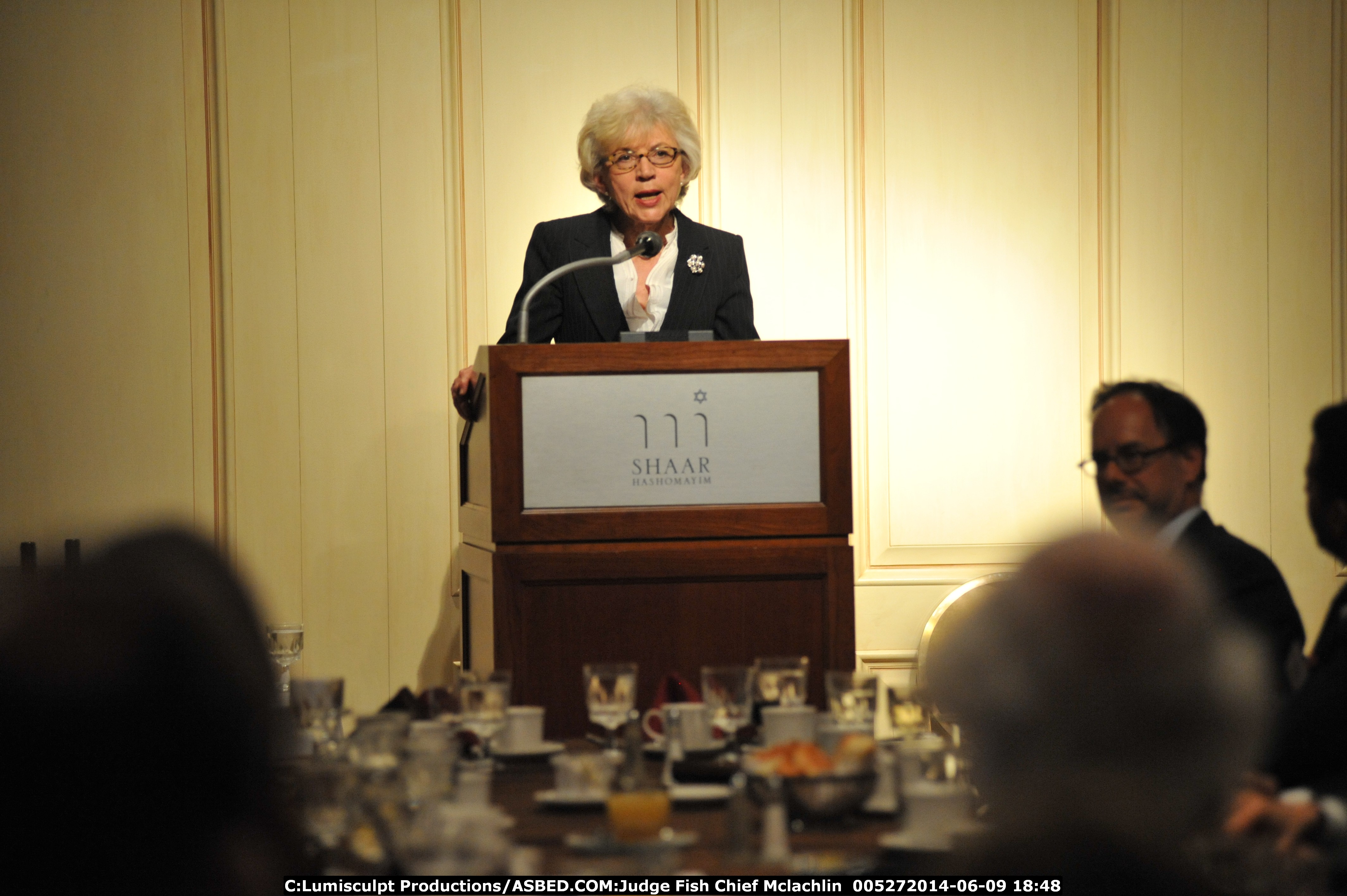
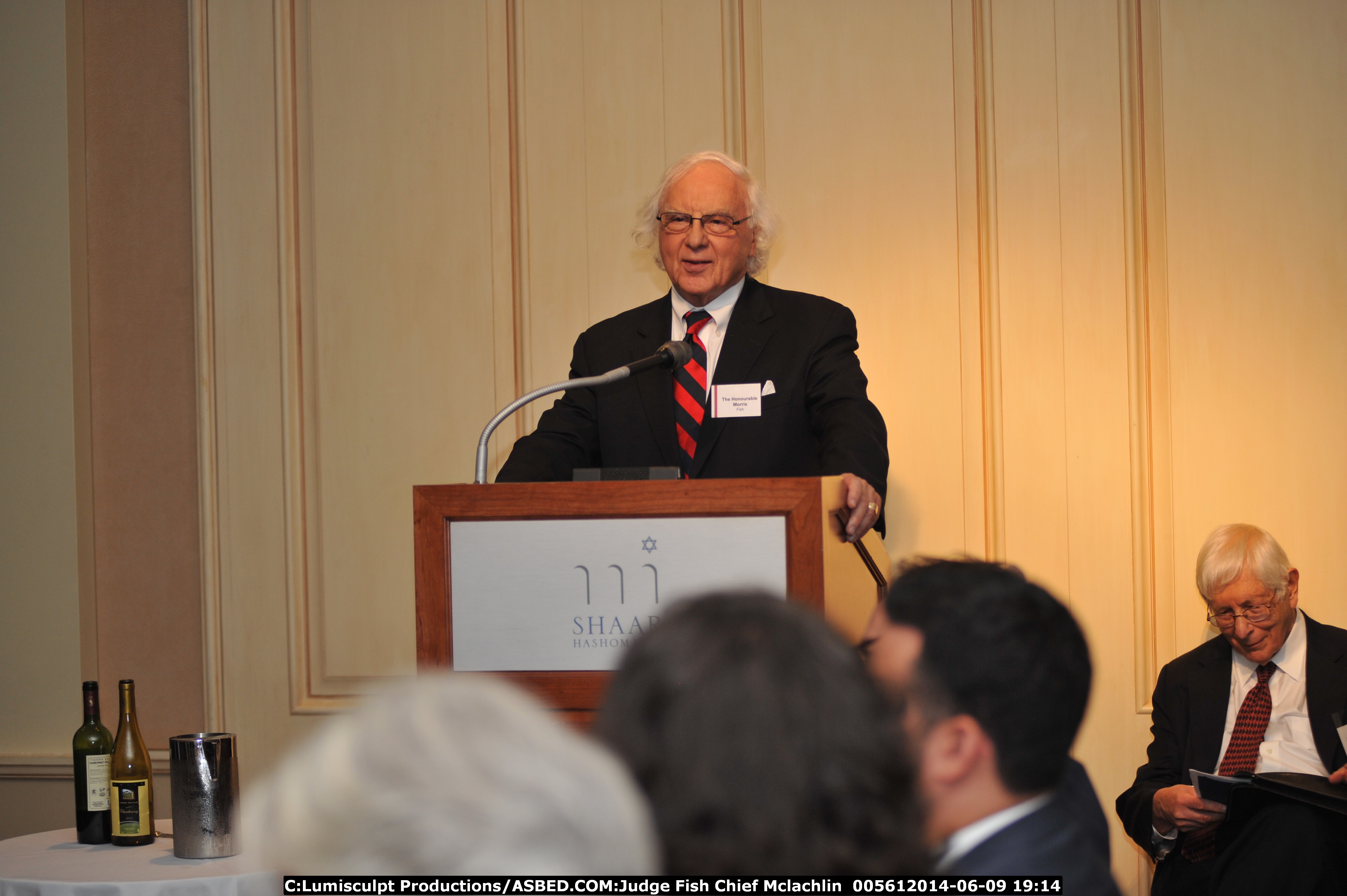
On June 9th, the Lord Reading Law Society held a star-studded evening of tribute to recently retired Supreme Court Justice, The Honourable Morris J. Fish.  In one of the most highly attended events in the history of the Society, the hall was graced by the presence of the chief justice of every level of the court system in Quebec, including our featured speaker, The Right Honourable Beverley McLachlin, P.C., Chief Justice of Canada.

Also present were two other current Supreme Court justices, Andromache Karakatsanis and Marshall Rothstein, as well as nearly 30 other current and retired judges.  In addition, former Quebec premier Lucien Bouchard, and Mount Royal MP and former Justice Minister Irwin Cotler were also in attendance.

To begin the evening’s parade of prominent speakers, Chief Justice Nicole Duval Hesler of the Quebec Court of Appeal introduced Chief Justice McLaughlin, reminding us of Justice McLaughlin’s modest beginnings in Pincher Creek, Alberta, followed by her rapid ascent through the various levels of court system – “faster than most litigants!” quipped Madam Justice Duval Hesler.

Then, in an eloquent and deeply personal allocution entitled “Justice Morris Fish: 10 years at the Supreme Court of Canada”, the Chief Justice of Canada paid tribute to Mr. Justice Fish, highlighting his politesse and, summoning her best Yiddish, described him as “Our Mensch on the Bench”.

The Chief Justice described Mr. Justice Fish as having a “profound sense of justice”, which manifested itself in his insistence on protecting the rights of the accused and on ensuring transparency of the justice system, as well as in his rulings in favour of the constitutionally protected right to be secure against unreasonable search or seizure.  This last point has taken on even greater importance in recent years with the exponential growth of the online world. “For these three reasons, we owe him our gratitude”, said the Chief Justice.

Mr. Justice Fish was a master of the art of cross-examination, observed Madam Justice McLaughlin, not unlike Lord Rufus Daniel Isaacs, for whom the Lord Reading Law Society was named.

On a more personal level, the Chief Justice expounded upon Justice Fish’s character as “a colleague and a friend”. She described his zest for life and his courteous manner.

Justice Fish is also a talented archivist and legal historian, revealed Justice McLaughlin. She referred to his prodigious memory for every case in which he’s been involved and how he would mysteriously be able to instantly produce a copy of every factum and legal opinion he ever wrote.

Mr. Justice Fish mentored over 30 law clerks in his decade at the Supreme Court, getting to know each one, learning the clerks’ passions and then encouraging them to pursue that passion.

Outside of the legal scene, Justice Fish is an accomplished visual artist – talented in both photography and painting. A photo of the Chief Justice taken by Justice Fish is one her most prized possessions, she said, as it makes her look “serene”.

In the closing portion of her tribute, Chief Justice McLaughlin described Justice Fish as “Morris the Montrealer”. After 10 years in Ottawa, it was time to come full circle – back home to his roots here in Montreal. This concept is exemplified by the poem entitled “Caring” by famed McGill law professor F.R. Scott, which reads in part:

After the present falls the past,
After the festival, the fast.
Always the deepest is the last.

This is the circle we must trace,
Not spiralled outward, but a space.
Returning to its starting place

“He could have written it for you, Morris!” exclaimed the Chief Justice.

She then cited another poem by N. Scott Momaday entitled “To a Man Among Us”. It concludes:

You ascend the stair of justice
And take your place among those
Who have fashioned the bulwarks of civilization
We wish you well and Godspeed. Be of cheer
In your going.  Be the keeper of right and rule.

In closing, addressing her friend and former colleague, Madam Justice McLaughlin said to the evening’s honouree, “You are a ‘shofet zedek’, a ‘just judge’.” Then, alluding to the foregoing poem, she added, “You will always be ‘A Man Among Us’.”

*************

The Chief Justice was thanked by Society board member and Superior Court Justice, The Honourable Carol Cohen, following which Justice Fish’s lifelong friend, and former law partner and colleague from the criminal defence bar, Harvey Yarosky, covered the part of Justice Fish’s life and career prior to his being named to the bench in 1989. In taking to the podium, Maître Yarosky half-jokingly referred to himself  as “an expert witness on Morris”. 

Me Yarosky described Justice Fish’s childhood on Bagg Street on the Plateau Mont-Royal, his studies at Baron Byng High School, his education at McGill and his years as a criminal defence practitioner with the firm known mainly as Yarosky, Fish, Zigman, Isaacs & Daviault while Justice Fish was practicing.

Mr. Justice Fish was then presented with the Human Rights Award of the Lord Reading Law Society. Established in 1994, the Society’s Human Rights Award is presented to an individual who has demonstrated a sustained contribution to, or has been influential in the advancement of, human rights and fundamental freedoms. This is a significant award, since it represents the very core of the Society’s mission.  Past winners have included Irwin Cotler and Roméo Dallaire, among others.

*************

Finally, the evening’s honouree took to the dais to thank the Chief Justice, reminding her that he’d once introduced her to members of the Israeli Supreme Court as “Hamalka shelanu” (our Queen). He also thanked the Lord Reading Law Society.

In honour of the evening and its honouree, the Society presented a $1,000 cheque to McGill’s Faculty of Law as a contribution toward the Justice Fish endowment fund in support of internships in human rights law.

In accepting the gift, Dean Daniel Jutras joked, “Morris gets the award, but I leave with the cheque!”

*************

All in all, this evening was truly a momentous occasion, and indeed a memorable occasion, in the history of the Lord Reading Law Society.

Call for candidates – consultative committees of the Barreau du Québec

Nancy Cleman

We strongly encourage our members and friends to apply for the consultative committees of the Barreau du Québec before the deadline of October 31 2014. With the upcoming changes in governance at the Barreau, it is even more important that we try to get involved.

For more information, please see Le Journal Barreau du Québec pages 38 & 41 or the Barreau’s website. It sets out the lists of committees for which applications are sought.

Thank you,

Nancy Cleman
President

“Controlling the Difficult Witness: Don’t Let Go of the Leash” CLE – save the date!

Ian M. Solloway

Dear Colleagues,

Please note that the 6th Annual CLE of the English-Speaking Section of the Bar of Montreal will take place on Thursday, November 6th, 2014  from 4:00 pm – 6:00pm. in Salle 5.15 (Salle Jules Deschênes) of the Montreal Courthouse.

This year’s conference is entitled “Controlling the Difficult Witness: Don’t Let Go of the Leash”. The conference will be moderated by Society Board member Robert Pancer. Additional details will follow in the coming weeks.

Please hold the date in your respective agendas!

Regards to all.

Ian M. Solloway
Chair
English-Speaking Section
Bar of Montreal

Society Humour

(Image courtesy Legally Drawn)

News from the Mishpuchah

MAZEL TOV

  • Past President Mark Schrager on his appointment to the Court of Appeal of Québec
  • Past President Yoine Goldstein who will be the Jewish Community Foundation’s 2014 honouree on September 18th
  • Past President Sharon G. Druker on being recently selected by her peers for inclusion in The Best Lawyers in Canada 2015 in the field of Corporate Law
  • Board member Elliot Lifson for being named co-chair of the 2014 Centraide Campaign
  • Board member David Ettedgui on his marriage to Amanda Singer
  • Board member David Ettedgui on winning the English Oratory Competition of the AJBM
  • Board members Marissa Lydynia and Robert Steinman on the birth of their son Max Jacob
  • Board member Robert Pancer on being named Family Law lawyer fo the year by The Best Lawyers in Canada 2015
  • Irwin Cotler who will be honoured by Federation CJA and receive the Samuel Bronfman Medal on September 22nd

CONDOLENCES

  • To Mr. Justice Fish on the loss of his beloved wife Judith
  • To Board members Ron Stein and Roanne Bratz on the loss of their mother and mother-in-law Beatrice Stein

June 2014

Heather Michelin, President
Allen Mendelsohn and Larry Markowitz, Editor(s)

President’s Message

Heather Michelin

Dear Colleagues, Honourable Judges, and Friends,

As my term comes to an end, I find myself looking back to the opening dinner of the 2013-2014 season.

That night, I reminded you that 65 years ago, a group of forward-thinking Jewish lawyers joined forces to create a Society, now known as The Lord Reading Law Society, whose mission was to lobby for the fair representation of Jews on the Bar and on the Bench during a time when Jews were being marginalized. Their dream  was also to create a social forum where they could meet and further their knowledge of the law.  With that, the Society’s seeds were sown and like a tree, its roots run deep, defining its past, as well as its future.

During this past year, the Society was reminded of its raison d’être when Bill 60, or the Charter of Quebec Values, was tabled.  The Society’s Board of Directors quickly assembled a Bill 60 committee, and their teamwork and collaboration resulted in the Society submitting its Brief opposing Bill 60 to the former Quebec government. The Brief is a true example of the Society’s unending commitment to the defense of human rights, and reminds us that the Society continues to play a pivotal role in defending those rights.

The Society is making a concerted effort to preserve its history for future generations – we are collaborating with the Interactive Jewish Museum of Montreal to create an exhibit featuring the Society’s history and accomplishments.

We have also been asked to assist the Faculty of Law of the Université de Montréal in reaching out to its Jewish alumni for anecdotal information for the Faculty of Law’s upcoming book documenting the history of the Jewish community within the Faculty. Please see the item further below in this newsletter for more information.

Our programming organized an excellent lineup of speakers this season, which will culminate on June 9th when we will be addressed by The Right Honourable Beverley McLachlin, P.C., Chief Justice of Canada, and at which time The Honourable Morris J. Fish, retired Justice of the Supreme Court of Canada, will receive the Society’s Human Rights Award. You may sign up for the evening using the links found on the left of this page. We are grateful to the evening’s sponsor, Boro Polnicky Lighter.

The Society continues to grow, and our recent Young Bar cocktail event was a huge success. As part of our effort to welcome new lawyers and notaries to the Society, we continue to offer free membership to lawyers and notaries for the year following their call to the Bar.

I am privileged to have served as President of the Society, and I extend sincere thanks to the Society’s Board and Executive for their hard work and dedication.  The incoming President will be announced on June 9th, please join us for what promises to be a wonderful evening.

Sincerely,

Heather

CETA: The Canada-Europe Comprehensive Economic and Trade Agreement

Larry Markowitz

On April 29th, the Society had the honour of welcoming former Quebec Premier Pierre Marc Johnson, who spoke on the topic of “Canada-EU: The CETA – A Long-awaited and Promising Agreement”. Mr. Johnson is both a lawyer and a physician, and is known for his expertise in the areas of international trade negotiations, environmental law and health law.

Me Johnson modestly introduced his speech as being the “first-year-of-law-school version” of the topic. However, his talk was far more sophisticated. That said, he kept things understandable – even for those members of the audience who were not international trade law specialists.

The CETA, which stands for “Comprehensive Economic and Trade Agreement”, will make Canada the world’s only major economy with preferential access to the world’s two largest markets, the EU and the United States, home to a total of 800 million people. For Europe, the accord is meant to be a template for its trade negotiations with the United States, which would encompass a third of world trade and almost half the global economy.

Both the EU-Canada deal and the accord with the United States seek to go far beyond tariff cuts and to reduce transatlantic barriers to business. Such trade deals are seen as a way for developed countries to generate economic growth and overcome the worst financial crisis in a generation.

CETA will address everything from tariffs to product standards, investment, professional certification and many others areas of activity, including government procurement. The EU has sought comprehensive commitments by Canada to open up government procurement at the provincial and municipal level in Canada. In return, Canada will obtain reciprocal access to EU state and sub-state entities and enterprises. Me Johnson remarked, in light of recent scandals here in Quebec, that having competition in our public procurement markets can only help us. Education, health and water are excluded from CETA, however, so “we can continue to discriminate” in those areas, as Me Johnson put it lightheartedly.

The origins of the CETA are based on certain principles: 1) prosperity is built on commerce; and 2) a significant portion of our Gross Domestic Product is dependent on exports. The EU is already Quebec’s second-largest trading partner and export destination. While the EU currently accounts for only 12% of Quebec’s exports, much of those consist of what may be termed “high-value” exports. These include chemical products, aerospace, avionics and wood products.  The CETA will eliminate tariffs on almost all of Quebec’s key exports and provide access to new market opportunities in the EU.

The origins of CETA go back to a 2007 meeting between then-Quebec premier Jean Charest, then-European Union Trade commissioner Peter Mandelson and European Commission president Manuel Barroso. The Europeans responded that it would be “no go” unless the provinces were on board. They knew how Canadian federalism worked and realized that the CETA would cover areas that fell under provincial jurisdiction, such as public procurement at the municipal level.

Premier Charest then proposed the idea of CETA to the Council of the Federation, the congress comprising the premiers of each of Canada’s 13 provinces and territories, which he chaired at the time. In May 2009, the provinces came to an agreement with federal International Trade Minister Stockwell Day to the effect that the provinces would have a place at the CETA negotiating table.

While the EU’s economy is significantly larger than that of Quebec (and Canada’s population of 35 million pales in comparison to the 500 million residents of the EU), Premier Charest was able to pursue a top-down approach to getting the EU to the negotiating table. For one thing, he had a strong personal relationship with French president Nicolas Sarkozy. In addition, Germany, boasting Europe’s strongest economy, is generally in favour of trade, so that country was on-board. In addition, the EU was motivated by its desire for access to Canada’s public procurement process (eg in respect of universities, hospitals and the like).

Fast forward to 2013:  In October, Prime Minister Stephen Harper and EC president Barroso announced the completion of CETA.  However, pointed out Me Johnson, some fine-tuning still remains.

Me Johnson indicated that he expects CETA to be implemented within 24 months if all goes well. This process will include the massive undertaking of translating the accord into the 24 languages of the EU and the adoption by the European parliament, followed by ratification by all 28 EU member states (Though if any balk at adopting the CETA, the EU can force member states to ratify).

What next?

The EU-Canada accord may serve as a prelude and a model for a USA-EU accord.  However, while the EU and Canada share social democratic systems, the USA has a different attitude toward social programs, plus its population is younger than those of Canada and the EU.

For the time being, though, as it emerged in the question & answer period that followed Me Johnson’s main presentation, the EU cannot use Canada as a base from which to export to the USA under NAFTA. In order to do so, there would need to be enough transformation here in Canada to meet the NAFTA rules of origin to be considered a Canadian tariff-free good.

In his concluding remarks, Me Johnson further opined that it’s good thing that OECD countries are taking control of the norms of international trade, rather than, say, non-democratic China.

*****

That same evening, the Society was thrilled to bestow the Past Presidents’ Medal upon Me Ian M. Solloway, an honour granted only five previous times in the Society’s rich history.

Université de Montréal’s Faculty of Law dives into its Jewish history – and needs your help

Dear Society Members and Friends,

The Faculty of Law of the Université de Montréal is currently working on the publication of a book documenting the history of the Jewish community within the Faculty of Law, and wishes to reach out to the community for contributions on the project.

In existence since 1878, the Faculty of Law of Université de Montréal has been the alma mater of numerous members of the community, including several past and current presidents and directors of the Lord Reading Law Society. Through this project, the Faculty of Law wishes to underscore the numerous and remarkable contributions of its Jewish alumni to the Québec and Canadian legal fields, and to publicise what remains a lesser known facet of Quebec’s largest francophone law school.

The Faculty would greatly appreciate if you could offer your assistance in terms of personal experience, pictures, documents or anecdotes for the project, which it hopes will be as comprehensive as possible. If you would like to share your experience as an alumnus/alumna or as a spouse or relative of one, please contact Me Paolo De Michele, Development and Alumni relations officer, at the following address: paolo.de.michele@umontreal.ca.

Thank you for your participation.

Me Paolo De Michele
Conseiller en développement
Faculté de droit – Université de Montréal

Society Humour

News from the Mishpuchah

Mazel Tov

  • To Board member Gregory Azancot on the upcoming bar mitzvah of his son
  • To Board members Nancy Cleman and Tibor Hollander on being re-elected Councillors of the Barreau de Montréal
  • To Board member Brian Mitchell on being elected Councillor of the Barreau de Montréal
  • To Board member Elliot Lifson on being named Co-Chair of Centraide’s 2014 campaign
  • To Society member S. Zalman Haouzi on being elected to the Board of Directors of the AJBM
  • To The Honourable Morton S. Minc on being named an honourary member of the AJBM
  • To Greg Moore on being elected Bâtonnier of the Bar of Montreal
  • To Andréanne Malacket on being elected Secretary of the Bar of Montreal
  • To Paul-Matthieu Grondin on being elected President of the AJBM

Condolences

  • To Board member and Membership Chair Hershie Frankel on the loss of his wife Marilyn

April 2014

Heather Michelin, President
Allen Mendelsohn and Larry Markowitz, Editor(s)

President’s Message

Heather Michelin

Dear Colleagues and Honourable Judges,

I hope that you had a joyous Passover holiday in the company of family and friends. 

On April 29, 2014 we will have the honour of welcoming former Quebec Premier Me Pierre Marc Johnson, G.O.Q., FRSC who will speak on the topic of  “Canada-EU: The CETA – A Long-awaited and Promising Agreement”. Mr. Johnson is both a lawyer and a physician, and is known for his expertise in the areas of international trade negotiations, environmental law and health law.  You can download the dinner invitation or reserve and pay online. I would like to thank Lavery for their generous sponsorship of the evening.

On that evening we will also be presenting the Society’s Past Presidents’ Medal to Me Ian M. Solloway. You can read more about that honour just below my message. I invite you to join us in celebrating Ian’s notable accomplishments.   

Our closing dinner promises to be an exciting one; on June 9, 2014 The Right Honourable Beverley McLachlin, P.C., Chief Justice of Canada, will address the Society at which time the Society’s Human Rights Award will be bestowed upon The Honourable Morris J. Fish, Q.C.  This will surely be an enlightening and memorable evening.

Sincerely,

Heather Michelin
President

Ian Solloway to Receive the Past Presidents’ Medal

Allen Mendelsohn


Me Ian M. Solloway

On April 29th, the Society will bestow an honour on Me Ian M. Solloway that has only been awarded five times in the past – the Past Presidents’ Medal. As stated by the Society’s charter documents, the Past Presidents’ Medal is to be awarded from time to time to a worthy recipient:

  1. who is a member or former member of the Society;
  2. who has achieved excellence in the legal profession;
  3. who has made a significant contribution of service to the community; and
  4. who embodies the highest standards of integrity.

Me Solloway has certainly met, and indeed far exceeded, these criteria. He joins previous distinguished winners The Honourable Yoine Goldstein, The Honourable Herbert Marx, j.c.s., The Honourable Irving Halperin, j.c.s., Me Casper Bloom, Q.C., Ad.E., and Me Manny Shacter,Q.C., Ad.E. We hope you will join us on the 29th to celebrate the career and accomplishments of Me Solloway.

Burn the Code! A review of the March 12 dinner-lecture

Larry Markowitz

On Wednesday, March 12, 2014, prominent commercial litigator Me Doug Mitchell of the firm Irving Mitchell Kalichman, LLP addressed the Society. His topic was “The New Code of Civil Procedure: Will this fix all our problems?”

Some background:

On February 20, 2014, Bill 28, An Act to establish the new Code of Civil Procedure, was passed by the National Assembly.

According to then-Minister of Justice and Attorney General of Québec, Bertrand St-Arnaud, the new rules were intended to have a significant impact on access to justice.

“The completion of this reform will help move our civil justice system into the 21st century. In concrete terms, the new provisions will help make our civil justice system more accessible, and will reduce delays, obstacles and costs,” the Minister stated at the time.

The Code of Civil Procedure, as it existed prior to the reform, was enacted in 1965 and partially amended over time. In recent years, many different partners and specialists were consulted for the purposes of an in-depth revision designed to facilitate access to civil justice.

All the provisions of the new Code are scheduled to come into force in the fall of 2015.

*******

While the title of Me Mitchell’s speech may have suggested that he would be doing an article-by-article review of the new legislative text, Me Mitchell’s speech was anything but that. Instead he delivered an impassioned plea to the litigators and judges in the audience to improve access to justice, while avoiding the sorts of time-wasting procedural games that surround many trials.

In this vein, Me Mitchell proposed an alternate title for his speech: “Let’s Burn the Code”.

The proposed Code is not the answer, according to Me Mitchell. Responsibility for enhancing access to justice and making the justice system more efficient lies with litigators and judges, rather than with the legislator.

An “attitude shift” is needed. The system has not been working. Me Mitchell cited a couple of real life examples:

The first that he mentioned was a complex case that will require a 50-day trial. The Courts are so booked and the pre-trial procedures have been so cumbersome that trial has been scheduled for 2018!   Four years hence, one of the expert witnesses, a 67-year-old leader in his profession, may be retired and no longer a leader in his profession!

In this case, there were rumblings from the judge that the delay is the fault of the lawyers and experts. At the same time, the lawyers were blaming the judge for the delay.

Another example cited was a $2 million lawsuit against Tim Hortons for injuries sustained as a result of the spillage of bowl of hot soup on the plaintiff’s lap. She called four experts and the trial lasted 12 days.  In Me Mitchell’s view, somebody (the judge, her lawyer …) should have told the claimant (who received a “mere” $66,000 in the end) that the amount of her claim was excessively high and that she didn’t require so many witnesses to testify about the appropriate temperature of soup.

There needs to be a balance between procedure and access to justice. At the end of the day, what is a civil trial all about?  Does it seek a perfect result? No. The burden of proof is 50-percent-plus-one. The essential goal is that litigants must have the sense that they were heard and that the process was fair. Achieving this goal does not require a four-year wait for trial or a 12-day hearing about spilled soup!

In Me Mitchell’s view, lawyers should be able to propose alternate ways of conducting a trial, provided the parties are heard, the process is fair and time is saved. Said Me Mitchell: “Front-end load the system; don’t back-end load the system”.

Judges should trust lawyers to prepare the case. At the same time, judges should tell the litigators before them, “I don’t care if you want three days to examine this witness. That’s too long!”

Lawyers need to be given incentives to speed things up. Essentially, they need to be told that if they cooperate, their case will be heard sooner.

The Commercial Division of the Quebec Superior Court was established for this purpose. Prior to having access to this specialized division of the Court, Quebec’s commercial litigators would do all they could to have their cases heard in Ontario – particularly by prominent (now-retired) judge The Honourable James Farley, who would decide the matter before him in a practical manner and without delay.

In the question and answer session that followed, Me Julius Grey asked how we should control the rash of objections that often punctuate pre-trial discovery. In response, the quotable Me Mitchell said, “There’s no mechanism to control people who are out of control.”

In conclusion, Me Mitchell stated, “Don’t blame the Code. Don’t blame the judges. Look at yourselves!”

On a more hopeful note, he concluded by proposing a “group hug”!  (For the record, this did not actually happen …).

Conference on Legal Employment at the Bar of Montreal Featuring Society Executive Members

Allen Mendelsohn

On May 8, 2014, the Bar of Montreal will be hosting a conference entitled À la recherche d’un emploi ou d’un nouveau défi? Une activité à ne pas manquer! The conference’s participants include Society First Vice-President Nancy Cleman, and Past President and Chair of the Career Advancement Committee Robin Schiller. The conference will be of significant importance to Society members and students who are looking for new career opportunities, including stagiaires and first year lawyers. There will be a cocktail afterwards at which attendees will have the opportunity to mingle with potential employers. The conference has also been accredited for 2 hours of CLE from the Barreau.

You can read more about the conference and register on the Bar of Montreal’s website.

Young Bar Cocktail – Save the date!

Allen Mendelsohn

The annual Lord Reading Young Bar Cocktail will take place this year on Thursday, May 22nd. We will be sending out invitations with details to our Young Bar members shortly, but we wanted to let you know for you to mark it in your calendars! We look forward to seeing you.

Young Bar of Montreal – English Oratory Competition

Allen Mendelsohn

The Young Bar Association of Montreal (YBAM) is thrilled to invite Lord Reading Young Bar members to participate in their annual English Oratory Competition. Details can be found at their website, and we are pleased to pass on their invitation:

Take a stand!

You are a litigator of excellence, the YBAM’s oratory competition is for you. Rather than test your legal knowledge, this contest, stemming from a long European tradition, aims at highlighting the qualities of eloquence, rhetoric and general knowledge of each candidate. Wit and humor are encouraged and “Court room drama” is expected!

For the guidelines, topics and registration form: http://www.ajbm.qc.ca/fr/activites/english-oratory-competition-332
Date : June 10th, 2014
Time : 6:00PM to 8:30PM, followed by a Cocktail
Place : Quebec Court of Appeal | 100 Notre-Dame E. St. in Montreal

For more information, please contact Ms. Catherine Taleb, by email at: ctaleb@ajbm.qc.ca

Society Humour

March 2014

Heather Michelin, President
Allen Mendelsohn and Larry Markowitz, Editor(s)

President’s Message

Heather Michelin

Dear Honourable Judges and Colleagues,

Those of you who attended the Society’s Student Dinner in February were privy to a fantastic lecture delivered by our Director of Communications, Me Allen Mendelsohn. We were delighted to have a huge turnout, including a large number of law students, bar students and stagiaires, as we listened to an informative legal lecture infused with humour.

I am very pleased that Me Doug Mitchell will be addressing us on Wednesday, March 12, 2014 on the topic of “The New Code of Civil Procedure: Will this fix all our problems?”.  On February 20, 2014 the National Assembly passed Bill 28, An Act to establish the new Code of Civil Procedure, therefore this topic is very relevant and important. Me Mitchell, co-founder of Irving Mitchell Kalichman, is a well-known commercial litigation lawyer in Montreal and we look forward to an informative lecture.

An early registration discount will be available for those who register by March 7, 2014. We encourage you to register and pay online. You can also download the dinner invitation if you prefer to pay by cheque.

A sincere thank you to Me Mitchell’s firm, Irving Mitchell Kalichman, for their generous sponsorship of the upcoming dinner lecture.

Sincerely,

Heather Michelin
President

Rhymin’ and Stealin’: Can Copyright and Creativity Co-exist on the Internet?

Larry Markowitz

In a dynamic and engaging presentation, the Society’s Director of Communications (and co-editor of this newsletter), Allen Mendelsohn, posed the following question: “Can Copyright and Creativity Co-exist on the Internet?”

Following an introduction by this author [Co-editor’s (Allen’s) note: This sentence should read: “Following a wonderful introduction that was both humorous and informative,  Society newsletter co-editor Larry Markowitz, taught us the new word “Twibel” (‘Twitter’ plus ‘Libel’ equals ‘Twibel’!) and commemorated the tenth anniversary of Facebook, which was founded on February 4, 2004, ten years to the day prior to that evening’s dinner], well-known Internet lawyer Allen Mendelsohn addressed the assembled crowd.

Me Mendelsohn kept the packed banquet hall enthralled with a wide-ranging discussion of popular topics ranging from rap music to Star Trek to Beethoven, and from Twitter to Bill C-11.  

The audience was composed of a large number of students (this being the Society’s Annual Student Dinner), several judges and many members of the legal and notarial communities, as well as Me Mendelsohn’s proud mother!

At the outset, our speaker grabbed the crowd’s attention by suggesting that he might be violating copyright – his own copyright! It seems he’d once covered some of the same content in an earlier speech to McGill law students …

Me Mendelsohn then expounded upon the copyright implications of rap artists sampling existing musical works, citing the Beastie Boys as accomplished practitioners of this art form. Indeed, those veteran rappers once recorded a song on the very topic of Me Mendelsohn’s presentation, aptly entitled “Rhymin’ and Stealin’”!

Not only have the Beastie Boys acknowledged the practice of sampling, but so has Canada’s ruling Conservative government – with its 2012 passage of Bill C-11, the Copyright Modernization Act. This Act contains new exceptions to copyright for “mash-ups”.    A mash-up is essentially a song created by blending two or more pre-recorded songs, usually by overlaying the vocal track of one song over the instrumental track of another. There are video mash-ups as well. To the extent that such works are “transformative” of original content, in the United States they may find protection from copyright claims under the “fair use” doctrine of American copyright law.

Bill C-11 provides for a so-called “YouTube exception” or mash-up exception.  The new song or video resulting from a mash-up will be protected from copyright claims, provided:

  • it is done for non-commercial purposes;
  • if possible, the source of the copyright material is mentioned;
  • the source material is not infringing any copyright; and
  • the “mash-up” does not have a substantially adverse effect on the market for the copyright protected material.

Basically, if the new work does not hurt existing revenues of the work that was sampled, it will be permitted.

The Copyright Modernization Act also expands the definition of “fair dealing” to include parody and satire. However, if the parody is exploited for commercial purposes, the owner of the original work may be entitled to apply for an injunction and to claim damages.

In contrast, US law does not automatically deny copyright protection to a mash-up that makes money for its “creator”. Profitability of the new work is but one of several factors for the Court to consider.

The fair use principle of American copyright law stems from a 1989 parody of the classic Roy Orbison song Oh Pretty Woman by the controversial rap group 2 Live Crew. Orbison’s music publisher sued 2 Live Crew on the basis that the fair use doctrine did not permit reuse of their copyrighted material for profit. However, the United States Supreme Court decided in 2 Live Crew’s favour, greatly expanding the doctrine of “fair use” and extending its protections to parodies created for profit, and effectively providing US Supreme Court confirmation of the old adage, “Good artists copy.  Great artists steal!”

************

Following Me Mendelsohn’s speech, the Lord Reading Law Society presented its annual Scholastic Achievement Prizes for the 2012-2013 academic year.  Indeed, almost from its establishment in 1948, the Society has awarded prizes for scholastic achievement by students in the faculties of Law at McGill University, Université de Montréal, and Université de Sherbrooke.  These prizes are:

  • McGill University:  a prize in the amount of $200.00 awarded annually to the student with the highest standing in First Year.  The winner was John Zelenbaba.
  • Université de Montréal: a prize in the amount of $200.00 awarded annually to the student with the highest standing in Constitutional Law I and II. The  winner was Camille Sylvestre.
  • Université de Sherbrooke: a prize in the amount of $200.00 is awarded annually to the student with the highest standing in the Legal English courses offered at the Faculty. The winner was Sarah de Villers.

The Society offers its sincere congratulations to all the winners.

Important Information from the Society Regarding Email

Allen Mendelsohn

As Communications Director for the Society, one of my responsibilities is managing our electronic mailing list. Email has become the principle mode of communication with our members and members of the legal community, and it is vitally important that we have the most up to date information. To that end, there are two messages I need to pass on.

First, we please ask you to always keep us informed if your email address changes during the year. This has become especially important given the recent changes in the Montreal law firm landscape. We only want to ensure that you receive our communications. Please email info@lordreading.org if your email address has recently changed.

Second, some of you may have heard about new legislation, Canada’s Anti-Spam Law (“CASL”). CASL comes into force July 1, 2014 and has implications for the Society. It requires that the Society have your “consent” to receive our emails. The Society is currenlty putting together a simple method to obtain your consent prior to July 1st. There is nothing for you to be concerned with now, but I wanted to introduce you to this topic, which I will be discussing in more detail in future newsletters.

If you have any questions about any communications matter, please email me at info@lordreading.org any time. Thank you.

Notice of the Nominating Meeting of the English-Speaking Section of the Bar of Montreal

Ian M. Solloway

A meeting of the English-Speaking Section of the Bar of Montreal shall be held in the Salon des avocats (Room 2.149) of the Montreal Courthouse, 10 St. Antoine Street East, Montreal, Quebec, on Tuesday March 11th, 2014 at 5:00 p.m. to discuss the traditional representation of English-Speaking councillors on the 2014-2015 Montreal Bar Council and to select one member to fill the position of Bâtonnier and three (3) members to fill the positions of Councillor, in preparation for the annual election and annual general meeting of the Bar of Montreal to be held on May 7th, 2014 at 5:30 p.m. in the Jules-Deschênes room (5.15) of the Montreal Courthouse.

Nomination papers may be obtained from the undersigned at 770 Sherbrooke Street West, Suite 1700, Montreal (Qc), H3A 1G1, tel. (514) 906-1701 ext. 251 and fax (514) 844-7290 and must be filed no later than April 1st, 2014 at 5:00 p.m. Each member is requested to forward to the undersigned $5.00 to defray the cost of the meeting, whether or not you are able to attend.

Please confirm your attendance no later than March 7th, 2014 at (514) 906-1701 ext. 251 or by e-mail to ims@sollaw.ca.

IAN M. SOLLOWAY
Chair
English-Speaking Section
Bar of Montreal

News from the Mishpuchah

MAZEL TOV

  • To Society Member Richard Yufe on the birth of his daughter Rachel

BEST WISHES

  • The Society wishes a speedy recovery to Board Member Donald Michelin

January 2014

Heather Michelin, President
Allen Mendelsohn and Larry Markowitz, Editor(s)

President’s Message

Heather Michelin

Dear Honourable Judges and Colleagues,

Happy New Year to you all. I hope that 2014 brings you health, joy and happiness. I am thrilled that our upcoming lecture on Tuesday, February 4, 2014 will feature the Society’s Director of Communications, Me Allen Mendelsohn. The evening is our annual Student Dinner when we host stagiaires and law students, and present The Lord Reading Law Society’s academic prizes to the deserving winners.  The award winners, as well as representatives from each of the law schools will be present at the dinner lecture. 

The Society’s future will be shaped by today’s young lawyers, stagiaires and law students.  They bring a fresh perspective  to the practice of law, and to the Society.  As many of you can attest , the years pass very quickly while practicing law, and the importance of taking time to connect with peers, to enhance your knowledge and to expand your network should not be underestimated.  The Society offers a unique opportunity to accomplish those goals, and we strive to do so in a warm and inviting manner.  With this in mind,  I invite each lawyer attending our upcoming dinner to personally welcome the next generation of LRLS members by taking some time to meet and speak with some of the law students and stagiaires who will join us on February 4th.

We are pleased to announce the following dates for the rest of our current season, when we will be welcoming the following speakers:

Wednesday, March 12, 2014 – Me Doug Mitchell

Tuesday, April 29, 2014 – Me Pierre Marc Johnson, G.O.Q., FRSC

Monday, June 9, 2014 -The Right Honourable Beverley McLachlin, P.C., Chief Justice of Canada, will address the Society at which time the Society’s Human Rights Award will be bestowed upon the Honourable Morris Fish.

Finally, I would like to extend the Society’s sincere thanks to the Canadian Bar Insurance Association (CBIA) for their generous sponsorship of the Student Dinner.

Sincerely,
Heather Michelin
President

The Municipal Court: Not Just a Place to Fight Parking Tickets – Justice with a Heart

Larry Markowitz

At our annual Henry Steinberg Memorial Lecture on November 12th, 2013, the Lord Reading Law Society was privileged to have at its podium four judges, including two chief justices!

Our featured guest speaker was Society member and Chief Justice Morton S. Minc of the Municipal Court of Montreal. Accompanying Mr. Justice Minc on the evening’s distinguished panel were his colleagues, the Honourable Nathalie Haccoun and the Honourable Richard Starck. Their topic was: “The Municipal Court of Montréal – Past, Present and Future”.

Our featured panel was introduced by the Chief Justice of Québec, the Honourable Nicole Duval Hesler of the Québec Court of Appeal, who gave us a primer on the jurisdiction of the Municipal Court and then, foreshadowing the focus of the evening’s presentation, remarked that the Municipal Court serves our city by improving the social fabric of Montreal.

The Municipal Court hears a wide variety of cases and has implemented several important social programs that reflect the needs of urban society. It has 32 full-time judges, of whom one-third are women. There are 14 courtrooms at its main Gosford Street courthouse, with an additional seven courtrooms in a variety of satellite locations throughout the city, some of which offer evening sessions.

Despite being in existence since 1851, the Municipal Court is not well-known among the general public. It turns out this is not simply the place one goes to fight a parking ticket!

Besides dealing with traffic tickets and the like, the Municipal Court has jurisdiction over penal and criminal matters that are subject to a fine of $2,000 or less, or to a prison term of six months or less. These matters include driving while impaired and unlawful assembly. Other topics include noise infractions, pollution, environmental offenses and zoning disputes. The court hears some 60,000 cases a year, of which 20,000 deal with criminal matters. Judges of the Court also preside over some 5,000 bail hearings each year.

Since 2009, when Mr. Justice Minc’s was named chief justice, the Court has instituted a number of progressive outside-the-box programs to lower rates of recidivism, thereby reducing the burden on society caused by repeat offenders. The Municipal Court of Montreal is not merely a place where justice is meted out by judges and legal counselors; it is also a place where counselors of other sorts are available to help defendants (and victims) get their lives in order. Parties who appear before the Municipal Court are often our city’s least fortunate citizens.

Being a judge of the Municipal Court requires patience. Besides English and French, proceedings can occur in over 100 languages and dialects (numerous interpreters are on staff).  There is also a regular stream of defendants who are homeless and have mental health issues.

In addition, many defendants represent themselves and are thus unfamiliar with courtroom etiquette. Madam Justice Haccoun laughed while recalling that she has been referred to by at least one nervous litigant as “Your Royal Highness”! Sometimes, she remarked, just listening to a litigant will yield a positive result.

To reduce recidivism and ultimately help society, the Court has collaborated with social workers to institute a number of programs to help litigants straighten out their lives. All of these programs are voluntary. Defendants are not obliged to participate. However, many choose to do so and the results have generally been positive.

These innovative programs cover such areas as:

  • Repeat drunk driving
  • Mental health
  • Women who shoplift
  • Spousal abuse
  • Elder abuse
  • Conciliation programs to settle disputes between landlords and tenants & between neighbours
  • And further programs are in the works.

Mr. Justice Starck highlighted the program to prevent repeat spousal abuse. Typically, a team comprised of the judge, the prosecutor and a social worker will focus on both the defendant and the alleged victim to ensure there is no repeat of the violence. Such cases are heard in a dedicated courtroom, in which it is ensured that the alleged victim is isolated from the alleged aggressor. The defendant will be encouraged to submit to anger management programs and other counseling. In many cases, by agreeing to such treatment, the defendant can avoid a trial and jail time, while society avoids having a repeat offender in its midst.

During the question period, Mr. Justice Minc summed-up his Court’s novel approach when he stated that, not only is his tribune a court of justice, but it is also a progressive team of problem-solvers. Indeed, the progressive programs introduced by Mr. Justice Minc and his colleagues are bearing fruit, resulting in reduced rates of recidivism. No longer is the Municipal Court a revolving door between the streets and the jailhouse.

In thanking our guest speakers, Nancy Cleman pointed out that the system of incorporating alternative justice into the Municipal Court is a success. The fact that other cities are copying Montreal’s approach is a testament to that success.

Université de Montréal JLSA Shabbat Dinner

The Jewish Law Students Association (JLSA) of the University of Montreal is hosting its annual shabbat dinner on January 31st at the Chevra Kadisha Synagogue.

Last year, the event was a huge success with 250 participants and the honourable judge Michel Shore as the guest speaker. This year, the honourable Lucien Bouchard will be speaking. We believe the Shabbat dinner will be a positive experience that promotes cultural diversity, and encourages interaction between law students and lawyers in a social environment.

Tickets cost $20 and may be purchased online. We invite everyone at the Lord Reading Law Society to attend.

Shayna Goldman
JLSA, Université de Montréal

News from the Mishpuchah

Mazel Tov

  • To Marissa Frishman and Zev Zelman on the birth of their daughter Lily
  • To Society member The Honourable Michel A. Pinsonnault, on his appointment to the Superior Court of Québec

Condolences

  • To Society member Peter Kalichman on the loss of his father Nathan
  • To Society member Richard Uditsky on the loss of his wife Evelyn
  • To Sheldon Merling on the loss of his wife Roslyn