November 2015

Steven Slimovitch, President
Allen Mendelsohn, Larry Markowitz, and Ashley Kandestin, Editor(s)

President’s Message

Steven Slimovitch
Dear Colleagues and Honourable Judges,

If you were not present at the Society’s Young Bar Hockey Evening on Monday, November 16th, you missed out. Approximately 30 of our younger members and future members, gathered to network with members of the Society, while cheering on the Habs (who won in overtime!) Notwithstanding the lack of rest following that late night of fun, all those in attendance had a great time.

As for our dinners, Justice Stober enthralled us with his insights into the right to silence and his wonderful sense of humour on October 15th at the Alan B. Gold Advocacy Lecture.

On Tuesday, November 24th, the Deputy President of the Supreme Court of Israel, Justice Elyakim Rubinstein, will be our guest.  He will be delivering the Henry Steinberg Memorial Lecture named in honour of the late Quebec Court of Appeal judge. You can find links to register for the dinner on the left of this page. Don’t forget that the early bird discount expires on Thursday, November 19th.

The annual students dinner is set for January 28, 2016.  We are in the process of finalizing our speaker. Stay tuned.

Looking farther afield, don’t forget to “input into your smartphones” the date of March 17th, 2016.  When once again one of the “Supremes” will honour us with their presence. With his first speaking engagement at a LRLS dinner, the former Bâtonnier of the Barreau de Montréal, Mr. Justice Richard Wagner will be our guest.

In addition, another prominent speaker has recently been confirmed.  The Dean of the Law Faculty at McGill University, Prof Daniel Jutras, Ad.E., will honour the Society with his words of wisdom on April 6, 2016.

Following Spring break, Purim and Passover, we resume in May with the annual Young Bar Cocktail organized, as it has been for a number of years now, by Marissa Lydynia & Andrew Kliger, our Young Bar Chairs.

Then, on May 25th, we have a most special treat in store.  The Annual Human Rights Dinner will be a tribute to one of the most respected jurists in Canada and a cherished member of the mishpacha, the Honourable Irwin Cotler.  The organization of the evening is in the very capable hands of two of our Past Presidents, Casper Bloom and Ted Goloff, and their committee.

I look forward to seeing you on the 24th and beyond.

Sincerely,

Steven Slimovitch
President

The 2015 Alan B. Gold Advocacy Lecture: When Silence may be Golden

Larry Markowitz

On October 15, 2015, we were honoured to have as our guest speaker for the annual Alan B. Gold Advocacy Lecture, Mr. Justice Michael Stober of the Superior Court of Quebec. In an informative speech filled with humorous anecdotes from his days as a Crown prosecutor in both Alberta and Quebec, he expounded on his chosen topic “When Silence may be Golden” (the title serving as both an indication of the topic and an allusion to the late Justice Gold).  More particularly, our guest speaker expounded upon “Legal rules and practical scenarios of interest to every practitioner concerning the right to-and sometimes the need for- silence”.

Mr. Justice Stober’s speech covered the right of the accused to counsel and dealt with questions of admissibility of evidence. Although one is required to allow a search warrant to be administered, there is no obligation to respond to the questions posed by police who are executing the warrant.

Our guest speaker gave us some historical perspective on how there is now greater respect for the rights of the accused (and greater use of technology). Where once police statements were written out by the accused (or dictated to police who wrote them out) and then signed by the accused, nowadays, the questioning is recorded on video. This allows for more accurate evidence when a court is later called upon to determine whether a statement was given “freely and voluntarily”.

The right to silence must be balanced with society’s right to investigate crimes. The issue, in other words, is whether or not a witness statement is admissible at the hearing.

Section 24(2) of the Canadian Charter of Rights and Freedoms states that when “evidence was obtained in a manner that infringed or denied any rights or freedoms guaranteed by [the] Charter, the evidence shall be excluded if it is established that, having regard to all the circumstances, the admission of it in the proceedings would bring the administration of justice into disrepute”. Thus, the Crown must prove beyond a reasonable doubt that any statement was obtained voluntarily and that is was made of the free will of the accused.

The right to remain silent is not, however, a right not to be spoken to – the police can keep asking questions. R v. Hebert [1990] 2 S.C.R. 151 is the leading Supreme Court of Canada decision on an accused’s right to silence under Section 7 of the Charter. The case dealt with an undercover officer who elicited a confession in a jail cell after accused had invoked his right to remain silent when earlier questioned by the police.

At the end of the day, though, each case turns on its unique facts.  As Mr. Justice Stober himself wrote in R. c. Tshitenge Masuku, 2011 QCCS 5492, “Each case turns on its own facts and each interview reflects a different dynamic between the police interviewer and the detainee. One must not lose sight of the fact that an interrogation between a police detective and a criminal suspect is not a light-hearted picnic at Club Med.”

Throughout his speech to the Society, Mr. Justice Stober regaled the audience with funny stories from his days as a prosecutor, including Freudian slips made by litigators, such as the time when a defence counsel wishing to proclaim the honesty of his client, who was accused of shooting somebody, stated in court, “My client is a real straight-shooter”. Whoops …

He also told the story of his first jury trial as a crown prosecutor, where the accused, on trial for arson, was a Mr. Larson. He had red hair and was represented by defence counsel named Percy Pyro. So it was the case of “Red-headed Larson up on arson, defended by a Pyro!”

The Lord Reading audience laughed heartily at our guest speaker’s anecdotes. By the end of the evening, we emerged more knowledgeable, but also thoroughly entertained!

Young Bar Hockey Night a Huge Success!

Allen Mendelsohn

On November 24th, several dozen law students, stagiaires and young lawyers gathered at the Lord William Pub for the Society’s first ever Young Bar Hockey Night. An initiative of Young Bar Chairs Andrew Kliger and Marissa Lydynia, the evening was designed to introduce young people to the Lord Reading Law Society in a more informal atmosphere.

The evening was a smashing success. The guests had an apportunity to meet and talk with numerous members of the Executive and Board who were present, and learn about the Society while enjoying a drink and a Habs overtime win. We congratulate the Young Bar Chairs for their organization, and look forward to this event  becoming a regular part of the Society’s calendar.

CIJA International Law Conference

Allen Mendelsohn

The Lord Reading Law Society is pleased to invite you to a very special daytime conference on Tuesday, November 24th, entitled “Contemporary Challenges in International Law – Canadian and Israeli Perspectives”.

Prominent panelists will include Irwin Cotler, former Minister of Justice and Attorney General of Canada, and Daniel Taub, former Israeli Ambassador to the United Kingdom, along with other leading Canadian and Israeli legal experts. The session will be recognized by the Barreau du Québec for five (5) hours of continuing legal education.

The conference is hosted by the Israeli Consulate General in Montreal and the Centre for Israel and Jewish Affairs (CIJA), with the participation and support of the Lord Reading Law Society. It will be held at the Gelber Conference Centre, 5151 rue Côte Ste-Catherine, and will begin at 8:30 AM, ending at approximately 3:30 PM (just in time for you to make it to the Shaar for the Society’s dinner that evening!).

The cost of the conference is $75, and students can benefit from a reduced price of $36. The price includes both breakfast and lunch, as well as the aforementioned 5 hours of CLE credits. You can register and pay online at http://internationallawconf.eventbrite.ca/. If you need any more information, please email quebec@cija.ca or call 514-345-6411 ext. 3166.

Society Humour
News from the Mishpuchah

Mazel Tov

  • To Society Board member Eric Maldoff on receiving the RBC Tikun Olam Award from Federation CJA;
  • To Society Executive Director Morris Chaikelson on the bat mitzvah of his granddaughter.

Condolences

  • To Society member Harry Dikranian on the loss of his father, Dr. Dikran Dikranian.
October 2015

Steven Slimovitch, President
Allen Mendelsohn, Larry Markowitz, and Ashley Kandestin, Editor(s)

President’s Message

Steven Slimovitch

Dear Colleagues and Honourable Judges,

Another rentrée judicaire, another new season for the Lord Reading Law Society. Now in our 68th season, First Vice President Larry Markowitz and I wish to extend a warm welcome to all. We have an action-packed list of events planned for you this year, several of which I would like to highlight.

We begin our season on October 15th with the Alan B. Gold Advocacy Lecture. We are honoured to have as our guest Mr. Justice Michael Stober, who will speak on “When silence may be golden”. The evening is graciously sponsored by Davies. The dinner invitation can be downloaded here, or we encourage you to reserve and pay online. Don’t forget that the early bird discount expires on October 10th.

On Tuesday, November 24th, we have the Henry Steinberg Memorial Lecture, which this year will be delivered by the Deputy President of the Supreme Court of Israel, Mr. Justice Elyakim Rubinstein. 

From there, we break for the winter holidays and resume in January with the annual Student Dinner. On this night, we will be addressed by the former Bâtonnier of the Barreau de Montréal, Mr. Justice Richard Wagner of the Supreme Court of Canada.

March and April will feature a pair of dinners that we are currently in the process of confirming.

Following the spring break, Purim and, of course, Passover, we resume in May with our annual Young Bar Cocktail, to be organized by Marissa Lydynia & Andrew Kliger.

Finally, on May 25, 2016, we have a most special treat in store. The Annual Human Rights Dinner will feature a tribute to one of the most respected jurists in Canada, a cherished member of the mishpacha, The Honourable Irwin Cotler.  The organization of this evening is in the able hands of two of our Past Presidents, Casper Bloom and Ted Goloff, and their committee.

The Society has a rich and storied history, is deeply ingrained in Montreal’s legal landscape and continues to evolve and play an important role in the Montreal legal community. Like any organization, it is dependent on the participation of its members and supporters.  We encourage you to become involved and attend our meetings to personally experience the warmth and collegiality of a Lord Reading Law Society dinner-meeting.

Larry and I look forward to seeing everyone at the opening dinner on October 15th and at other meetings throughout the 2015-2016 season.

Shana Tova! Wishing you a happy and healthy New Year.

Sincerely,
Steven Slimovitch, President

Annual Human Rights Lecture – Jacques Frémont

Larry Markowitz

On June 16th, the Lord Reading Law Society held its annual Human Rights Dinner and who better to address the Society on this important occasion than the president of the Quebec Human Rights Commission, Jacques Frémont?

Prior to Maître Frémont’s captivating talk, the Society set the tone for the evening by awarding the prestigious Past Presidents’ Medal to former Society president and active board member Theodore Goloff in recognition of his work in the area of human rights generally and particularly his leadership role in connection with the brief filed last year by the Society in reaction to the Parti Québécois’ then-proposed Charte des valeurs québécoise.

Not only was Maître Fremont’s presentation the highlight of our annual Human Rights Dinner, but it also fell one day after the 800th anniversary of the promulgation of the Magna Carta and 40 years to the month following the passage of the Quebec Charter of Human Rights and Freedoms.

Much like the Quebec human rights charter, the Magna Carta did not have much impact at first, but eventually events conspired to demonstrate its importance. The Quebec Charter of Human Rights and Freedoms was adopted by the National Assembly in 1975 to little fanfare. It was really only once the Canadian Charter of Rights and Freedoms was passed as part of the constitutional repatriation process in 1982 that the Quebec Charter was “discovered”. As the courts proceeded to interpret provisions of the Canadian Charter, they would also cite the Quebec Charter.

The rights of Quebecers are better protected by the Quebec Charter of Human Rights and Freedoms than are the rights of residents of most other provinces, whose provincial human rights legislation is generally not as far-reaching as that of Quebec. Most provincial human rights legislation in Canada is restricted to protection against non-discrimination, whereas the Quebec Charter covers a wider ambit.

Quebec society still faces many challenges on the human rights front – be it with respect to women’s rights, the rights of the handicapped, the rights of the homeless or the proper integration of newly arrived immigrants. One of the reasons these challenges remain is because a significant element of Quebec society wants the will of the majority to trump the rights of the minority.

In his two years thus far as head of the Human Rights Commission – or as it is formally known, La Commission des droits de la personne et des droits de la jeunesse – Maître Fremont has found his biggest challenge to be the closed mindset of many Quebecers. However, if we want to discuss the inclusion of marginalized groups in society, we need to work with the majority, he stated.

To more effectively target his efforts to change the public’s mindset, Maître Fremont felt he needed a “sociological map” of Quebec. The worldview of those living in urban areas such as Montreal (the “514”, as he put it) is different than the worldview of suburban and rural dwellers (e.g., the “450”).

To draw this sociological map, Maître Fremont recently commissioned a detailed opinion poll of Quebecers. Although the results will only be released in October 2015 (at the National Assembly), Maître Fremont was kind enough to provide the Lord Reading audience with a sneak-peak based on preliminary poll results. Data collected to date indicates that, while Quebecers are often open to minority or marginalized groups, some groups are more “tolerated” than others. More “popular” groups – so to speak – include the physically disabled and visible minorities. Less “popular” groups include religious minorities and welfare recipients.

Factors that appear to affect tolerance levels include age (older Quebecers were less open to diversity) and education level (the more educated were found to be less prejudiced). The most important factor, though – by a factor of four – was proximity: The more often an individual had personal contact with members of minorities, the more tolerant that respondent was found to be.

Survey results thus far indicate that work remains to be done to change the mindset of a large segment of Quebec’s population. This jibes with the Human Rights Commission’s opposition to the Parti Québécois’ 2014 proposal for a “Charter of Values”, which made reference to undefined “common values” (“valeurs communes”). Would Quebec’s so-called “common values” reflect the will of the majority? or would they include protection for minorities against discrimination? It was quite clear the PQ intended the answer to be the former and not the latter.

Maître Fremont has observed widespread concerns among Quebecers about immigrants. We must be careful not to give legitimacy to unfounded worries, he said. Instead the government needs to learn the origins of such worries. Instead of speaking of “common values”, the government should speak of “democratic values”. These include inclusiveness, dignity, justice, equality and respect for diversity of religious beliefs.

Related battles being waged by the Human Rights Commission include fighting racism on social media and ending bullying in schools. Quebec society has come a long way in combatting racism, but there is still plenty left to do. That is why Maître Fremont’s role remains so important.

From left to right: Larry Markowitz, Jacques Frémont, David Birnbaum, Steven Slimovitch

English CLE on the new CCP from the Bar of Montreal

Ian M. Solloway

The series of eight (8) courses being offered by the English-Speaking Section of the Bar of Montreal on the New Code of Civil Procedure began on September 29th with our lecture on “Pre-litigation Measures” given by Me Richard McConomy.  Our courses, which  feature some of the most prominent members of the Montreal Trial Bar, will continue at the St. James Club, 1145 Union , Montreal, on Tuesdays, from 8:30 – 10:30  am. (doors opening at 8:00 am for coffee and light early morning snacks).

A full schedule of the courses and instructions on how to register can be found on the Barreau de Montréal website.

Please note that if you are not available to attend any particular lecture in person, or if you wish to watch the previous lectures, each lecture will be made available by webinar on the date of the lecture or later in the fall. Therefore, I urge you to register for all eight (8) courses which will be accredited by the Quebec Bar for CLE purposes (2 hours per course; 16 hours for all 8 courses).

I would also ask you to circle the date of November 5th, 2015 on your calendar. On that date, the Section will be holding its 7th annual “Trial Practice Do’s and Don’ts: Hot Tips From The Experts” CLE Conference from 4:30 -6:30 pm in salle 5.15 (Salle Jules Dechênes) of the Montreal Courthouse. Our “Do’s and Don’ts” CLE Conference has proven to be one of the most popular and widely-attended conferences of the year. Further details will follow shortly.

Ian M. Solloway
Chair
English-Speaking Section
Bar of Montreal

CLE from the Bar of Montreal – “The Language of Statutes and Judgments”

The Bar of Montreal, the Office of the Commissioner of Official Languages, the Language Rights Support Program and the Quebec Community Groups Network are pleased to invite you to the conference “The Language of Statutes and Judgments” on October 21, 2015, from 12:30 to 6:00 PM at the St. James Club. The conference has been certified for 4 hours of CLE.

The conference features a distinguished group of speakers on two distinct panels – “English Version of Quebec Laws” and “Lack of Visibility of Quebec Jurisprudence in the Rest of Canada”. Lunch will be served, and during lunch there will be an address by Mr. Graham Fraser, Commissioner of Official Languages.

Full details and registration instructions can be found on the Barreau de Montréal website.

Make Your Mark in the 2015 Election

Jonathan Kalles, CJPAC

Lawyers are always in high demand by political campaigns on Election Day. Volunteer on a political campaign and help our community have an impact beyond its numbers. CJPAC (the Canadian Jewish Political Affairs Committee) connects you with the party and campaign (or riding) of your choice. Contact us at volunteer@cjpac.ca, 514-938-0514 or visit www.cjpac.ca/volunteer.

“Honorary Protestants” Book Launch

Allen Mendelsohn

The Society is pleased to announce that it has pledged its support to a new book entitled “Honorary Protestants: The Jewish School Question in Montreal, 1867-1997“. Written by author and law professor David Fraser in conjunction with the Osgoode Society for Canadian Legal History, the book will be released October 30.

The Society is delighted to invite you to the book’s official launch on November 10th, 2015 at 6:00 p.m., at Paragraphe Bookstore at 2200 McGill College.

Educaloi seeks English Volunteer Lawyers

Allen Mendelsohn

Éducaloi, an independant non-profit organization with a mission to inform Quebecers about their legal rights and responsibilities, is in need of English and bilingual lawyers to give workshops on a number of topics. If you would like to volunteer, please contact Diane Skiejk at 514 954-3408, ext.3658 or diane@educaloi.qc.ca.

Society Humour

News from the Mishpuchah

Mazel Tov

  • To Society Second Vice-President David Ettedgui and his wife Amanda Singer on the birth of their daughter;
  • To Society member Zalmy Haouzi on his recent wedding;
  • To Society member Sarah Pinsonnault on the birth of her daughter;
  • To Society member and past Executive member The Hon. Eva Petras on being named juge en chef adjointe of the Cour Supérieure;
  • To Society Past President Casper Bloom on being named the upcoming recipient of the “Lifetime Achievement Award” of the Barreau de Montréal’s English-Speaking section, only the second person so honoured;
  • To friend of the Society Marc Gold on receiving the Samuel Bronfman Medal from Federation CJA, and on being named to the Parole Board of Canada;
  • To the following members and friends of the Society on achievving their respective milestone of having been a member of the Barreau du Québec: The Hon. Fred Kaufman, C.M., Q.C., for 60 years; and Me Gordon L. Echenberg, Me Allen E. Feldman, Me C. Ralph Lipper, and Me Barry H. Shapiro for 50 years.

Condolences

June 2015

Nancy Cleman, President
Allen Mendelsohn and Larry Markowitz, Editor(s)

President’s Message

Nancy Cleman

Dear Colleagues, Honourable Judges and Friends,

As my term comes to an end, I am surprised how quickly it has passed. It has been an honour and a pleasure to serve as your President. The raison d’être of the Society remains as relevant today as when it was founded 66 years ago, and it has been my privilege to continue its tradition and hard work.

The Society is making a concerted effort to preserve its history for future generations. I am pleased to announce that the Lord Reading Law Society exhibit will be launched this month as part of the Interactive Jewish Museum of Montreal. The exhibit will recount the Society’s history and accomplishments, and will also have links to both our website and the Lord Reading archives at the Canadian Jewish Congress Foundation.

In the same historical vein, we continue to assist the Faculty of Law of the Université de Montréal in reaching out to its Jewish alumni for anecdotal information for the Faculty of Law’s upcoming book documenting the history of the Jewish community within the Faculty.

Our programming committee organized an excellent lineup of speakers this season, and the final lecture is no exception. The June 16th lecture will be delivered by Jacques Frémont, President of the Quebec Human Rights Commission. During the evening we will honour Theodore Goloff with the Past Presidents’ Medal in recognition of all the work he has done in the area of human rights matters in general and in particular with respect to the brief filed by the Society on the Québec Charter of Values, as well as his numerous other accomplishments. You may sign up for the evening using the links found on the left of this page. We are grateful to the evening’s generous sponsor, Robinson Sheppard Shapiro.

The Society continues to grow and look toward the future. Once again, the Young Bar cocktail event was a great success. We thank Richter for their generous sponsorship of the event. We understand that the current economic situation for young lawyers is difficult; we are here to support them. As part of our effort to welcome new lawyers and notaries to the Society, we continue to offer free membership to lawyers and notaries for the year following their call to the Bar or the Chambre des Notaires – please spread the word!

I wish to extend my sincere thanks to the Society’s Board, Executive, Past Presidents, committee members and volunteers for their hard work and dedication. The incoming President will be inaugurated on June 16th, please join us for what promises to be a wonderful evening. I look forward to seeing you there.

Sincerely,
Nancy Cleman

The Evolution of Computer Forensics and E-Discovery in Litigation

Larry Markowitz

Our April 16th dinner featured a practical and entertaining talk by MNP forensic accounting specialists Corey Bloom and Iain Kenny entitled “The Evolution of Computer Forensics and e Discovery in Litigation”.

As lawyers and their clients spend more and more of their workdays online, it has become more and more important that lawyers understand both the legal rules and the technology surrounding electronically stored information – regardless of the area of law in which they practise.

Electronically-stored Information
In fact, being aware of the technology surrounding electronically-stored information, or ESI, may be even more important than understanding the applicable laws. For instance, while it is clear to most people that ESI may be found on a computer’s disk drive or on a USB key, it is not as widely known that modern photocopiers also contain a hard-drive through which passes scanned copies of all documents that are reproduced.  Modern automobiles contain data recorders that can be used to analyze factors surrounding an automobile accident. And let’s not forget the car’s GPS, which records its owner’s location (which is data can prove useful in matrimonial cases!)

All such sources of ESI are susceptible to being subpoenaed and their data analyzed and submitted as evidence in court.

But what are the rules surrounding the conduct of e-discovery? How is data to be collected, analyzed and, finally, produced in court?

The Sedona Principles comprise the state of art in this field.  This set of 14 “best practices, recommendations and principles” was developed by members of the Sedona Conference, a non-partisan law and policy think tank, in order to apply the basic principles of discovery to the new medium of ESI. They are intended to address the entire range of e-discovery issues that may arise.

Most important are points 1, 3, 11 and 12:

1. Electronically stored information is potentially discoverable. Organizations must properly preserve electronically stored information that can reasonably be anticipated to be relevant to litigation.

3. Parties should confer early in discovery regarding the preservation and production of electronically stored information when these matters are at issue in the litigation and seek to agree on the scope of each party’s rights and responsibilities.

11. A responding party may satisfy its good faith obligation to preserve and produce relevant electronically stored information by using electronic tools and processes, such as data sampling, searching, or the use of selection criteria, to identify data reasonably likely to contain relevant information.

13.  Absent a specific objection, party agreement or court order, the reasonable costs of retrieving and reviewing electronically stored information should be borne by the responding party, unless the information sought is not reasonably available to the responding party in the ordinary course of business.

Computer Forensics
Computer forensics, which differs from e-discovery, uses technological fixes to recover remnants of partially deleted data on unallocated sectors of a disk drive. It’s more investigative. The forensic accountant is essentially seeking a “smoking gun”.

Emergent Technologies
In addition to the data storage technologies discussed above, new emergent technologies are coming onboard at breakneck speed.

Today, nearly everyone has a smartphone with huge data capacity that they carry with them during every waking hour, which leaves quite the data trail. In fact, it is estimated that 18-to-24 year olds spend the equivalent of a whole week of each month playing on their smartphones!

Moreover, much data is now stored in the “cloud”, which is comprised of numerous servers located in disparate locations. Nowadays, a single computer file might be split into several components and stored in servers located in several countries. This raises jurisdictional issues when e-discovery is being conducted. The evidentiary and privacy laws of more than one country may apply. If data is on a US server, could the US Patriot Act apply?

Modern web browsers allow users to browse “incognito”, so past Google searches and the like are no longer readily available if the user wants to their browsing history.

Smartphones can be wiped clean, but then the data might be automatically repopulated from backup data synced to the device from the cloud. BlackBerry devices send encrypted messages.

All of this rapid technological change is making the lives of forensic accountants – such as our guest speakers – more difficult!

As lawyers, we need to be aware of the potential impacts of technology.  In their informative presentation, Ms. Bloom and Mr. Kenny provided us with a thought-provoking introduction to this topic that will be sure to instill in us the appropriate reflexes whenever we encounter a situation where computer data and new technologies meet the law.

Society Humour

News from the Mishpuchah

Mazel Tov

  • To Society member Jillian Friedman on her marriage to Joseph Neudorfer
  • To Board member David Franklin on his marriage
  • To Past President Ted Goloff on the birth of his grandson
  • To Society member The Honourable Morton Minc on being named the recipient of the Quebec Justice Prize 2014
  • To 2014 winner of the Society’s student award John Zelenbaba on being named a clerk to the Supreme Court
  • To Past President Ian M. Solloway on receiving the Mérite du Barreau. You can read his remarks given on the occasion here
  • To past speaker at the Society The Honourable François Rolland on his retirement form the position of Chief Justice of the Superior Court. The Society wishes him the best of luck.
  • To Angela Nevard on winning the Jeune Barreau’s English Oratory Competion

Condolences

  • To Society members Richard McConomy and The Honourable Pierrette Sevigny on the loss of their brother and brother-in-law Kevin McConomy

April 2015

Nancy Cleman, President
Allen Mendelsohn and Larry Markowitz, Editor(s)

President’s Message

Nancy Cleman

Dear Honourable Judges and Colleagues,

At our last meeting, the Society was very fortunate to welcome the Honourable Justice Andromache Karakatsanis as our speaker, on the occasion of the Annual Henry Steinberg Memorial Lecture. Justice Karakatsanis spoke on the topic of “That’s how the light gets in: reflections on the rule of law.” The meaningful presentation reminded us all of our many obligations as lawyers. A more detailed report may be found below. We were also very pleased to have in attendance three generations of Justice Steinberg’s family – his wife, son and grandson.

Our next dinner lecture, on April 16th, will feature the topic of e-discovery; so important as lawyers and their clients are doing more and more online. Corey Bloom and Iain Kenny, specialists in forensics technology at the accounting firm MNP, will address us with their talk entitled “The Evolution of Computer Forensics and E-Discovery in Litigation”. The evening has been approved for one hour of CLE credits from the Barreau. You can register for the dinner-meeting using the links in the sidebar on the left.

Special thanks to our generous sponsor for the evening, Thomson Reuters.

The final two events for the 2014-15 season will be the Young Bar Cocktail on May 21st and the Annual Human Rights Lecture on June 16th. Details will follow soon, and we look forward to seeing you.

I also want to take this opportunity to remind those of you who are eligible to vote in the upcoming elections for the Barreau du Québec and the Jeune Barreau de Montréal to participate in the voting process. The elections for the Barreau du Québec are extremely important. This is the first year of the new governance of the Barreau, which includes many changes. The members of the Montreal section will have the opportunity to vote for four Barreau du Québec directors from a field of seven candidates, as well as for the bâtonnier.

For the first time ever, you will be able to vote electronically. The voting period runs from May 5th through to May 22nd. Everything you need to know about the elections can be found at the Barreau website.

I look forward to seeing all of you on April 16th.

Sincerely,
Nancy Cleman
President

SCC Justice Andromache Karakatsanis: “That’s How the Light Gets In: Reflections on the Rule of Law”

Larry Markowitz

On March 9, 2015, the Lord Reading Law Society held its annual Henry Steinberg Memorial Lecture, featuring the Honourable Madam Justice Andromache Karakatsanis of the Supreme Court of Canada. Her engaging talk was entitled “That’s How the Light Gets In: Reflections on the Rule of Law”, a clever allusion to the lyrics of local legendary troubadour Leonard Cohen. This allusion was even more à-propos since, as she pointed out, Leonard Cohen’s grandfather was one of the founding members of Congregation Shaar Hashomayim, the venue for our dinner!

Madam Justice Karakatsanis was introduced by Society board member Madam Justice Carol Cohen (who is actually a distant cousin of Leonard’s … though on her mother’s side), who described our guest speaker’s well-rounded professional background as both a jurist and a high-ranking civil servant, as well as her interest in the arts.

Madam Justice Karakatsanis began her speech by reminding members of the audience (which included the chief justice of every level of the court system in Quebec and the bâtonnier of all major bar associations in Quebec) that the work we do as jurists is critical in shaping the rule of law, so that it “bends towards justice”.

“The rule of law is how we mend society’s imperfections”, mused Madam Justice Karakatsanis.

Canada was founded on the basis of the rule of law. It orders civil society, allowing us to resolve disputes in a peaceful manner, while protecting the public from arbitrary actions of the state.

As Martin Luther King stated, justice is more than rules and laws. An essential element that must be thrown into the mix is humanity. Equity, integrity and respect are fundamental Canadian values. These values, combined with an independent bar and respect for solicitor-client privilege, make Canada a world leader in implementing the rule of law. Our system functions effectively because the Canadian public accepts its legitimacy.

Why does this matter?

The rule of law illuminates our Canadian way of life in three principal ways:

1- The Rule of Law: Economic Certainty and Stability

By taking on their clients’ cases, lawyers make a difference by ensuring access to justice. In Canada, that justice is administered independently. The court system is accessible and does not charge onerous fees to allow parties to be heard. As a result, Canada’s justice system is admired internationally.

However, we must not be complacent, as there are ongoing challenges to access to justice in our country. For instance, “justice delayed is justice denied”. If these challenges are not dealt with, our social and economic order could be at risk.

To ensure stability in our legal system, we need clear laws and justice that is administered fairly – regardless of “who you know”. Without an effective court system, society would look to other, potentially less desirable methods of dispute resolution – potentially meaning that the “stronger party [would] win”.

If our system of justice is perceived to be weak, people would compensate through their behaviour: For example, businesses would be hesitant to change suppliers, sticking with the “one they know”. This would result in a less fluid and less competitive economy. This point illustrates the positive real-world effects that a robust system of justice has on our commercial reality.

2 – The Rule of Law: Limits on Government Action

Legal counsel and the courts each play a role in protecting the various institutions in society. The Canadian Charter of Rights and Freedoms and the independent judiciary that interprets the Charter are at the centre of this process.

Even when a trial judge finds a “$20 drug dealer” not guilty by reason of their Charter rights right to be secure against unreasonable search or seizure having been violated, the Court is effectively protecting all of society against excessive government action.

In R. v. Fearon, 2014 SCC 77, Madam Justice Karakatsanis wrote the minority opinion. In her dissent, she stated that modern smartphones are a “portal to our digital lives” and therefore need to be protected against illegal search and seizure as much as our homes.

3 – The Rule of Law: Allows Us to Work through Society’s Social Issues

Each of the branches of government – legislative, executive and judicial – has a distinct role to play in ensuring that the rule of law applies, and the Charter provides us with a legal framework to work through conflicts between individuals and the society around them.

Family relationships have evolved greatly over time. For instance, the Supreme Court decision in M. v. H., [1999] 2 S.C.R. 3, held that the definition of a “spouse” contravened the equality provisions in the Charter.

At the time, Madam Justice Karakatsanis worked for the Ontario Ministry of Justice and was entrusted with the responsibility for coming up with the Ontario government response to the decision. This Supreme Court decision ultimately required the amendment of multiple laws and statutes. Once the judiciary had played its role, it was the turn of the legislative branch to play its role.

Indeed, the courtroom is where the three branches of government come together for the administration of justice. It is the “intersection of the political and the legal” – the place where a “dialogue” takes place to “bend the rule of law towards justice”.

Madam Justice Karakatsanis feels the burden of responsibility in every case that is heard before the Court. This is a testament to the strength of the rule of law in Canada. Even when the rule of law doesn’t please everyone, the work of our guest speaker and her fellow Supreme Court justices serves to protect the rule of law.

The rule of law must be infused with Charter values and humility when being applied by judges. We need to cherish the rule of law and protect it through our professionalism as jurists. Each of us has a role to play to ensure that the law is applied impartially and with an open mind in conformity with the wishes of the legislator.

In her concluding remarks, Madam Justice Karakatsanis pointed out that through our everyday respect for access to justice, we create something more glorious that enhances our Canadian way of life – Tzedek tzedek tirdof (“Justice justice shall you pursue”).

Young Bar Cocktail – Save the date!

David Ettedgui & Marissa Lydynia, Young Bar Chairs

The annual Lord Reading Young Bar Cocktail will take place this year on Thursday, May 21st. We will be sending out invitations with details to our Young Bar members shortly, but we wanted to let you know for you to mark it in your calendars. We look forward to seeing you!

CLE at Lord Reading

Hershie Frankel and Larry Markowitz

We would like to remind everyone that the new two-year period for counting your CLE hours for the Barreau commenced on April 1, 2015. All Lord Reading events are certified by the Barreau for CLE credit, and credit is available to anyone who signs in at the CLE table / reception table at our events.

The Society looks forward to offering CLE credits to all our members and friends for years to come!

Events of Interest

Allen Mendelsohn

The Society is pleased to inform you about the following upcoming outside events which may be of interest to our members.

  • The Society’s young members are encouraged to participate in the annual Young Bar of Montreal English Oratory Competition to be held on June 9th. More information can be found on the AJBM website.
  • On April 29th, The Canadian Institute for Jewish Research (CIJR) is presenting a one-day conference entitled “Israel’s High-Tech Miracle and Canada: Innovation for Humanity”. For more information, please visit the Conference website and their Facebook event page.
  • Chabad is organizing a CLE Israel Mission from October 18 – 27, 2015. The trip includes a full 30 hours of CLE credits. For more information, please visit the website.

Society Humour

News from the Mishpuchah

Mazel Tov

  • To Past President Ian M. Solloway on being named for a 7th consecutive term as Chair of the English-Speaking Section of the Bar of Montreal. In recognition and in advance of his being presented the Mérite du Barreau, Ian was the subject of a wonderful profile in the Barreau de Montréal newsletter, which we encourage you to read
  • To Past President Robin Schiller on being named Councillor of the Bar of Montreal
  • To Society member Brian Mitchell on being named Treasurer of the Bar of Montreal
  • To Past President Ian M. Solloway on the birth of his granddaughter Emma Blossom Saks

March 2015

Nancy Cleman, President
Allen Mendelsohn and Larry Markowitz, Editor(s)

President’s Message

Nancy Cleman

Dear Honourable Judges and Colleagues,

The Lord Reading Law Society’s Annual Student Dinner was a resounding success. Me Raphaël Schachter spoke to us on how to represent the high profile client. His talk provided useful tips that we can all use in our practice. Please read Larry’s summary below for all the details.

Our annual Henry Steinberg Memorial Lecture will take place on March 9, 2015 when we will welcome The Honourable Madam Justice Andromache Karakatsanis of the Supreme Court of Canada, whose topic is “That’s how the light gets in: Reflections on the rule of law”. We are extremely honoured that Justice Karakatsanis found the time in her busy schedule to address us. This promises to be a very interesting and engaging evening and I sincerely hope that you will join us. We have offered dinner reservations to law students at a reduced rate and we look forward to continuing to host law students on a regular basis. The lecture has been approved by the Barreau du Québec for 1 hour of CLE accreditation.

Special thanks to our generous sponsor for the evening, BLG.

This has been a busy month for the Society. On March 3, 2015 we hosted a breakfast meeting at Robinson Sheppard Shapiro. Our speaker was Professor Daphne Richemond-Barak who spoke on the topic of “International Law – does it matter?”. She was introduced by Michal Cotler-Wunsh, Adv., Director of International External Relations at the Interdisciplinary Center (IDC) in Herzliya, Israel.

The Society has two more dinner-meetings scheduled this year, and we invite you to mark the following dates in your calendar. On April 16 we will host a lecture on forensic data and evidence, with guest speakers Corey Bloom and Iain Kenny of the accounting firm MNP. On June 16 we will hold our Annual Human Rights Lecture when our speaker will be Jacques Frémont, President of Québec’s Commission des droits de la personne et des droits de la jeunesse.

Finally, I am pleased to announce that the Society’s Past President’s Medal will be awarded to Past President Theodore Goloff for his tireless efforts on the Society’s behalf and in particular for his recent work in the area of human rights. Congratulations Ted!

I look forward to seeing all of you on March 9th.

Sincerely,
Nancy Cleman
President

Raphaël Schachter: Representing the High-profile Client

Larry Markowitz

In a sometime-humorous, sometime-serious, but always anecdote-filled discourse, prominent local criminal defence counsel and former Lord Reading Law Society President Raphaël Schachter shared with us the lessons he’s learned over his many years of “Representing the High-Profile Client”.

This being the Society’s annual Student and Stagiaire dinner, Me Schachter took it upon himself to remind the next generation of lawyers that regardless of how high-profile their clients might be, they mustn’t forget that “the most high-profile client of all is the rule of law”. In fulfilling our role as counsel, we have the opportunity to show that ours is a noble profession. “Proceed truthfully and honourably”, Me Schachter reminded us.

Me Schachter dedicated his January 28th speech to the memory of his dear friend and inspiration, the recently deceased prominent criminal defence counsel Edward Greenspan. Mr. Greenspan, who graced the Society’s tribune on more than one occasion, had no hesitation to come to Montreal to speak, “as long as we [went] to Schwartzs!”

Me Schachter harkened back to the early days of his career, when he worked as a prosecutor, recounting his discomfort with the role he was asked to fill when Prime Minister Pierre Trudeau invoked the War Measures Act. He refused to act on that file once he saw how this controversial law was being applied in a haphazard manner.

Before launching into a series of anecdotes from his career, our guest speaker shared with us two basic principles of representing the high-profile client: 1) respect the client’s privacy; and 2) notwithstanding their high-profile, these clients are “just people”.

Other than this brief “theoretical” interlude, the entertaining speech was short on legal theory, but long on tales of yore. “We’re here to chill” began Me Schachter …

Citing the time he represented the “son of a former prime minister”, Me Schachter gave us advice on how to deal with the press:

  • If I speak to the media, will it benefit my client?
  • If speaking to the media would be beneficial to the client, counsel should have a script prepared and should not divert from that script, regardless of the questions posed by reporters. It is essential to control the message.

In any event, our guest speaker reminded us, if you’re not in the courtroom, you’re in no position to judge based solely on what you read about the case in the media.

Me Schachter then delved into the story of a private school student he represented, who had stabbed her victim 28 times. (This gory tale might not have been ideal for a Lord Reading dinner audience that still hadn’t eaten its main course …). In the end, his client was acquitted. The court found that the stab wounds had been inflicted in self-defence. Had the case been tried in the media, the idea of self-defence would have seen “laughable”, said Me Schachter.

While the high-profile client is “just a person”, sometimes their tendency towards giving orders, rather than taking orders, shines through. In such instances, the client will start questioning defence counsel’s strategy and dictating a new approach of the client’s own choosing. It is at moments like these that defence counsel needs to read the riot act to the client:

When you came to me, you were in dire straits and you relied upon me to extricate you. But now we have a serious dilemma – a serious problem of communication. You’ve come to the point of believing your own bulls**t!

At this point, our guest speaker went into full name-dropping mode with the story of how a 28-year-old model named Ivana Winklmayr arrived in his office one day “looking like Bo Derek”. She showed Me Schachter a copy of the New York Times with a photo of Donald Trump on the page, telling Me Schachter that she intended to marry this gentleman and asking whether the proposed prenuptial agreement was appropriate.

Several years later, when the Trumps were in the midst of a bitter divorce, “The Donald” sent a lawyer to snoop through Me Schachter’s files in respect of the prenuptial agreement. Me Schachter refused him access to the file. The Donald was not happy …

Next, referring to himself as the “Original Rock n’ Roller”, Me Schachter proudly informed us that he is the lawyer of the Rolling Stones … when they are in Montreal. This privileged role pays him zero legal fees, but does come with free concert tickets for excellent seats, plus backstage passes.

Once when he showed up to the Stones’ Old Montreal hotel to pick up his credentials for the concert, the bouncers wouldn’t let him in, thinking he was some sort of deluded groupie. But Me Schachter insisted he was “the lawyer of the Rolling Stones”. Once his story checked out, the bouncer changed his tone 180-degrees and Me Schachter walked into the hotel “with the strut and swagger befitting the ‘lawyer of the Rolling Stones'” (Sounds like Me Schachter has the ‘moves like Jagger’!)

In his concluding remarks, which he addressed primarily to the students and young lawyers in the Lord Reading audience, Me Schachter advised us that whether we represent the high-profile client or the homeless, in order for our democratic system to survive, in the immortal words of Pope Paul VI, we must “work for justice” and in biblical terms, “Tzedek tzedek Tirdof” (“Justice justice must you pursue”).

Mazel Tov to the Lord Reading Student Award Winners!

Allen Mendelsohn

The Society congratulates the students who were presented with the Lord Reading student awards as part of the Annual Student Dinner. The Society is pleased to support students at all Montreal-area law faculties.

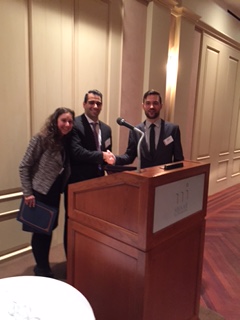
From left to right – Society Young Bar Chairs Marissa Lydynia and David Ettedgui present the McGill student award to Fraser Harland


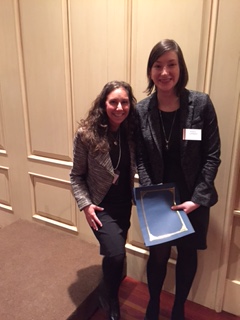
Marissa Lydynia with Université de Montréal student prize winner Emilie Lanteigne

Entering your Lord Reading CLE Credits on the Barreau Website

Larry Markowitz, Hershie Frankel, and Allen Mendelsohn

The Society wishes to ensure that you are properly credited with your Continuing Legal Education from Lord Reading events. April 30, 2015 is the deadline to register your CLE hours in your online mandatory continuing education record, and it is rapidly approaching! We remind you that you must have taken 30 hours of recognized CLE training during the period that runs from April 1, 2013 to March 31, 2015.

To enter Lord Reading training activities in which you participated, log into your “training statement” at: https://www.barreau.qc.ca/dossier-fco/

Click on “Ajouter une activité de formation”.

Search for “Lord Reading”. All of our past events since April 2013 will appear.

Click on each event you wish to add to your file, then click on “+ Ajouter”. The changes are saved automatically.

For some older events (circa 2013), if the particular dinner event does not appear, don’t fret!  Simply choose “Formations exclusivement réservées aux avocats à l’emploi de Lord Reading Law Society et aux participants invités.  Dispensée par «Lord Reading Law Society».” and indicate the number of hours using the drop-down menus that will appear.

If you are having problems accessing or completing the form, please visit the FAQ on the Barreau website or contact the Barreau by calling 514-954-3460, option 2. Or see the following document: http://www.barreau.qc.ca/pdf/formation/info-dossier-fco.pdf

Be sure to keep a copy of all CLE certificates in your files for at least the next 5 years in case you are inspected by the Barreau.

The Society is proud to help you fulfill your CLE obligations, and we look forward to doing so for many years to come.

Upcoming Barreau Events

Allen Mendelsohn

The Society is pleased to direct our members and friends to Barreau events that may be of interest.

On March 19, 2015 the Jeune Barreau de Montréal is offering a wonderful and informative program entitled “Forum sur le Demarrage et la Gestion d’un Cabinet.” The event is followed by a cocktail, and is approved for 4.5 hours of CLE credits. More information and online registration can be found on the AJBM website.

Society Humour

News from the Mishpuchah

Mazel Tov

  • To Society Past President Ian M. Solloway who will be awarded the Mérite du Barreau at the AGM of the Barreau de Montréal at 5:30 PM on May 6th in Salle 5.15 (Salle Jules Deschênes) of the Montreal Courthouse
  • To Society Board member Julie Schlesinger on the birth of her son Oliver, and grandson to Society Board member Frank Schlesinger
  • To Society Board member Tibor Holländer and Michael Hollander on the birth of their granddaughter and daughter

Condolences

  • To Society Second Vice-President Larry Markowitz on the loss of his father Jack
  • To Society Past President Raphaël Schachter on the loss of his mother-in-law Neri Bloomfield
  • To Society Board member Eric Maldoff on the loss of his brother-in-law

January 2015

Nancy Cleman, President
Allen Mendelsohn and Larry Markowitz, Editor(s)

President’s Message

Nancy Cleman

Dear Honourable Judges and Colleagues,

Happy New Year to you all. I hope that 2015 brings you health, joy and happiness. I am thrilled that our upcoming lecture on Wednesday, January 28th, 2015 will feature Society Past President Raphaël Schachter Q.C. Ad.E., who will speak on the topic of “Representing the High Profile Client”. This evening is our Annual Students Dinner when we host stagiaires and law students, and present The Lord Reading Law Society’s academic prizes to the deserving winners. The award winners, as well as representatives from each of the law faculties, will be present at the dinner lecture and we look forward to welcoming them.

You can register and pay online, or download the paper invitation to pay by cheque, using the links at the left of this page.

Me Schachter was born and raised in Sherbrooke, Quebec and is a graduate of the Université de Montréal’s Law Faculty where he has established a perpetual scholarship in criminal law. We are honoured to have him as our speaker for such an important dinner meeting.

Thank you to Lavery for their generous sponsorship of the evening.

The future of our Society will depend on today’s young lawyers, stagiaires and law students. We understand that young jurists face all sorts of challenge in the early stages of their careers. We want them to know that we are here to support them as they embark on their careers in law. I ask you to welcome our young guests and take the time to introduce yourselves and make them feel at home. The Society is always here to provide a welcoming atmosphere. Our meetings are an excellent setting to meet colleagues of all ages and to establish and maintain long-lasting connections.

On another note, I want to encourage you to participate in SALON VISEZ DROIT which will take place this year from April 13th to 16th. Please volunteer some time; it is a truly rewarding experience. There is more information about the event further down in this newsletter.

We are also pleased to announce the following dates for the rest of our current season, when we will be welcoming the following speakers:

Monday March 9, 2015 – The Honourable Madam Justice Andromache Karakatsanis (the Henry Steinberg Memorial Lecture)
Thursday April 16, 2015 – Corey Anne Bloom and Iain Kenny of MNP, on forensic evidence
Tuesday June 16, 2015 – The Annual Human Rights Lecture

We look forward to seeing you on the 28th and at future dinners.

Sincerely,
Nancy Cleman
President

Quebec’s Bill 52: An Act Respecting End-of-Life Care

Larry Markowitz

For our final dinner meeting of 2014, the Lord Reading Law Society tackled a serious topic, hosting a panel discussion on Quebec’s Bill 52: An Act Respecting End-of-Life Care. Guest speakers Me Gordon Kugler – of Kugler Kandestin LLP – and Rabbi Sydney Shoham – Rabbi Emeritus of Beth Zion Congregation – raised numerous questions that challenged the wisdom of this new law.

Unfortunately, the intended third member of the panel, McGill professor Daniel Weinstock, who is on the record as being in favour of Bill 52, was forced to cancel at the last-minute due to illness. Had Professor Weinstock been present, there likely would have been more of a debate.

An Act Respecting End-of-Life Care was passed by the National Assembly in June 2014 and is expected to come into force within the coming year, once the “Commission sur les soins de fin de vie” has been established to oversee application of the law and various administrative requirements have been met. The Act will give Quebecers the right to receive medical assistance to die in exceptional circumstances and under tight controls. In addition, the legislation formally recognizes Quebecers’ right to palliative care.

While public opinion polls indicate that a significant majority of Quebecers are in favour of allowing physicians to help competent people to die if they are suffering, Physician-assisted Death, or PAD, is a choice that is incompatible with traditional Jewish values. The Orthodox Jewish position on PAD is clear: To help someone die is murder. Judaism teaches that every moment of life is precious and of infinite value.

Proponents of the new law characterize Bill 52 as a major advance, as it gives people the right to choose the end of life they want. Our two speakers were not of that view, however. Rather than “coming out swinging” against Bill 52, they instead posed a series of thought-provoking questions to the audience – Me Kugler from a juridical point of view and Rabbi Shoham from a religious perspective.

In true lawyerly form, Me Kugler cited several key terms in the Act that are not defined. These include expressions such as “end of life”.

Me Kugler also pointed out that Bill 52 may contravene section 241(b) of the Criminal Code, which prohibits “aiding suicide” (though suicide itself in not illegal). Under section 241(b), anyone who “aids or abets a person to commit suicide” is guilty of an indictable offence and liable to imprisonment for up to 14 years. The Quebec government has not sought an exemption to section 241(b) and we may therefore expect a constitutional challenge to Bill 52 on this basis in the not-too-distant future.

That said, as recently as October 15, 2014, the Supreme Court of Canada heard the case of Carter v Canada (Attorney General) and will have to choose whether to follow its 1993 decision in Rodriguez v. British Columbia (Attorney General), which upheld section 241(b), or to distinguish from it.

The Quebec legislator did incorporate safeguards and conditions in its new end-of-life legislation. For instance, the “patient must request medical aid in dying themselves, in a free and informed manner”, as opposed to via, say, a living will.

The patient cannot merely be in a hopeless situation (e.g. suffering from ALS, which almost invariably leads to death). They must truly be at the “end of life” (even though, as mentioned, that term is not defined in the law). Bill 52 leaves much to the judgment of the attending physician, but “is [the attending physician] qualified?” asked Me Kugler.

To ensure that the request to die is “free and informed” and that the patient won’t change their mind, the physician must conduct more than one interview and these interviews must take place “at reasonably spaced intervals”. However, the law is silent as to what amount of time must have passed between interviews. “Is it two days? Ten minutes?” asked Me Kugler.

When his turn to speak came, Rabbi Shoham grabbed the audience’s attention by citing a recent People Magazine cover that extolled the “pleasant”-ness of an assisted death. “But who possesses the ability to make that decision?” asked the Rabbi. Is it the patient, as “owner” of their own body, or is it the right of the “creator who gave life”?

Rabbi Shoham distinguished between types of euthanasia: active and passive. Active euthanasia includes death with the patient’s consent and death without the patient’s consent. Passive euthanasia, by contrast, is where therapy is withheld. However, the bible states that one should “not stand idly by the blood of your brother”.

In the Judeo-Christian tradition, any taking of life is murder (the sixth commandment: “Thou shalt not kill”). Furthermore, the Talmud states that “Whoever destroys a soul, it is considered as if he destroyed an entire world. And whoever saves a life, it is considered as if he saved an entire world.”

The Catholic tradition dictates that God is the supreme master over life and death. The Church will not allow “private killings” for expediency. The Protestant view is more nuanced. There is an inherent conflict between the principles of “do not kill” and “have mercy on your fellow human being”. The Jewish view more closely resembles the Catholic one. Even removing one moment of life is considered murder.

Rabbi Shoham concluded his presentation by speaking out in favour of the guarantee of the right to palliative care, which is contained in the new Quebec legislation.  A peaceful death without killing the patient fits within the framework of Jewish law. After all, even with pain, a patient can live.

Some food for thought, indeed.

Sponsorship Opportunities at Lord Reading

The Lord Reading Law Society is currently seeking sponsors for its upcoming events.

Why sponsor Lord Reading?

The Lord Reading Law Society is the voice and gathering place for Jewish members of the Bar in Montreal, as well as their colleagues from the Chambre des notaires and members of the judiciary. By sponsoring one of our events, you will place your firm name or brand in front of some of Montreal’s most prominent lawyers, notaries, in-house counsel and judges, while benefiting from the opportunity to raise your firm or company profile among existing and potential clients, and referral sources.

The Society organizes some six dinner events per year, with attendance at each dinner typically ranging from 150 to 250 leading legal professionals. Our conferences are also widely regarded as valuable networking occasions. Sponsorship therefore offers you the opportunity to put your firm or company brand in front of some of the top members of Montreal’s legal profession, decision-makers in prominent law firms and in-house counsel of major corporations.

We offer many opportunities for potential sponsors to become involved with the Lord Reading Law Society, which in turn allows you to reach our 300-plus members and 900-plus mailing list.

For more information on sponsorship opportunities or should you have contacts with potential sponsors, please get in touch with our Sponsorship Chair, Steven Slimovitch, at slimovitch@montrealcriminallaw.com.

Your Lord Reading Membership

Hershie Frankel, Membership Chair

We always encourage lawyers and notaries, as well as judges, students and stagiares, to join the Society. Being a member and paying your annual dues helps to support the long-term health of the Society, and for you offers the immediate benefit of a discounted rate for dinner-meetings.

Many of you have been members for years but have not yet renewed your membership for the current season; we would ask you to please renew your membership online or renew by completing the paper form and mailing it with your cheque to the coordinates on the form. Even if you are exempt from paying membership dues (this includes judges and retired judges, first-year lawyers and stagiaires, as well as lawyers over 75 or who have been practising for 50 years) we ask that you complete the membership form so that we have your coordinates (and so that you can benefit from the dinner discount!) and to ensure you remain part of the Lord Reading family.

Thank You!

Université de Montréal JLSA / AEJD Shabbat Dinner Invitation

Allen Mendelsohn

All members and friends of the Lord Reading Law Society are cordially invited to Shabbat Dinner on January 30th, hosted by the Jewish Law Students Association of the Université de Montréal, in conjunction with Hillel. The dinner features, as guest speaker, noted constitutional law expert Professor Peter Hogg. Dinner begins at 6:00 P.M. and takes place at the Spanish and Portuguese Synagogue.

For more information and to register online, please visit Hillel’s website.

Bar of Montréal Seeks Volunteer Lawyers for Salon Visez Droit

Barreau de Montréal

The Bar of Montreal is currently preparing the program for Salon VISEZ DROIT, which will be held in the Grande Place of Complexe Desjardins from April 13 to 16, 2015.  It will feature many different activities, including free legal consultations, quiz games and mock trials.  In addition to reaching a very large segment of the general public, Salon VISEZ DROIT brings together over a hundred lawyers as well as judges from all jurisdictions.

We strive to make the Salon a memorable event.  For this purpose, we would appreciate your volunteering for the free legal consultations, one of the activities which is most appreciated by the general public. These consultations provide visibility and help us promote the human dimension of our profession. Since this activity is offered from 9:30 a.m. to 5 p.m. without interruption for four consecutive days, we need a large contingent of volunteers.

We therefore invite you to volunteer a half day of your time for this increasingly popular event which benefits from a large-scale advertising campaign. Please click here to download the registration form which must be completed by each volunteer to confirm his or her availabilities. Requests for information and/or offers of services may be sent directly to Christine Plourde by telephone at 514 866-9392, ext. 235, or by email to cplourde@barreaudemontreal.qc.ca.

Society Humour

News from the Mishpuchah

Mazel Tov

  • To Society Board member Irving (Bo) Narvey for his dedicated service to the Head and Hands Legal Clinic for the past 43 years(!), as discussed in this wonderful profile;
  • To Society member and past LRLS Human Rights Honouree The Honourable Irwin Cotler P.C., O.C., M.P. on another upcoming honour. He will receive The Law Society of Upper Canada’s inaugural Human Rights Award on February 12th.

Condolences

  • To Mark Brender and his wife, Society member Rhonda Rudick, on the loss of Mark’s mother Bernice.