October 2020

Editors – Allen Mendelsohn & Larry Markowitz

President’s Message

Andrew Kliger, President
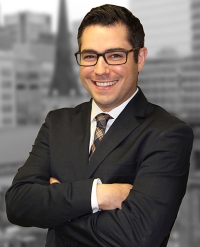
Dear Colleagues, Honourable Judges, and Friends of the Society,

This is certainly not the type of President’s Message that I envisioned sending out when I accepted the post as President of Lord Reading. Since our last newsletter in February 2020, the world has certainly been turned upside down in the wake of the Covid-19 pandemic. Live events, which are the cornerstone of our Society, will not happen for the foreseeable future. But we must, and we shall, go on!

I am incredibly honoured to be the President of the Lord Reading Law Society this year, despite the fact it is conceivable that I will not have the opportunity to greet any of you in person. I would like to give an enormous thank-yous to our Immediate Past President, Gregory Azancot, for his tremendous leadership in the wake of very difficult circumstances last season and for the wisdom that he bestowed upon me.

I would also like to thank the entire Executive and Board members who generously volunteer their time to make this organization and our events so outstanding. I am incredibly grateful to all of them who have provided me help and guidance, and for dedicating their time to planning this season’s exciting series of events.

As I stated above, we must go on. My mission this year is to uphold the honour and prestige of the Society by arranging top quality speakers on topics of importance to us, as advocates.  Perhaps a silver-lining to the fact that we cannot host live events for now is that logistical issues of physically bringing speakers to Montreal no longer exist and we literally have access to the entire globe at our fingertips, or at least at the click of a Zoom link!

To this end, our season will officially begin on Tuesday, October 20, 2020, with the annual Alan B. Gold Advocacy Lecture.  Our guest speaker is Adam Liptak, the Supreme Court reporter for the New York Times. His talk, entitled “The Roberts Court in the Trump Era: A Reporter’s Reflections”, could not be timelier given the recent passing of Justice Ruth Bader Ginsburg and the nomination process for the next Supreme Court justice, which is literally taking place this week.  This lecture promises to be a real eye-opener for what can be expected from the US Supreme Court as it turns further to the right. I invite all of you to register for this event by clicking here.

The other speakers that we have confirmed to date are: Senator Murray Sinclair, who will speak at our annual Human Rights lecture in late November or early December. Senator Sinclair has had a distinguished legal career and is well known for serving as both Co-Chair of the Aboriginal Justice Inquiry in Manitoba and as Chief Commissioner of the Truth and Reconciliation Commission. This event, especially given the overdue attention to systemic racism in the public discourse, is sure to be both timely and informative and we are honoured to host the Senator.

On January 14, 202, our annual student lecture will be given by Robert Laurie, international lawyer based in British Columbia, whose legal practice focuses on commercial business and regulatory issues surrounding cannabis and psychedelic plant medicines. His lecture will focus on the current and future of policy decisions facing these substances and why there is a strong movement to seek legalization for certain uses.

Later in the season (date to be confirmed), Professor Frederick Schauer, constitutional law professor at the University of Virginia who focuses on the First Amendment, will give a talk on the current climate of freedom of expression, on campuses, online and in public discourse.

As usual, all of these events will be CLE-accredited by the Barreau du Québec and the Chambre des Notaires.

On another note, the trial involving Lord Reading’s intervention in the Bill 21 court challenge is scheduled to begin on November 2nd, 2020.

You should have already received the notice to renew your annual membership in the Lord Reading Law Society. I would like to encourage all those who have not yet renewed their membership to do so now. I want to remind our members that all of our online Zoom events this year are free to members, who will obtain no fewer than five CLE’s during the season. This is excellent value for the quality of speakers that we will feature this year.

Members will also benefit for being eligible to member-only events, such as CLE breakfast or lunch programs, which again, will likely take place online this season. You can register and pay your membership fees online here, or alternatively, you may download the paper membership form.

In addition, it is important that as a membership-driven advocacy group, we be able to continue to speak for our usual high number of members, regardless of whether our meetings are online or in-person.

I look forward to seeing all of you (virtually) at our opening event on October 20, 2020, and at all of our other events throughout the 2020-21 season.

I wish everyone the best of health and that you remain in good spirits during these challenging times.

Andrew Kliger, President
Lord Reading Law Society

Tom Mulcair: Love in the Time of Corona

Larry Markowitz
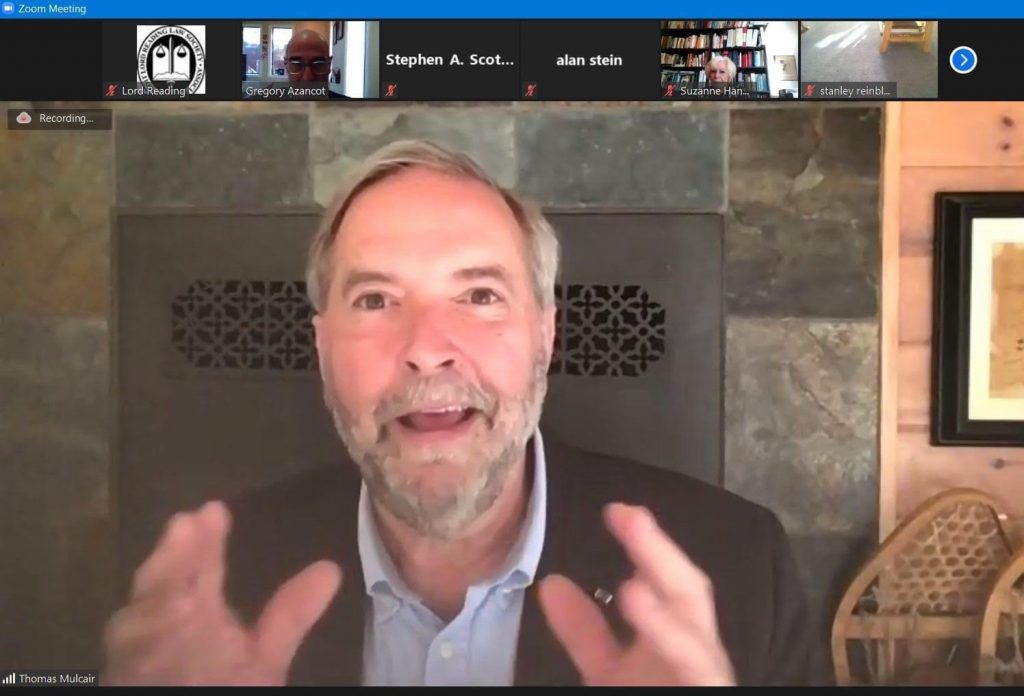
On May 21st, the Lord Reading Law Society held its first-ever virtual event. On this historic occasion, our special guest speaker was the former Leader of Her Majesty’s Loyal Opposition, and current political analyst, the Honourable Thomas Mulcair, PC. His talk was entitled “Love in the Time of Corona: Laws, Directives, Guidelines and Suggestions in a Time of Crisis”.

Despite the format being virtual, our speaker and his interactions with our audience of well over 100 members were very much real.

As we now know, time passes slowly during the time of COVID-19. Mr. Mulcair’s presentation remains timely many months later. He posed the question of why Quebec had the worst record of any province in fighting COVID, a question many are still asking as we fight off a second wave of the pandemic.

Mr. Mulcair held up British Columbia and its provincial health officer, Dr. Bonnie Henry, as the gold standard for public health policy in Canada. Dr. Henry has the power to make binding orders having the force of law. Her declarations are delivered independently of statements by politicians. When she ordered that health professionals not work in more than one seniors’ residence at a time, so as to avoid spreading the virus, that immediately became an enforceable rule.

In Quebec, our politicians have the ultimate say and our chief public health officer, Dr. Horacio Arruda, generally appears alongside the premier or other government ministers. While Quebec suggested that healthcare workers not move between CSHLDs, it was never made the rule.

Mr. Mulcair also contrasted the culture of enforcement in the United States with Quebec’s culture of suggestions. Clear and enforceable rules, rather than mere requests that call upon Quebecers sense of patriotism, would be more effective in the battle against the novel coronavirus, he opined.

He complimented the federal government’s success in quickly pushing money into the economy to avoid a complete shutdown, and what would have been even worse unemployment and insolvency, when COVID-19 initially hit. However, he criticized the federal government’s initial hesitancy to tighten controls on travellers arriving from abroad at our airports.

Following his remarks, Mr. Mulcair took questions from the audience. Impressed with our guest speaker’s performance, one audience member asked when he’d be returning to active politics. Mr. Mulcair stated clearly that this was not to be, exclaiming, “I’ve hung up my skates.”

While that questioner might have been disappointed, the rest of us can rest assured that we will be able to continue to enjoy Tom Mulcair’s insightful political analysis on a daily basis in both the English- and French-language media.

This online discussion was moderated by our then-President, Gregory Azancot, in his final event as head of the Society. Mr. Mulcair was thanked by his McGill Faculty of Law classmate, Society Past President Ronald H. Levy.

In addition to our usual crowd of prominent local jurists, we were thrilled that Lord Alexander Rufus-Isaacs, honorary lifetime member of the Society and great-grandson of Rufus Daniel Isaacs, 1st Marquess of Reading, after whom the Society is named, was able to join us from his home in Beverly Hills.

A set of screenshot photos from the talk can be found on our Facebook page

Lord Reading Runs for a Great Cause

Allen Mendelsohn
.

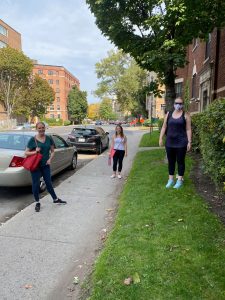
Lord Reading members on the run!

The Society was delighted to sponsor a team for the recent Juri Course, the annual fundraiser for Montreal’s legal community in support of Justice Pro Bono. While the pandemic meant that the community could not physically gather for the event, individuals participated on their own in 5k and 10k runs, and a 5k walk. Lord Reading was ably represented by numerous members of our Young Bar, and other members who are young at heart! We congratulate all those who participated and Juri Course for the incredible effort keeping the event together during these unprecedented times.

Professor Payam Akhavan: Justice for Genocide

Larry Markowitz
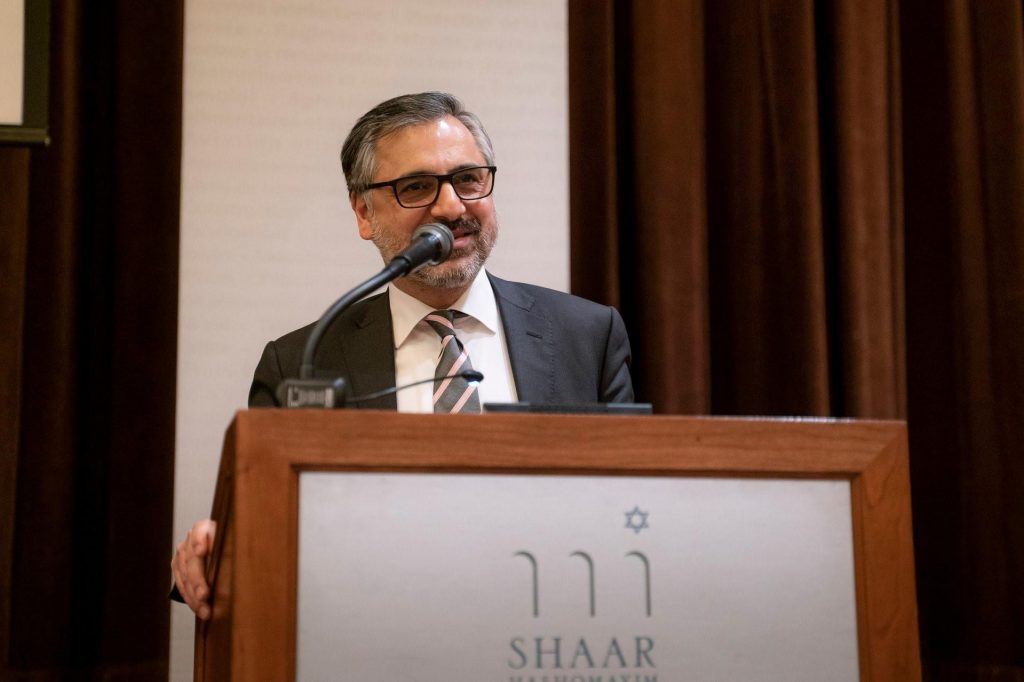
We lawyers like to think we help society—and indeed we usually do—but it is not every day that one of us literally saves thousands of lives as a result of a victory in court.

For our last in-person event prior to the pandemic, our annual Student Dinner on February 6th, the Lord Reading Law Society was delighted to welcome Professor Payam Akhavan of McGill University, world-renowned scholar and attorney in the field of human rights and international law. Professor Akhavan’s talk was entitled “Justice for Genocide”.

In a gripping presentation, Professor Akhavan described his victory of only a couple of weeks earlier at the International Court of Justice, or ICJ, at The Hague, where by unanimous decision, all 17 judges granted what amounted to a restraining order, requiring Myanmar to cease and desist from all acts that United Nations investigators had already determined as constituting genocide against the Rohingya people.

The Lord Reading audience, and especially the many law students in attendance, were deeply moved by our guest speaker’s talk.

* * *

The Rohingya people are a stateless Indo-Aryan ethnic group, who mainly reside in Rakhine State, Myanmar. Denied citizenship under the 1982 Myanmar nationality law, they have been described by the United Nations as one of the most persecuted minorities in the world.

At least 10,000 Rohingya have been killed over the past three years, and thousands subjected to horrific violence. Their villages have been burned, their crops razed, and their livestock slaughtered. Roughly a million have either fled or been driven into neighbouring Bangladesh. The 600,000 Rohingya who remain in their homeland, in Rakhine, continue to suffer violence and persecution.

* * *

Only states are permitted to bring an action before the ICJ. Fortunately, The Gambia, Africa’s smallest country, stepped up as plaintiff. This was the first time in history that a state not directly affected has brought a case at the ICJ on behalf of the international community.

Myanmar is a signatory to the 1948 Convention on the Prevention and Punishment of the Crime of Genocide, which is intended to prevent and punish genocide, and under which the ICJ trial was conducted.

At trial, Myanmar’s leader, now-disgraced 1991 Nobel Peace Prize winner Aung San Suu Kyi, was present. Professor Akhavan recounted to the Lord Reading audience how he spoke truth to power, looking Ms. Suu Kyi in the eye as he pleaded his case. In addition, Professor Akhavan was accompanied by several survivors of the genocide, who were able to see justice being done as they sat in the same courtroom as their lead persecutor.

Myanmar claims that its domestic legal system is dealing with crimes committed in Rakhine, which, it argues, should be understood in the context of civil disturbances arising from a separatist insurgency. The ICJ did not give credence to this argument.

Now that the ICJ has ruled in favour of The Gambia and the genocide victims and survivors it represents, Myanmar must cease and desist from all acts of genocide. The ICJ decision also requires periodic reports from Myanmar on what it is doing to preserve evidence of past acts of genocide and to report every six months on what steps it is taking to comply with the court order.

The next step in the judicial proceedings is the merit stage—conducted in writing. Then, in perhaps three years, oral arguments will be heard and the ICJ will rule on Myanmar’s responsibility. There remains a long road ahead, but in the meantime, the continuation of a genocide has been averted and many lives have been saved.

* * *

The International Court of Justice was established in the wake of the Holocaust, as the United Nations vowed “Never Again”. However, these words have frequently been reduced to a cliché—words that are spoken, but not acted upon.

Is it possible our guest speaker’s victory at the Hague will be a turning point? We can only hope so. The world is watching—in large part thanks to the inspiring efforts of our guest speaker, Professor Payam Akhavan.

A full set of photos from the evening can be found on our Facebook page

At the Student Dinner we also had the occasion to award the Lord Reading Student Awards for the year; please see the next story in the newsletter for the winners!

Lord Reading Student Award Winners

Congratulations to all the student awards winners from last season. Each winner receives a cash scholarship from the Society, in recognition for their excellence in various academic fields.

From McGill University:
Winner : Nathaniel Reilly
For: Highest Standing in First Year in the Faculty of Law, McGill University, for the 2018-2019 Academic Year

From the University of Ottawa:
Winner: Pierre Malhame
Pour la meilleure note dans le cours Droit international public.

De l’Université de Sherbrooke :
Winner: Sandrine Raymond
Pour: Prix pour excellence en anglais juridique à la Faculté de droit de l’Université de Sherbrooke pour l’année académique 2018-2019

De l’UQAM :
Winner: Samuel Roy
Pour: Prix pour la meilleure note en droit pénale

Le Prix Lawrence Glazer, l’Université de Montréal :
Winner: Audrey Labrecque
Pour: Prix pour excellence en Droit constitutionnelle I et II à la Faculté de droit de l’Université de Montréal pour l’année académique 2018-2019

Don’t Forget Your Membership and Your CLE!

The Society wishes to remind you that the current period for Barreau CLE will be coming to an end on March 31, 2021. Do you want to know a great way to get CLE? Become a member of the Society!

Society membership will get you a minimum of 5 free Zoom conferences that will be admissible for CLE. We are also planning members-only CLE events. And if we are able to return to in-person events in the new year, you’ll receive substantial discounts on your dinner-meeting prices. Sounds like a great deal, no?

Click here to become a member today!!!

Congratulations to Our Members for these Barreau Anniversaries

The Society salutes its current and past members who are celebrating the following special Barreau anniversaries:

70th Anniversary

Me Harry Blank, Q.C.

60th Anniversary

Me David R. Franklin, Ad.E.

50th Anniversary

Me Max R. Bernard, Ad.E.
Me Jeffrey K. Boro
Me Howard W. Dermer
Me William F. Finkelberg
Me Michael D. Levinson
Me Elliot Lifson
Me Carl Gelber
Me Peter M. Gold
Me Sheldon G. Price
Me Frank Schlesinger
Me Melvin S. Schiff
Me Boris Stein
Me Leonard Waxman
Me Lawrence P. Yelin

Society Humour

News from the Mispacha

Mazel Tov

  • To Society Board member and Young Bar chair Elissa Brock on being named a finalist for the Young Bar of Montreal’s Gala, “Les Leaders de Demain”, in the Corporate Law category

Condolences

  • To the family of Senator Yoine Goldstein, Past President of the Society
  • To the family of The Honourable Herbert Marx, longtime member of the Society
  • To The Honourable Pierrette Sévigny and family on the loss of her husband, distinguished Society member Richard McConomy
  • To Society member Jonathan Foldiak on the loss of his mother Marietta
  • To good friend of the Society Anthony Housefather on the loss of his father, Me David Housefather, notary

February 2020

Editors – Allen Mendelsohn & Larry Markowitz

President’s Message

Gregory Azancot, President

(le message en français suit l’anglais)

Dear Colleagues, Honourable Judges, and Friends of the Society,

There are a myriad of inspirational quotes about change – how it’s hard, why it’s a must and why nobody likes it except for a wet baby… well the Society over the course of its history has changed maybe subtly, maybe without very many people noticing or maybe in respect of things that, with the benefit of hindsight, were not as dramatic as we thought but yet were always steps forward and improvements.

I find it extremely difficult in these few lines allotted to me to convey all that I think I need to say to all of you – so to be concise I’ll borrow David Letterman’s format – here are, in no particular order, ten things (and not necessarily the top ten things) you need might want to know about the LRLS :

  1. As you have surely noted from media reports the Board chose, for what I believe is the first time in the LRLS’s history to intervene last November in a court proceeding concerning a contestation of Bill 21;
  2. We did this because we are an association of lawyers who share a passion for human rights;
  3. We are all individuals from various backgrounds with different points of view both as regards the world around us and the law – but as lawyers the vast majority of our membership believe that Bill 21 runs counter to the human rights of many Quebecers and this regardless of whether you agree or not with the societal issues this law proposes to deal with;
  4. We uphold the rights of those who disagree with our position. However, we appreciate when these opposing viewpoints are voiced respectfully and with civility;
  5. We are all volunteers and the lawyers representing us in our court intervention are doing so pro bono;
  6. We do not pay our speakers. The fee for attendance covers some of the cost of the dinner but as we have significant discounts for students, junior and senior members, we run a deficit at every dinner conference for which we seek sponsorships. We do not make money on our dinner-meetings;
  7. Our membership is not solely Jewish and we strive for full inclusion and diversity at all levels of the Society;
  8. Despite certain reports, we all read, write and speak French and have submitted all of our briefs to the National Assembly and our court intervention in that language;
  9. We respect the rule of law and as such have and shall continue to do what we believe is right, despite public opinion, to uphold that principle and protect all of its institutions;
  10. We are a law society not a dinner society. As such, we are and will remain willing to sacrifice all of our dinners, if necessary, to fight laws that we believe are discriminatory and violate the laws and Charters of Quebec and Canada.

All of this being said, we remain excited about our upcoming student dinner and will continue to encourage our student honorees and put forth speakers such as Professor Payam Akhavan who through his entire body of work inspires us by his attempts to perfect the world by performing the mitzvah of Tikun Olam – repairing the world.

*******************

Il y a une myriade de citations inspirantes sur le changement – comment c’est difficile, pourquoi c’est nécessaire et pourquoi personne n’aime ça sauf un bébé avec la couche pleine… eh bien l’Association au cours de son histoire a changé peut-être subtilement, peut-être sans que beaucoup de gens ne le remarquent ou peut-être en ce qui concerne des choses qui, avec le recul, n’étaient pas aussi dramatiques que nous le pensions mais qui étaient pourtant toujours des pas en avant et des améliorations.

Il m’est extrêmement difficile, dans ces quelques lignes qui me sont allouées, de vous transmettre tout ce que je pense devoir dire à tous – donc pour être concis, je vais emprunter le format de David Letterman – voici, sans ordre particulier, dix choses (et pas nécessairement les dix premières) que vous devez savoir sur le LRLS :

  1. Comme vous l’avez sûrement remarqué dans les reportages, notre conseil d’administration a choisi, pour ce que je crois être la première fois dans l’histoire de l’Association, d’intervenir en novembre dernier dans une procédure judiciaire concernant une contestation de la loi 21 ;
  2. Nous avons fait cela parce que nous sommes une association d’avocats dédiés à la promotion des droits de la personne;
  3. Nous sommes tous des individus d’origines diverses avec des points de vue différents tant en ce qui concerne le monde qui nous entoure que le droit – mais en tant qu’avocats, la grande majorité de nos membres pensent que la loi 21 va à l’encontre des droits de l’homme de nombreux Québécois et ce, que vous soyez d’accord ou non avec les questions de société que cette loi propose de traiter ;
  4. Nous défendons les droits de ceux qui ne sont pas d’accord avec notre position. Toutefois, nous apprécions que ces points de vue opposés soient exprimés avec respect et civilité ;
  5. Nous sommes tous bénévoles et les avocats qui nous représentent dans notre intervention devant les tribunaux le font pro bono ;
  6. Nous ne payons pas nos conférenciers. Les frais de participation couvrent une partie du coût du dîner, mais comme nous offrons des rabais importants pour les étudiants, les membres juniors et seniors, nous enregistrons un déficit à chaque dîner-conférence pour lequel nous recherchons des commanditaires. Nous ne gagnons pas d’argent sur nos dîners-conférences ;
  7. Nos membres ne sont pas uniquement juifs et nous nous efforçons de favoriser l’inclusion et la diversité à tous les niveaux de notre Association ;
  8. En dépit de certaines allégations, nous lisons, écrivons et parlons tous français et nous avons soumis tous nos mémoires à l’Assemblée nationale et notre intervention devant les tribunaux dans cette langue ;
  9. Nous respectons la primauté du droit et, à ce titre, nous avons fait et continuerons de faire ce que nous croyons être juste, malgré l’opinion publique, afin de faire respecter ce principe et protéger toutes ses institutions ;
  10. Nous sommes une société de droit et non une société de dîner-conférences. En tant que tel, nous sommes et resterons prêts à sacrifier tous nos dîners, si nécessaire, pour lutter contre des lois que nous estimons discriminatoires et qui violent les lois et les chartes du Québec et du Canada.

Ceci étant dit, nous restons enthousiastes à l’idée de notre prochain dîner d’étudiants et nous continuerons à encourager nos étudiants honorés et à proposer des conférenciers tels que le professeur Payam Akhavan qui, à travers tout son travail, nous inspire par son travaux à travers le monde en effectuant la mitzvah de Tikun Olam – réparer le monde.

Ken Dryden: Brain Injuries in Sports

Larry Markowitz

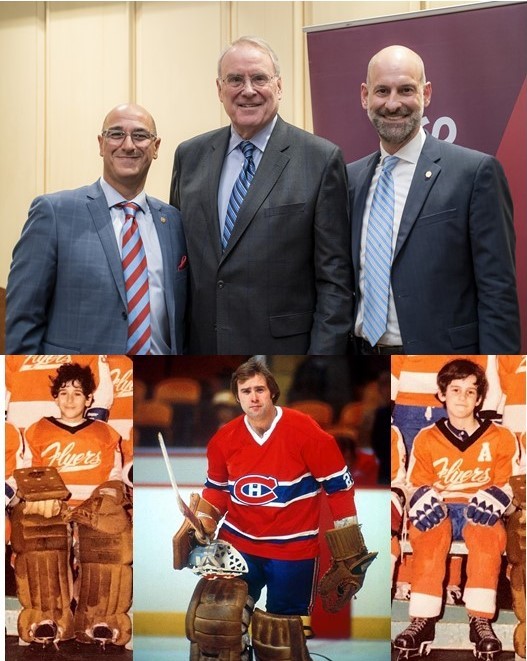
(left to right, top and bottom: Society President/Atom C Flyers goalie Greg Azancot, our speaker/Montreal Canadiens goalie, and this reporter/Greg’s Atom C defenceman)

To open 2020 in style, on January 15th, the Society was delighted to welcome lawyer, author, businessman, broadcaster, politician, Hockey Hall of Famer and six-time Stanley Cup-winning goaltender Ken Dryden, who delivered a provocative talk entitled, “When the Decision Makers Don’t Decide: Brain Injuries in Sports, and Other Matters”.

In a heartfelt tribute, Mr. Dryden was introduced by Society president (and fellow goaltender) Greg Azancot.

Our speaker was thanked by this reporter, who happens to have been Greg’s Atom C teammate (and defenceman) many years ago, at the same time as our guest speaker was leading Stanley Cup parades down the “usual route”.

The multitalented Mr. Dryden was described as “Canada’s Renaissance Man”.

Concussions in Hockey

In delivering his impassioned talk on player safety, Mr. Dryden explored the implications of inaction by those in charge of the sport of hockey, even when faced with clear evidence of the serious implications of concussions.

A concussion a brain injury. When an athlete hurts their knee, they walk with a limp.  When an athlete injures their brain, “their whole being limps”.

Present and former NHL players have talked about the symptoms they’ve experienced after brain injuries from blows to the head. These include depression, memory loss, anxiety, loss of routine problem-solving abilities and a lack of anger control.

Mr. Dryden brought this phenomenon to the wider attention of the public in his 2017 bestseller entitled, Game Change: The Life and Death of Steve Montador, and the Future of Hockey.

In it, he tells the story of NHLer Steve Montador, who after his death, was diagnosed with Chronic Traumatic Encephalopathy (CTE), a neurodegenerative disease caused by repeated head injuries. In the book, Mr. Dryden outlines the evolution of the sport of hockey and provides prescriptions to counter what, in the author’s view, is its greatest risk for the future: head injuries.

The future of hockey depends on decision-makers making evidence-based decisions to ensure the health of players.

Attitudes in society shift. Attitudes at the highest levels of hockey have to change, too. Mr. Dryden drew parallels with society’s changing attitudes towards tobacco, asbestos, and now climate change. While in the past, the negative repercussions of each of these were ignored by decision-makers, the facts are now incontrovertible and mainstream attitudes have shifted.

Even in hockey, play-by-play announcers now spontaneously ask, “Was that a hit a to the head?”

Mr. Dryden was critical of Gary Bettman, who has been Commissioner of the National Hockey League since 1993. Mr. Dryden and Mr. Bettman are both lawyers and have known one another for a long time. Normally, claims Dryden, Mr. Bettman has a thirst for knowledge. However, when it comes to learning more about the effects of concussions — and acting — Mr. Bettman has not changed with the times.

NHL Commissioner Bettman’s Perspective

Last spring, Commissioner Bettman appeared before a government of Canada parliamentary subcommittee on concussions in sports. He argued that hockey is a game “played in an enclosed environment, at high speeds, by players of different heights, weights and skills,” and is, “by its very nature, a collision sport.”

“Fighting is thus a natural part of the game, that offers players a release at an emotional moment,” Mr. Bettman testified.

He cited the addition of Rule 48 to the NHL rule book, which, in his words, “prohibits all hits to an opponent’s head where the head was the main point of contact and such contact was avoidable.”

He pointed out that fighting is at its lowest level since 1964. Eighty-five per cent of the league’s games are now fight-free and the majority of the league’s players do not fight. He boasted of the league’s concussion protocol.

Mr. Dryden isn’t Buying these Arguments

However, Mr. Dryden retorted, most of the league’s actions kick in after the brain injury has occurred; after the damage has been done. Actions need to be taken to prevent head injuries from occurring in the first place. For instance, fighting should be banned outright.

“If fighting is natural and important, as Mr. Bettman claims, why is it down?” Mr. Dryden asked rhetorically.

  • Why aren’t there fights every game? Isn’t every game “emotional”? Why do only 25% of the players fight, and many of them only once a season?
  • Why don’t 100% of the players fight? Do they not play in the same enclosed space, at the same high speeds? Do they not “lose it” on occasion?
  • Do Sidney Crosby, Connor McDavid and the rest of the league’s stars not have “emotional” moments? Did Bobby Orr, Wayne Gretzky, and Mario Lemieux not care?
    -Ken Dryden

Mr. Dryden wants Mr. Bettman to be proactive to prevent head injuries; not just “manage” the situation.

There came a point when CEOs of producers of tobacco, opioids and asbestos could no longer just manage their situations. Willful blindness was no longer acceptable. The scientific evidence was clear. These leaders had to make concrete and drastic changes to their businesses.

To save the game of hockey, the NHL also needs to make concrete and drastic changes. And, according to Ken Dryden, the time is now!

A full set of photos from the evening can be found on our Facebook page

Remembering Armando Rodrigues, 1964-2020

Allen Mendelsohn

The Society was tremendously saddened to learn of the passing of Armando Rodrigues, a member of the Shaar Hashomayim staff for 18 years.

You may not have known his name, but if you ever attended a Lord Reading event at the Shaar you know who he is. You most likely recognize him as a bartender extraordinaire, but he was so much more. I had the occasion of working with Armando regularly behind the scenes at Lord Reading events, and he was a problem-solver who always got done whatever needed to be done, and with a smile. And yes, I appreciated how he always knew my drink order before I did. Our events won’t be the same without him. He will be dearly missed.

We extend our deepest condolences to his family.

Society Humour

News from the Mispacha

Mazel Tov

Condolences

  • To Society Board Member Tibor Hollander and his entire family on the loss of his granddaughter Ronnie Joy Hollander

January 2020

Editors – Allen Mendelsohn & Larry Markowitz

President’s Message / Mot du Président

Gregory Azancot

(le message en français suit l’anglais)

Dear Colleagues, Honourable Judges, and Friends of the Society,

As the date on the calendar moves to what some of us growing up believed would be a space odyssey (and I’m aware the original was 2001) and while it’s not quite the world of flying cars and robot butlers some people imagined- advances in the tech and medical fields have been astounding… and somewhat worrisome.

Thankfully some predictions such as the end of the world have not come true others like the rise of the global average temperature (< 1°C since the mid-90s) and the global rise of sea levels (< 3 inches since 1992) unfortunately have.

It’s easy and tempting to focus on the negatives especially when in New York the eight days of Hanukkah became synonymous with anti-semitic attacks. But since when have we as Jews or the Lord Reading Law Society taken the easy route? It would have been easy for our predecessors 72 years ago to just be quiet and not attend the Bar conference and thus not attract the wrath of certain of their colleagues, just as it would have been very easy to not intervene in the Bill 21 court proceedings and avoid the media stories (some highly erroneous) and hateful commentary… But like I said we don’t do easy.

So what are the positives?

Well as a species and a planet they are too many to mention but I regularly follow Colonel Chris Hadfield so here’s a great video or you can read professor Vincent Geloso‘s article on the subject in La Presse … But what of Lord Reading?

Our membership has grown and continues to do so our dinner lectures are arguably the best of any in the country and our presence related to issues that affect the Jewish community and human rights in general has continued to grow in terms of scope – such as briefs submitted to the National Assembly regarding Bill 60 and Bill 62 which were accompanied by the Society’s oral presentation and of course our recent brief to the National Assembly and court intervention into Bill 21 contestations.

So… « Si la tendance se maintient » and barring nuclear Armageddon, the next decade for the Society is exciting and full of promise. As we continue to rejuvenate and grow our membership it is imperative that we continue to remember and honor our roots. So I look forward to the new roaring 20’s and hope that you too will welcome in this new decade with renewed passion in all of your endeavours.

******************************

The decade starts out on a wonderful note with Ken Dryden visiting the Society on January 15th. You can register online here. Don’t forget to mark your calendar with all of our amazing events for the rest of the season. The 20’s are indeed starting off roaring!

Gregory Azancot, President
Lord Reading Law Society

******************************

Cher(e)s collègues, honorables juges, et ami(e)s de l’Association,

Alors que la date sur le calendrier se déplace vers ce que certains d’entre nous croyaient être une odyssée de l’espace (et je sais que l’original était en 2001) et bien que ce ne soit pas tout à fait le monde des voitures volantes et des robots majordomes que certains imaginaient – les progrès dans les domaines de la technologie et de la médecine ont été stupéfiants… et quelque peu inquiétants.

Heureusement, certaines prédictions comme la fin du monde ne se sont pas réalisées ; d’autres comme l’augmentation de la température moyenne mondiale (< 1°C depuis le milieu des années 90) et l’élévation du niveau de la mer (< 3 pouces depuis 1992) se sont malheureusement concrétisées.

Il est facile et tentant de se concentrer sur les points négatifs, surtout quand à New York, les huit jours de Hanoukka sont devenus synonymes d’attaques antisémites. Mais depuis quand avons-nous, en tant que Juifs ou membres de l’Association Lord Reading, pris la voie de la facilité ? Il aurait été facile pour nos prédécesseurs, il y a 72 ans, de se taire et de ne pas assister à la conférence du Barreau et ainsi ne pas attirer la colère de certains de leurs collègues, tout comme il aurait été très facile de ne pas intervenir dans les procédures judiciaires relatives à la Loi 21 et d’éviter les reportages médiatiques (dont certains furent très erronés) et les commentaires haineux… Mais pourquoi prendre le chemin de la facilité quand un autre existe ?

Alors, quels sont les points positifs ?

Eh bien, en tant qu’espèce et planète, ils sont trop nombreux pour être mentionnés, mais je suis régulièrement le Colonel Chris Hadfield, alors voici une excellente vidéo où vous pouvez lire l’article du professeur Vincent Geloso sur le sujet dans La Presse… Mais qu’en est-il de Lord Reading ?

Notre base d’adhérents a augmenté et continue d’augmenter ; nos dîners-conférences sont possiblement les meilleurs au pays et notre présence liée aux questions qui touchent la communauté juive et les droits de la personne en général ont continué de croître en termes de portée – comme les mémoires soumis à l’Assemblée nationale concernant les projets de loi 60 et 62 qui étaient accompagnés de représentations viva voce de l’Association et, bien sûr, notre récent mémoire à l’Assemblée nationale et notre intervention devant les tribunaux relativement à la Loi 21.

Alors… si la tendance se maintient et exception faite d’une catastrophe nucléaire, la prochaine décennie pour l’Association est excitante et pleine de promesses. Alors que nous continuons à recruter des jeunes membres il est impératif que nous continuions à nous souvenir et à honorer nos origines. J’attends donc avec impatience ces nouvelles Années folles et j’espère que vous aussi vous accueillerez cette nouvelle décennie avec une passion renouvelée dans tout ce que vous entreprenez.

******************************

La décennie démarre sur une note merveilleuse avec la visite de Ken Dryden à l’Association le 15 janvier. Vous pouvez vous inscrire en ligne ici  N’oubliez pas d’inscrivez à votre calendrier tous nos événements exceptionnels pour le reste de la saison  En effet, les années 20 commencent en lion !

Gregory Azancot, Président
Association de droit Lord Reading

The Schwartz Report – Chronicles of a Canadian Clerking at the High Court of Israel

Michael “Mikie” Schwartz

Our intrepid foreign correspondent enjoys a Chanukkah party in Jerusalem with Justice Hanan Melcer, Deputy President of the Supreme Court of Israel, who is scheduled to speak at the Society May 21st

[Editors’ note – The Society is delighted to welcome our first-ever foreign correspondent! Mikie Schwartz is a Lord Reading member and regular at Society events. He was the winner of the “Prix du Ministre de la justice du Québec – Association de droit Lord Reading” Student Award in March 2017. Mikie is currently serving as a foreign law clerk at the Supreme Court of Israel, and was kind enough to take some time to share his thoughts and observations. Mikie will be back in Montreal this spring to tell us more! May the Schwartz be with you!]

So, how exactly does a Manitoba-raised, Quebec-trained, Ontario-licensed lawyer end up working at the Israeli Supreme/High Court? I suppose that applying for the job is a good start. Like chicken soup, it will do no harm and may even have positive effects, as it has in my case.

Many of you may not know that the Court maintains a foreign clerks program. The idea is for the clerks to research and present foreign law to the justices, who frequently look to legal systems outside of Israel for inspiration.

The High Court of Israel has a particularly strong interest in Canadian jurisprudence. Despite, or perhaps precisely because of, Israel’s own lack of a codified constitution*, Israel often turns to Canadian Charter interpretation as a means of developing Israeli law, especially in the domain of human rights and liberties.

Strong ties have been formed between Canadian and Israeli Supreme Court justices, such as was the case with Antonio Lamer and Aharon Barak (each Chief Justice of their respective courts) and Dorit Beinish and Rosalie Abella.

As for me, being trained in two systems of law in two languages at McGill no doubt was a boost to my candidacy.

Strangely enough, Hebrew (which I speak) is not a requirement, although it is considered an asset.

I have the privilege of working with Justice Daphne Barak-Erez, former Dean of Law at Tel Aviv University and author of, among other publications Outlawed Pigs: Law, Religion and Culture in Israel.

Having grown up with Winnipeg winters – Montreal’s may be tough, but Winnipeg’s take it to a whole new nadir – the mellow Jerusalem climate is a welcome respite.

With flexible hours, interesting work, not having to come in on Jewish holidays, and the opportunity to contribute to the development of a dynamic legal system, there is much to recommend in the clerkship. Also, our Court Chanukah parties are lots of fun. Moreover, I briefly made Israeli TV, which was kind of cool and augurs well for my long-held dream of having my own talk show.

Shalom from Jerusalem,

Michael A. Schwartz

*Israel’s Declaration of Independence promises a written constitution will be adopted no later than 1 October, 1948. Evidently, things are running somewhat behind schedule.

It’s Hockey Night at Lord Reading!

The Society is getting very excited for Ken Dryden’s visit on January 15! In preparation for this once in a lifetime dinner, the Newsletter’s hockey-loving editors dug up this vintage CBC profile of a young hockey star and law student, which we thought we would share. We’ll see you and Mr. Dryden on the 15th!

Don’t forget your Lord Reading Membership!

It’s no too late for you to renew your membership or become a member for the first time. Membership offers significant discounts for dinner-meetings and with our updated pricing for this season you’ll be saving even more! You’ll also get exclusive access to the great members-only CLE events which we have planned. We’d love to have you as a member!

You can become a member online here or alternatively, you may download the membership form here. Membership has its privileges!

And Don’t Forget These Amazing Events!

We’ve got these great events lined up for the rest of the year, with more to come. Mark your calendars!

  • February 6 (Student dinner) – Supreme Court Justice Russell Brown
  • April 28 – Marie Henein
  • May 21 (Henry Steinberg Dinner) – Justice Hanan Melcer, Deputy President of the Supreme Court of Israel

You can always keep abreast of Society events on our Events page.

Society Humour

News from the Mispacha

Mazel Tov