December 2021

Editors – Allen Mendelsohn, Larry Markowitz and Stephanie Perlis

President’s Message

Doree Levine, President

(cliquez ici pour lire le mot de la présidente en français)

Dear Colleagues, Honourable Judges, and Friends of the Society,

At the time of our last newsletter, we were ushering in a new year and a new rentrée judiciaire, with many of us welcoming the turning of another long page. This evening, I write this President’s Message with flickering Hannukah candles within eyesight. December is here and snow is on the ground. These annual traditions and changes of season provide a comforting sense of familiarity. Many of you have begun returning to offices, occasionally or full-time. Despite these small tastes of normalcy, the pandemic continues to be a constant source of discussion and debate, in our professional and personal lives.

While we at Lord Reading have certainly been impacted by the Covid-19 pandemic, most significantly by the absence of our popular dinner events, the topic of Covid-19 itself had not yet made its way into our lectures…until now.

On December 9, 2021 at 6:00 pm, via Zoom, we will have the opportunity to listen in on an engaging conversation between Dr. Vardit Ravitsky and the Right Honourable Beverley McLachlin, as they discuss the impact of Covid-19 on issues such as access to justice, the impact on vulnerable persons, and how our judicial system fared during this unprecedented period.

In addition to being a Full Professor of Bioethics at the Université de Montréal, Dr. Ravitsky is Chair of the Pierre Elliott Trudeau Foundation’s Covid-19 Impact Committee. Justice McLachlin, also a member of the Committee, and a most welcomed returning speaker to our Society, was Canada’s longest-serving Chief Justice and is now an internationally known best-selling author.

A Zoom link to the event will be emailed only to those who have registered. If you have not yet done so, we invite you to register.

*****

Given the uncertainty that comes with the pandemic, we have hesitated to divulge our speakers well in advance. In the last few weeks, I was given the green light to resume in-person dinner events as of January 2022 and therefore invite you to “Save the Date” for our first in-person dinner event in almost two years!

On January 25, 2022, at 6:00 pm, I will be delighted to greet you all in person for our Annual Student Dinner. Further details regarding the event will follow shortly.

This will be a long-awaited opportunity to reconnect with old friends and to warmly welcome law students and young lawyers – some of whom may only have experienced law school and the practice itself from behind a screen. I hope to see you there and will do my utmost to ensure a comfortable and safe return to in-person events.

As usual, all of these events will be CLE-accredited by the Barreau du Québec and the Chambre des notaires.

In the coming weeks, I also hope to announce upcoming events hosted by the Society’s Young Bar Committee in 2022; please stay tuned.

Wishing you all a peaceful holiday season and a happy, healthy new year.

Doree Levine, President
Lord Reading Law Society

Alan B. Gold Advocacy Lecture featuring Aboriginal law expert David Schulze

Larry Markowitz & Allen Mendelsohn
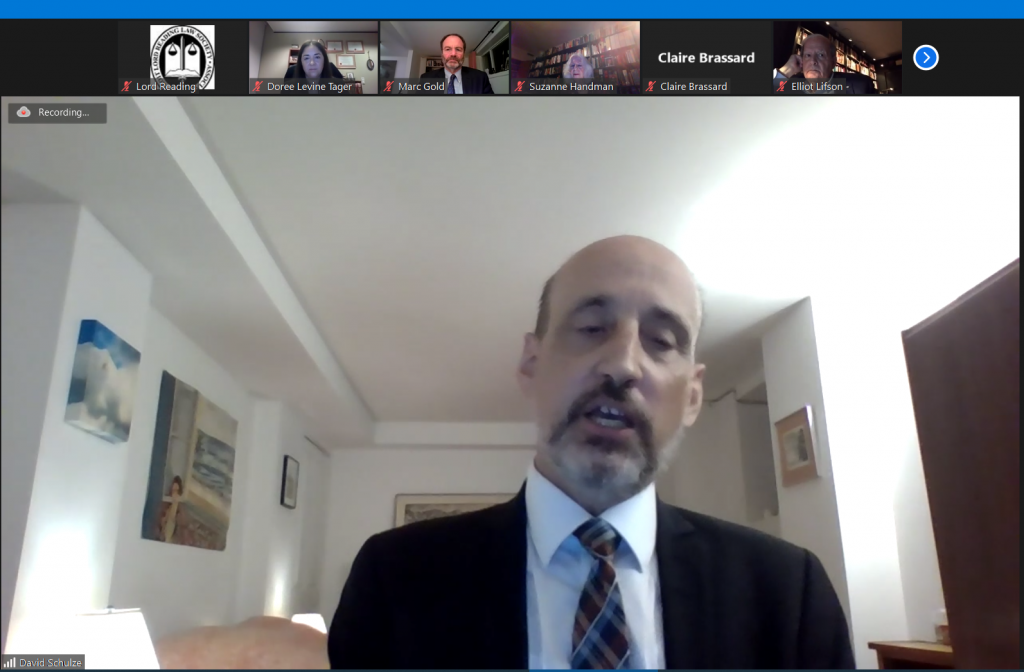
On October 13th, the Lord Reading Law Society held its annual Alan B. Gold Advocacy Lecture—this year featuring leading Aboriginal law expert David Schulze, who delivered a thought-provoking talk entitled “Reconciliation Goes to Court: Litigating the Indian Residential School Experience and Other Historic Abuse”.
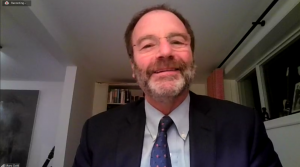
The late Chief Justice Gold’s son Senator Marc Gold opened the evening, while paying homage to his father’s legacy. Senator Gold shared an anecdote of watching the Grey Cup with his father, who “always rooted for the underdog”—much like our guest speaker Me Schulze, who has devoted his career to seeking justice for Indigenous peoples who have had to fight against forces determined to destroy their identity.

Prior to Me Schulze’s address, Chief Jean-Charles Piétacho of Ekuantishit, Assembly of First Nations Quebec-Labrador, presented deeply personal account of his experience at a residential school. The account was profoundly moving and provided ample material for reflection for all in attendance.

Me Schulze enumerated many abuses of members of First Nations and described several cases in which he has sought redress for evils committed in residential schools. Me Schulze provided a detailed background of the residential school history. He explained how First Nations members were often dispatched to institutions located great distances from their homes.

Our guest speaker provided us with a history lesson on the effects of the Indian Act and its provisions allowing for the displacement to residential schools. He recalled how he had expected to focus his practice on public law; yet when he began his career, his firm represented residential school survivors.

Me Schulze described the failure to disclose abuses at residential schools by Canadian authorities. While cases had been sent to RCMP for investigation, these were never really made public, a symptom of the attitude of the time.

He recounted how the residential school settlement came about. Numerous cases had gone to trial and the Supreme Court of Canada, which set out the liability (and the limits to the liability) of Canada and the Church, setting the stage for the settlement.

Me Schulze enumerated some of the details of the settlement, which encompassed almost 80,000 eligible claims. As he pointed out, “there were vastly more claims than Canada ever expected.” Canada made numerous “complicated and mean-spirited arguments”, according to Me Schulze, resulting in a number of payouts being held back. With that said, Me Schulze insisted he did not want to underrate what Canada achieved with the settlement.

On the other hand, the 2019 judgment in JW v Canada rendered by the Supreme Court provided ample evidence of the extent to which Canada was willing to go to in order to deny certain claims. Fortunately, J.W. emerged victorious, but Me Schulze provided other examples where the Government of Canada was reluctant to make payouts to survivors.

Me Schulze concluded by asking, “What was this all about”? Responding to his own question, he quoted renowned Métis writer Maria Campbell, who said, “We don’t need any more ‘sorrys’. We have closets full of sorrys. There is no Cree word for reconciliation. Only ‘kwayskahstahsoowin’ which means ‘setting things right.’ Restoring what is ours would set things right. Giving our land back would set things right.”

Our 2021 Alan B. Gold Lecture was held in the wake of our country’s first annual National Day for Truth and Reconciliation, which honours the lost children and Survivors of residential schools, their families and communities. As our guest speaker so ably described, public commemoration of the tragic and painful history and ongoing impacts of residential schools is a vital component of the reconciliation process.

It was a truly meaningful and moving evening at Lord Reading.

Mazel Tov!

The Society is delighted to recognize its distinguished past presidents, members and friends who were named avocats émérites for 2021 by the Barreau du Québec:

  • Past President Nancy Cleman
  • Member Sandra Abitan, who has also appeared on the Lord Reading stage
  • Past Lord Reading Speaker and friend of the Society Dean Robert Leckey of McGill’s Faculty of Law, whose Lord Reading talk Advocacy Notwithstanding the Notwithstanding Clause can be read here
  • Member Doreen Brown

Congratulations to all of you!

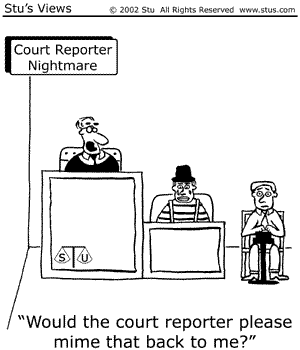
Society Humour

October 2021

Editors – Allen Mendelsohn, Larry Markowitz and Stephanie Perlis

President’s Message

Doree Levine, President

Dear Colleagues, Honourable Judges, and Friends of the Society,

When I embarked on the path to the presidency of the Lord Reading Law Society, I had visions of large reception halls filled with audiences eager to listen to fascinating speakers (while enjoying a nice end-cut!), small packs of old friends kibbitzing during cocktails, and young lawyers mingling with more seasoned members. Never would I have anticipated that we would not yet be back to our familiar format.

That said, the last 19 months or so have reaffirmed to me what many associated with the Society already knew – that behind the scenes of this organization is a veritable machine of incredible, creative, and loyal volunteer jurists who have helped our Society adjust, grow and strengthen during the most challenging of times. While it may sound trite, I could not be more indebted to the Board members and Executive for their time, dedication and wisdom in guiding me through these first few months. In particular, my predecessor Andrew Kliger has been a true leader and voice of reason as he passed the virtual torch after Lord Reading’s first (and hopefully only) full year of Zoom events.

Last year’s roster of intriguing speakers proved that, true to one of its main objectives, even on Zoom the Society can continue “to provide a stimulating and convivial forum for continuing legal education on matters of professional, topical or cultural interests”. My mission for this upcoming year is to maintain our tradition of top-notch speakers and compelling topics that will keep you engaged, challenged and even entertained. We anticipate remaining on Zoom for the first half of the season, but with the hope that 2022 might offer us a safe return to live events.

As you know, September 30, 2021 marked Canada’s first National Day for Truth and Reconciliation, a day honouring the hundreds of lost children and survivors of the residential schools, their families and their communities. A key component to the reconciliation process must involve public commemoration and awareness of not only the history, but the ongoing tragic impact of residential schools.

To that end, and to welcome you back, our first official lecture of the season is set for Wednesday, October 13, 2021 and will tackle that topic head on. The annual Alan B. Gold Advocacy Lecture will feature guest speaker David Schulze, an expert in aboriginal law. Me Schulze’s talk, entitled Reconciliation Goes to Court: Litigating the Indian Residential School Experience and Other Historic Abuse, will be preceded by a brief first-hand account by Chief Jean-Charles Piétacho, Innu Chief of Ekuantishit, Assembly of First Nations Quebec-Labrador. I invite all of you to register for this event by clicking here.

*****

Also true to its objectives to advocate and promote the advancement of human rights and fundamental freedoms, the Society has been particularly active over the last several months. In response to Quebec’s Bill 96—An Act Respecting French, the Official and Common Language of Quebec, the Lord Reading Law Society’s Human Rights Committee convened a drafting group, spearheaded by Human Rights Committee Chair Frank Schlesinger and Co-chair Robert Steinman, to prepare a brief highlighting the Society’s grave concerns for the future state of human rights and fundamental freedoms of all Quebecers, as well as their access to justice. The brief, which you can read here, was presented at the public hearings of the Quebec Community Groups Network (QCGN) on September 17, 2021, and subsequently widely circulated, also contained a critical analysis of Bill 96’s impact on the legal profession and the Quebec business community. We will continue to keep you apprised of our advocacy efforts throughout the season. I would like to thank all of our members who worked so hard on the brief and the presentation.

*****

By now, you will have received a notice inviting you to renew your annual membership in the Society, and we encourage you to do so immediately, prior to our first lecture. I wish to remind you that, for so long as our events are online on Zoom, they will be free for Members.

Members will have the opportunity to obtain at least 5 hours of CLE credit over the course of the season. They will also be eligible for several exclusive members-only events, including breakfast or lunch-time programming. Your membership dues allow us to continue to program excellent speakers, as well as to pursue our advocacy efforts on matters of human rights. They also ensure the financial health of our Society. You can pay/renew your membership online here.

Our active Young Bar Committee has brought a breath of fresh air to the Society with novel programming ideas. We encourage our younger members to join the committee and get involved by contacting me.

I look forward to announcing our roster of speakers and events in the coming weeks and months. In the meantime, I am eager to welcome you all at our opening talk on October 13, 2021.

With best wishes to you all for a healthy, happy and exciting year ahead,

Doree Levine, President
Lord Reading Law Society

International human rights legend Hillel Neuer addresses the Society – live from Geneva!

Larry Markowitz

May 26th marked the long overdue return of international human rights legend Hillel Neuer to the Lord Reading dais. Addressing our membership live from Switzerland, the Montreal native and McGill Law graduate delivered a compelling talk entitled, “On the Road to Durban IV: The UN, Human Rights and Israel”.

Mr. Neuer is the longtime executive director of UN Watch, a Geneva-based human rights NGO that advocates against discrimination, torture and injustice.

He is known around the globe for taking the United Nations to task; raising awareness of the UN’s double-standard when it comes to Israel, as well as its hypocrisy for having some of the world’s worst human rights abusers sit on its Human Rights Council.

His speech to the Society did not disappoint!

Mr. Neuer kicked off his presentation with a recap of the various UN conferences on racism, the first of which took place in Durban, South Africa in 2001 and which has been described by former Canadian Justice Minister Irwin Cotler as follows:

What transpired there was that a conference intended to be against racism turned into a conference against Israel and the Jews. A conference that was to commemorate the dismantling of apartheid in South Africa turned into a conference that called for the dismantling of Israel as an apartheid state.

(Professor Cotler was in the virtual audience for our May 26th event.)

The original Durban conference was followed by similar UN conferences in 2009 and 2011 that again scapegoated Israel. Canada pulled out of those conferences, which featured human rights abusers such as Libya on their organizing committee and hate-inciting speakers, such as former Iranian President Mahmoud Ahmadinejad.

A fourth UN “Conference on Racism” was slated for September 2021. Canada boycotted the event, as did several other Western countries.

UN Watch has taken to organizing parallel conferences for countries that boycott the UN’s Durban fiascos.

Mr. Neuer cited numerous examples of the singling out of Israel as a special human rights agenda item and the demonization of the Jewish state by the UN and its bodies over the years. Meanwhile, the UN has ignored human rights abuses against the Uyghurs in China, dissidents poisoned by Russia, artists arrested by Cuba, and political imprisonment of dissidents exercising free speech, such as Raif Badawi of Saudi Arabia—and one suspects our guest speaker could have gone on all day with further examples.

Despite the UN’s questionable track record on human rights enforcement, Mr. Neuer emphasized that UN Watch continues to believe in the United Nations and its founding principles. His desire is for the UN to fulfill its mandate, instead of being distracted by dictatorships.

While the UN will probably continue to demonize Israel and come up short on the enforcement of basic principles of international law, there are some hopeful developments. The Abraham Accords between Israel and several Arab states appear to be pointing toward more normalized relationship between Israel and the Arab co-signatories of those accords. While votes might not change at the UN, the tone of speeches at the world body, as well as the discourse behind closed doors, may become more reasonable where the Jewish state is concerned.

Lord Reading is grateful to have had the opportunity to hear from Hillel Neuer, a man who is not afraid to speak truth to power and hold the United Nations to account.

Additional photos from the event can be found on our Facebook page

Mazel Tov!

The Society is delighted to recognize its members who have reached certain anniversaries at the Barreau:

60 Years at the Barreau

Me Mark Abramowitz*
Me Earl H. Drymer*
Me Hershie Frankel
Me Brahm Gelfand
Me Gerald Y. Green
Me Martin Gross
Me Abraham M. Gurman
Me Israel H. Kaufman
The Hon. Pierre A. Michaud, Ad. E.*
Me Joel A. Pinsky
Me Jacob L. Rothman

*retired

50 Years at the Barreau

Me Philip E. Fine
Me Josef F. Fridman
Me Howard Jack Kaufman
Me Steven Korda
Me Zavie Levine
Me Stanley Reinblatt
Me Ian R. Rudnikoff
Me Brian M. Schneiderman
Me Harvey Earl Shaffer
Me Gérald Stotland
Me Rubin Strauber
Me Harvey Toulch

Congratulations to all of you. Your long and distinguished careers are an inspiration to the rest of us.

Society Humour


News from the Mispocha

Sincere Condolences

  • To the family of long-time Society member Thomas R. Davis
  • To the family of long-time Society member Earl Cohen
  • To the family of past Society speaker the Honourable Justice John Gomery

April-May 2021

Editors – Allen Mendelsohn & Larry Markowitz

President’s Message

Andrew Kliger, President

Dear Colleagues, Honourable Judges, and Friends of the Society,

These are busy times at Lord Reading and I’ve got a lot to talk about!

On April 6th, the Society hosted a captivating noontime lecture by Michal Cotler-Wunsh who joined us live from Jerusalem. Michal’s talk, entitled “Legislating in Israel: Language and Equality Rights and the Need for ICC Reform,” covered a dizzying array of legislative and political initiatives undertaken by Michal in just a short nine months in the Knesset. You can read more about the talk in Larry’s article further down in this newsletter.

During the same event, the Society was honoured to welcome our long-time friend and newly appointed Chair of the Canada-Israel Inter-Parliamentary Friendship Group, Anthony Housefather MP, who introduced Michal. Anthony is currently focusing a lot of his time with international parliamentarians combatting online hate, an incredibly important topic of our time and of great interest to Lord Reading. We hope to have Anthony return to us soon to address this topic in greater detail.

The April 6th lecture continued our longstanding tradition of hosting an event in conjunction with the Israeli consulate in Montreal, and we are grateful to David Levy, Consul General of Israel for Quebec and the Atlantic Provinces, for joining our event and thanking the guest speaker.

Liberation 75

I thought it was important to inform our members and friends of Liberation 75, the world’s largest international event to mark the 75th anniversary of liberation from the Holocaust, taking place from May 4th to 9th. Featured speakers include past speakers and friends of the Society, such as Justice Rosalie Abella, Professor Payam Akhavan, and Professor Irwin Cotler, O.C. I encourage you to click the link and find out more.

Upcoming Events

1. Young Bar Committee – Alternative Careers in Law

Next week, on May 5th, the Young Bar Committee of Lord Reading is hosting a unique panel discussion entitled “Le droit mène à tout: Alternative Careers in Law,” which is open to everyone, and free for everyone except for senior non-members. The panel will feature three lawyers who have forged unique career paths outside the traditional law firm. The outstanding lineup of speakers is:

  • Bonnie Frank, Vice-President, Enterprise Risk and Crisis Management, at the Public Sector Pension Investment Board (PSP Investments),
  • Catherine McKenzie, litigator turned best-selling author, and
  • Larry Markowitz, corporate lawyer turned entrepreneur and Senior Advisor at NATIONAL, Canada’s largest public relations firm (and Past President of the Society).

We are looking forward to a dynamic discussion with the speakers and encourage questions from the audience. Back by popular demand, we will be commencing the event at 5:30 pm with breakout rooms on Zoom, so that our members, guests and panelists will have a chance to speak informally and share a virtual cocktail prior to the event itself at 6:00 pm. You can sign up here.

2. Hillel Neuer returns!

Lord Reading is excited to announce the long-overdue return of a giant in the world of international human rights, Hillel Neuer, Executive Director of UN Watch, will present a talk entitled “On the Road to Durban IV: The UN, Human Rights and Israel,” which will take place May 26th at 12:00 noon. UN Watch is a human rights NGO based in Geneva, Switzerland. Hillel advocates tirelessly against discrimination, torture and injustice. A graduate of McGill’s Faculty of Law, he is especially known for taking the UN to task; raising awareness of the UN’s double-standard when it comes to Israel, as well as its hypocrisy for having some of the world’s worst human rights abusers sit on the Human Rights Council.  We look forward to hosting this renowned speaker and invite you to learn more about Hillel and UN Watch on their website. Registration will open soon.

We would like to sincerely thank Robinson Sheppard Shapiro for their generous sponsorship of this event.

As usual, all of these events will be CLE-accredited by the Barreau du Québec and the Chambre des Notaires.

Bill 21

On Tuesday, April 20, 2021, the Honorable Marc-André Blanchard rendered his judgment in the Bill 21 (“Charte de la Laicité”) file. In his 242 page judgment, Justice Blanchard deplored many aspects of the law, ruling that the law violates fundamental freedoms, legal rights and equality rights enshrined in the Canadian Charter (sections 2 and 7 to 15), and that these violations cannot be saved by s. 1 of the Charter. However, the law was held to be mostly valid, based on its use of the Notwithstanding Clause (s. 33 of the Charter).

Though we are disappointed with the outcome, the Society owes a great debt of gratitude to its Past President Ted Goloff, for his excellence and dedication in preparing for and pleading Lord Reading’s challenge of this law. We are proud of his work and the team that lent assistance. Lord Reading is currently considering its options vis-à-vis an appeal.

Barreau Elections

Don’t forget to vote! Voting in the Barreau du Québec elections begins on May 4th and will continue through May 14th. You can find more information on the Barreau’s election website.

I would like to thank the two candidates for Bâtonnier(ère), Me Antoine Aylwin and Me Catherine Claveau for graciously taking the time to speak with our members last week. We wish them the best of luck in the election.

I would also like to thank Me Julie Mousseau and Me Jonathan Pierre-Étienne for their letters to our members in connection with their candidacies for the First Councilor position at the Montreal Bar; we appreciate that they took they time to write to us. I congratulate Me Mousseau on her victory, and look forward to working with her and the entire Montreal Bar Council.

*****

Well that about wraps it up! I look forward to seeing all of you (virtually) on May 5th at 5:30 pm and on May 26th (exceptionally) at 12:00 noon and I encourage you to register for the May 5th event if you have not already done so which you can do here.

I wish everyone the best of health, and hope that you remain in good spirits during these challenging times.

Andrew Kliger, President
Lord Reading Law Society

MK Michal Cotler-Wunsh: Legislating in Israel

Larry Markowitz

At a special lunch hour meeting of the Society held on April 6th, Lord Reading was pleased to welcome Member of the Knesset Michal Cotler Wunsh – live from Israel!

A graduate of the law faculties of both Hebrew University and McGill, Ms. Cotler-Wunsh covered a range of topics relating to human rights and Israeli politics in rapid succession.

Declaration of Independence must be anchored in law

She began by pointing out that Israel is a young state whose basic law has yet to be codified in constitutional form.

The 1948 Declaration of Independence must be “anchored in law” to protect the rights of all citizens, she said. A vital discussion that must precede any such exercise surrounds the question: What does it mean for the State of Israel to be Jewish and democratic? This matter has yet to be adequately addressed because, since the State’s founding, Israeli leadership has been focused on the “urgent” to the detriment of long-term planning.

However, in contrast to the perception we may have of Israeli politics being polarized, Ms. Cotler-Wunsh argued that, “Eighty per cent of Israelis agree on 80 per cent of the issues, 80 per cent of the time.” There is hope.

International Criminal Court

MK Cotler-Wunsh then briefed us on the recent International Criminal Court announcement that its jurisdiction extends to the Palestinian territories.

In her view, this decision runs counter to the ICC’s foundational principles. The ICC was not designed to hear cases emanating from a country like Israel, with its renowned legal system and sophisticated judiciary. Rather, the ICC is meant to be the court of last resort for war crimes.

Israel asserts that the Israel Defense Forces prosecution is capable of investigating actions by the military, thus obviating the need for the international court to intervene.

To assume jurisdiction in this case, the ICC performed “legal acrobatics”, meaning it violated its chief principle of complementarity, which holds that the court should respect the investigations conducted by states and not seek to repeat or supersede such probes, ignoring fundamental principles of international law.

Going forward, our guest speaker urged Israel to employ the lingua franca of international human rights in order to make its messaging more accessible.

Online Hate

Ms. Cotler-Wunsh then touched on her efforts, in conjunction with parliamentarians around the world, to combat online anti-Semitism. She characterized this phenomenon as a global problem that requires a global response.

Part of the solution is to educate the public, rather than simply censoring them, in her view. The other important point is to define what constitutes online anti-Jewish hate in the first place. The International Holocaust Remembrance Alliance (IHRA) Working Definition of Antisemitism, a consensus definition arrived at over the past 20 years, is Ms. Cotler-Wunch’s preferred tool for this purpose.

The Abraham Accords

Finally, our guest speaker spoke in hopeful terms about the recently signed Abraham Accords, under which Israel normalized relations with the United Arab Emirates and Bahrain, subsequently adding normalization with Sudan and Morocco to the list. She cited examples of numerous Israelis travelling to the UAE, at least half of whom have been Israeli Arabs. This, she said, suggests that the accords will lead to a warm peace between peoples and not merely a formal peace on paper between governments.

Ms. Cotler-Wunch shared with us a positive anecdote in support of this view, describing how she hosted a group of influencers from the UAE for a Hanukkah celebration, terming the event a “fundamental moment of understanding”.

* * *

Friend of the Society Anthony Housefather, Member of Parliament and Chair of the Canada-Israel Inter-Parliamentary Friendship Group, introduced our guest speaker, describing their collaborative efforts to combat online anti-Semitism, among other shared projects.

She was thanked by David Levy, Consul General of Israel for Quebec and the Atlantic Provinces—also a long-time friend of Lord Reading.

This special mid-day session of the Society was thought-provoking and informative, and left us with a positive outlook for the future of Israel—both domestically and in its relations with neighbours both near and far.

Additional photos from the event can be found on our Facebook page

The Lord Reading Career Committee Has Been Relaunched

After a brief hiatus, the Lord Reading Career Committee is back!

All Society members and friends are encouraged to share paid employment opportunities for summer student or stagiaire positions with careers@lordreading.org. If you are a student looking for opportunities, we also encourage you to contact us.

We look forward to sharing more updates with you in the coming months.

Anna Bronshteyn, Chair
The Lord Reading Career Committee

Society Humour

News from the Mispocha

Mazel Tov

  • To former member of Lord Reading the Honourable Justice Peter Kalichman on being named to the Quebec Court of Appeal

Sincere Condolences

  • To Society Board member Robert Rapp, his wife Lisa and their entire family on the sudden passing of his father-in-law Dr. Samuel Israelovitch

April 2021

Editors – Allen Mendelsohn & Larry Markowitz

President’s Message

Andrew Kliger, President

Dear Colleagues, Honourable Judges, and Friends of the Society,

In the midst of Passover, I am pleased to inform our members about a flurry of activity for Lord Reading this spring.

On March 10th, we hosted our Annual Student Event, featuring Professor Frederick Schauer as our keynote speaker. The event began with a new twist – the use of Zoom “breakout rooms”. This feature allowed our members and guests, including our guest speaker, and professors and students from various law faculties, to interact and share a virtual cocktail in small groups, prior to the main event. Although nothing can replace our in-person dinners, this feature allows us to have some semblance of the collegiality and discussions that our members look forward to at our in-person events. We will continue with this practice going forward for our evening events.

During the March 10th event, we also presented awards to deserving students from the law faculties of the Université de Montréal, University of Ottawa, Université de Sherbrooke and UQAM. We were glad to help make it a special evening for the winners and for them to get to know our Society, and vice versa.

Professor Schauer captivated our audience with his insight on the shifting politics of freedom of expression, and provided hypotheses on why free speech is being championed more and more by those to the right side of the political spectrum. The Q&A period allowed our members to press Professor Schauer on this topic, including on former President Trump’s ban from Twitter, as well as his alleged incitement of the January 6, 2021 insurrection on the Capitol. The evening was also made special by opening remarks from Professor Martine Valois of the Université de Montréal, who was Professor Schauer’s student at Harvard. And to bookend the evening, Dean Robert Leckey of the McGill Faculty of law thanked our speaker.

On Tuesday, April 6th (exceptionally at 12:00 noon), Lord Reading is pleased to welcome outgoing Member of the Knesset Michal Cotler Wunsh – live from Israel! A graduate of the law faculties of both Hebrew University and McGill, Ms. Cotler-Wunsh is an engaging speaker, just like her father, Irwin. Her talk entitled “Legislating in Israel: Language and Equality Rights and the Need for ICC Reform” will cover two broad topics: First, her legislative proposals in the Knesset on language and equality rights, themes that are also relevant in Quebec law and politics. Second, MK Cotler-Wunsh will provide a briefing on the recent International Criminal Court judgment against Israel and will discuss how this decision represents an affront to the Court’s foundational principles.

We are pleased to announce that Anthony Housefather, MP and newly appointed Chair of the Canada-Israel Inter-Parliamentary Friendship Group, will be introducing our speaker. Furthermore, the speaker will be thanked by David Levy, Consul General of Israel for Quebec and the Atlantic Provinces.

On May 5th, our Young Bar Committee is hosting an event on alternative careers in law that is open to all members. An official title and invitation will be sent shortly, but the evening will feature a panel of three speakers – all lawyers – who have forged unique careers away from the conventional law firm setting:

  • Bonnie Frank, Vice-President, Enterprise Risk and Crisis Management, at the Public Sector Pension Investment Board (PSP Investments),
  • Catherine McKenzie, former litigator turned best-selling author, and
  • Larry Markowitz, corporate lawyer turned entrepreneur and Senior Advisor, Financial Communications and Investor Relations at NATIONAL, Canada’s largest public relations firm (and Past President of the Society).

In the next couple of weeks, we will be announcing another event, and perhaps two, for late spring, so please stay tuned. As usual, all of these events will be CLE-accredited by the Barreau du Québec and the Chambre des Notaires.

I look forward to seeing you all (virtually) on April 6th (at 12:00 noon!) and I encourage you to register if you have not already done so, which you can do on our website.

I wish everyone a Happy Passover and a Happy Easter and the best of health, and hope that you remain in good spirits during these challenging times.

Andrew Kliger, President
Lord Reading Law Society

The (Shifting) Politics of Freedom of Expression

Larry Markowitz

On March 10th, we held our Annual Student Event, at which we were delighted to welcome Professor Frederick Schauer, the David and Mary Harrison Distinguished Professor of Law of the University of Virginia, and former professor of the First Amendment at Harvard Law School.

Professor Schauer’s talk documented the shift in the politics of freedom of expression. He presented a series of hypotheses about freedom of expression and modern politics explaining why long-familiar alignments surrounding freedom of expression have shifted dramatically in recent years.

While free speech advocacy once came primarily from the left flank of the  political spectrum, our guest speaker posited that nowadays the loudest advocates for free speech tend to come from right of centre.

In the United States, the First Amendment prevents the government from making laws that would abridge the freedom of speech. In the 1950s and 1960s, the First Amendment was often cited in defence of socialists and pacifists, and the excluded and dispossessed. Indeed, many free-speech claims of that era involved civil rights and anti-Vietnam War protests, where it was easy for the left to sympathize with the speakers or believe that speech in general was harmless.

As the 1970s rolled around, there was a shift and the First Amendment started to become a weapon of the powerful and tyrannical, providing a shield for Nazis, Klansmen and other racists, and in a less extreme context, for corporations trying to influence elections.

Our guest speaker cited a 1978 Illinois decision permitting neo-Nazis to march through the Village of Skokie, where many Holocaust survivors resided. The concept of freedom of speech that had once been used to defend political dissenters was effectively hijacked by Neo-Nazis in this example.

“I disagree with what you say, but I will defend to the death your right to say it”

Admittedly, the United States has always been somewhat of an outlier in the extent to which freedom of speech arguments can be taken. In the US, process-driven arguments are more likely to prevail in the defence of morally objectionable content than in Canada.

However, according to Professor Schauer, even in Canada, defenders of free speech once tended to come from the left, but are now more likely to come from the right of centre. One can think of those who are fighting against cancel culture, political correctness, and other examples of what they perceive to be limitations on free speech propagated by the left.

Why this shift? Why are the greatest defenders of freedom of speech now more likely to come from the right?

Intellectual conservatism has shifted from communitarian values to libertarian values.

The Irving Kristols and William F. Buckleys of the 1950s and 1960s stood for community values and advocated a role for government in enforcing collective morality. In contrast, today’s libertarians wish to minimize the government’s role. Libertarians advocate a free market for ideas and the freedom of businesses to do as they please with minimal government oversight.

Also, modern communication tools have illuminated the importance of having the loudest voice. The corporation that buys the most advertising to influence elections has the most effect.

“People now realize that, in the marketplace of ideas, it helps to own the store!”

There is now an alignment of economic libertarianism and free speech libertarianism.

***

Freedom of speech is a second-order value. It is not a matter of good versus bad. In the past, arguments around freedom of expression tended to be about process rather than substance. However, nowadays, we are less likely to hear process-based arguments in defence of the freedom to spew questionable content.

Many on the left have traded an absolutist commitment to free speech for one sensitive to the harms it can inflict. In 1977, many liberals supported the right of the American Nazi Party to march among Holocaust survivors in Skokie, Illinois. Far fewer supported the free-speech rights of the white nationalists who marched in 2017 in Charlottesville, Virginia.

***

In thanking Professor Schauer, McGill Dean of Law Robert Leckey remarked that he envied our guest speaker’s students who have the good fortune of hearing from him about the fascinating and ever-shifting concepts surrounding freedom of speech on a regular basis.

We were indeed fortunate to have the opportunity to get a taste of Professor Schauer’s high level of scholarship and his engaging manner, if only for an hour.

**********

A set of photos from the evening can be found on our Facebook page

Comings and Goings at the Barreau – Get involved!

Allen Mendelsohn

The Society urges all of our members and friends to get involved in both the Barreau du Québec and Barreau de Montréal in the following ways:

  • You will be able to vote in the Barreau du Québec elections beginning May 4. Here is the list of candidates currently running. We encourage everyone to vote!
  • The Barreau de Montréal is currently accepting nominations for various positions on its Council. The deadline is today at 4:00 P.M., however, so act fast!
  • The Barreau de Montréal also offers numerous possibilities for volunteering on a variety of committees. Here is the form to fill out if you are interested, and we encourage you to do so!

Events of Interest

Allen Mendelsohn

  • Our sister society in Ottawa, the Bora Laskin Law Society, is pleased to host Mr. Anthony Julius in online Conversation with University of Ottawa Law Dean of Common Law Adam Dodek on April 29, 2021 at 12:30 PM. Mr. Julius is a UK lawyer and the Deputy Chairman of the global law firm Mishcon de Reya, based in London. He is a noted author and academic. Among other things, he is known for representing the late Princess Diana as well as Prof. Deborah Lipstadt in Irving v. Penguin Books inc.. You can RSVP by emailing laskinsociety@gmail.com;
  • Liberation75, the world’s largest international event to mark the 75th anniversary of liberation from the Holocaust, will take place online May 4th through May 9th. Featured speakers include past speakers and friends of the Society such as Justice Rosalie Abella, Professor Payam Akhavan, and Professor Irwin Cotler, O.C., as well as our April 6th speaker Michal Cotler-Wunsh and MP Anthony Housefather, among numerous other dignitaries. Registration is free and open to all.


Society Humour

News from the Mispocha

Mazel Tov

  • To Society Board member Judge Carol Cohen on the birth of her grandson, Lenox Duncan Dawson;
  • To Past President Sharon Druker Ad. E., lifetime member Irwin Cotler O.C., Ad. E., and friend of the Society Professor Hugo Cyr, Ad. E. on being named Avocat émérite (Ad.E.) by the Barreau du Québec;
  • To friend of the Society Anthony Housefather, M.P., on being named Chair of the Canada-Israel Inter-Parliamentary Friendship Group.

March 2021

Editors – Allen Mendelsohn & Larry Markowitz

President’s Message

Andrew Kliger, President

Dear Colleagues, Honourable Judges, and Friends of the Society,

With spring around the corner and vaccines on the horizon, I expect that our collective mood is on the cusp of brightening.

We kicked off 2021 with an exciting lecture from international lawyer Robert Laurie, whose talk Psychedelics: An Introduction to the ‘Rabbit Hole’ for Canadian Lawyers educated our audience about the evolving regulatory framework and legal obstacles surrounding psychedelic substances. He was accompanied by Trevor Millar, Chairman of the Multidisciplinary Association of Psychedelic Studies (MAPS) Canada. The two speakers explained their advocacy for the legalization of certain substances that can assist those with mental health issues. Their talk also explored constitutional law arguments regarding these substances, including freedom of conscience and religion. We hope all who attended enjoyed this novel lecture. You can read more about it in Larry’s article below.

As many of our members likely heard, there was also some unfortunate news since our last update. On January 13th, Lord Reading’s physical home, the Shaar Hashomayim synagogue, was attacked by a vandal who painted swastikas on its doors and tried to set the building on fire with a gasoline cannister. Thankfully, the synagogue’s security team quickly sprang into action and the police arrested the perpetrator before he could inflict further damage. Lord Reading condemns this cowardly act of hate in the strongest language possible and stands in solidarity with the Shaar Hashomayim congregation and staff. A letter of support was sent to Rabbi Scheier.

I am pleased to report some exciting events coming up at Lord Reading, so please mark your calendars.

On Wednesday, March 10th, we will be holding our Annual Student Event, at which we are delighted to welcome guest speaker Professor Frederick Schauer, the David and Mary Harrison Distinguished Professor of Law of the University of Virginia. Professor Schauer was previously, for nineteen years, the Frank Stanton Professor of the First Amendment at Harvard University. His talk will document the shift in the politics of freedom of expression and will offer a series of hypotheses about freedom of expression and modern politics that might explain why long-familiar alignments surrounding freedom of expression have shifted dramatically in recent years. Professor Martine Valois of the University of Montreal and Dean Robert Leckey of McGill University will also be making remarks.

During this event, we will hand out our annual student awards to recipients from various Quebec and Ontario law schools, beginning at 6:00 pm. Prior to that hour, we will organize “break-out rooms” on Zoom starting at 5:30pm, where we will meet and greet students from various law schools. We encourage all of you to join at 5:30 to make this a special night for the students! You can register for the evening here.

On Tuesday, April 6th (exceptionally at 12:00 noon), Lord Reading is pleased to welcome Member of the Knesset Michal Cotler Wunsh—live from Israel! A graduate of the law faculties of both Hebrew University and McGill, Ms. Cotler-Wunsh is an engaging speaker, just like her father, Irwin. More details about this event will be made available soon.

In the coming days, we will be announcing an event in late March or early April, to be hosted by the Young Bar Committee, but open to all Lord Reading members, so please stay tuned. It will feature a panel of lawyers who have pursued unique career paths and who work outside the conventional firms.

As usual, all of these events will be CLE-accredited by the Barreau du Québec and the Chambre des Notaires.

Please stay tuned for still more events, including more members-only events.

I look forward to seeing all of you (virtually) on March 10th and I encourage you to register if you have not already done so.

I wish everyone the best of health and that you remain in good spirits during these challenging times.

Andrew Kliger, President
Lord Reading Law Society

Lord Reading Takes a Psychedelic Trip!

Larry Markowitz

It is not often a Lord Reading event begins with a disclaimer. However, on January 21st, Society President Andrew Kliger kicked off the evening by warning us, “Some of the compounds and substances to be discussed this evening are prohibited in Canada, and Lord Reading is not endorsing the use of any substances that are currently illegal.”

On that unusual note, we opened 2021 with a discussion on psychedelics, a subset of hallucinogenic drugs whose primary effect is to trigger non-ordinary states of consciousness (known as psychedelic experiences or “trips”).

We welcomed West Coast attorney Robert Laurie, whose practice focuses on commercial business and regulatory issues surrounding cannabis and psychedelic plant medicines. Mr. Laurie addressed us via Zoom from his home on Vancouver Island and was accompanied by his Vancouver-based colleague Trevor Millar, Chair of the Board of the Multidisciplinary Association of Psychedelic Studies (MAPS) Canada, and the recently appointed Chief Psychedelic Officer of NeonMind Biosciences Inc.

Drawing on the history and experience of cannabis legalization in Canada, Mr. Laurie’s lecture, entitled Psychedelics: An Introduction to the “Rabbit Hole” for Canadian Lawyers, discussed how Canadian Law is positioned to address the constitutional and regulatory issues surrounding psychedelics.

Mr. Laurie recounted his advocacy efforts in support of the legalization of hallucinogenic substances which he claims can assist those grappling with mental health issues. His presentation also explored human rights-based arguments favouring the use of psychedelics, including several founded on freedom of conscience and religion.

The talk was followed by a Question-and-Answer session, ably moderated by our President. Mr. Laurie was thanked by Society member Julie Schlesinger-Svarc.

The evening of January 21st was a true eye-opener on a unique subject that broke new ground for the Society!

**********

A set of photos from the evening can be found on our Facebook page

The Society Mourns A Past President

Allen Mendelsohn

The Society was devastated to hear the very sad news that our beloved colleague and devoted Past President, Julian Kolter, Q.C., passed away on February 11th. Julian was a founder of the firm Phillips Friedman Kotler, where he had a long and distinguished career.

Julian served as Lord Reading’s President during the 1982-1983 season. His term as President was marked by the historic event of the Society being officially recognized by the Barreau du Québec as an institutional organization, allowing Julian to officially participate in the planning and execution of the annual Barreau convention, and official involvement in other Barreau matters.

Julian was also a dear friend to many of us. The Society extends our deepest condolences to his wife, Elaine, and to his entire family.

Society Humour

News from the Mispocha

Mazel Tov

  • We congratulate and wish a hearty mazel tov to Society Board member Judge Morton Minc on becoming a first-time grandfather. His daughter, Dr. Samantha Minc Steele recently gave birth to a baby girl, Sarah.

January 2021

Editors – Allen Mendelsohn & Larry Markowitz

President’s Message

Andrew Kliger, President

Dear Colleagues, Honourable Judges, and Friends of the Society,

I want to wish everyone a happy, healthy and safe New Year. Although it’s become a bit clichéd at this point to suggest that 2021 can only be better than 2020, here’s hoping that it will soon become a reality. Although the news cycle over the last year has been largely negative, and for good reason, I sincerely hope that Lord Reading’s programming continues to serve as a welcome respite.

At the outset, I wish to address the January 12th incident of vandalism at the Shaar Hashomayim. This was a most heinous anti-Semitic attack, carried out in broad daylight. I was devastated to learn the news.  We stand in solidarity with the entire congregation at the place we proudly call home. As President, I have sent a letter to Rabbi Scheier on behalf of the Society expressing our support and offering any assistance that may be needed.

*****************************************

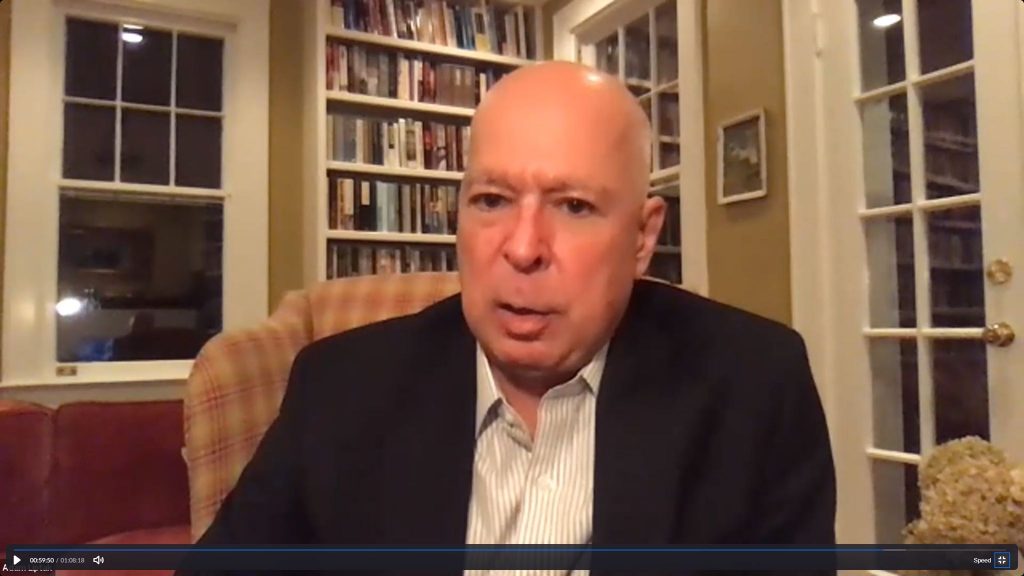
On October 20, 2020, the Society hosted a lecture by New York Times Supreme Court reporter Adam Liptak, who provided an enthralling and timely account of the US Supreme Court moving further to the right, following the recent passing of Justice Ruth Bader Ginsburg and the subsequent nomination of Amy Coney Barrett to the Court. We were fortunate to have an extensive Q&A period. A theme emerged in which our audience seemed to be frustrated by the US Supreme Court being divided based on political lines, but also grateful that the Canadian Supreme Court, in contrast, strives to simply apply the rule of law, without such a divide.

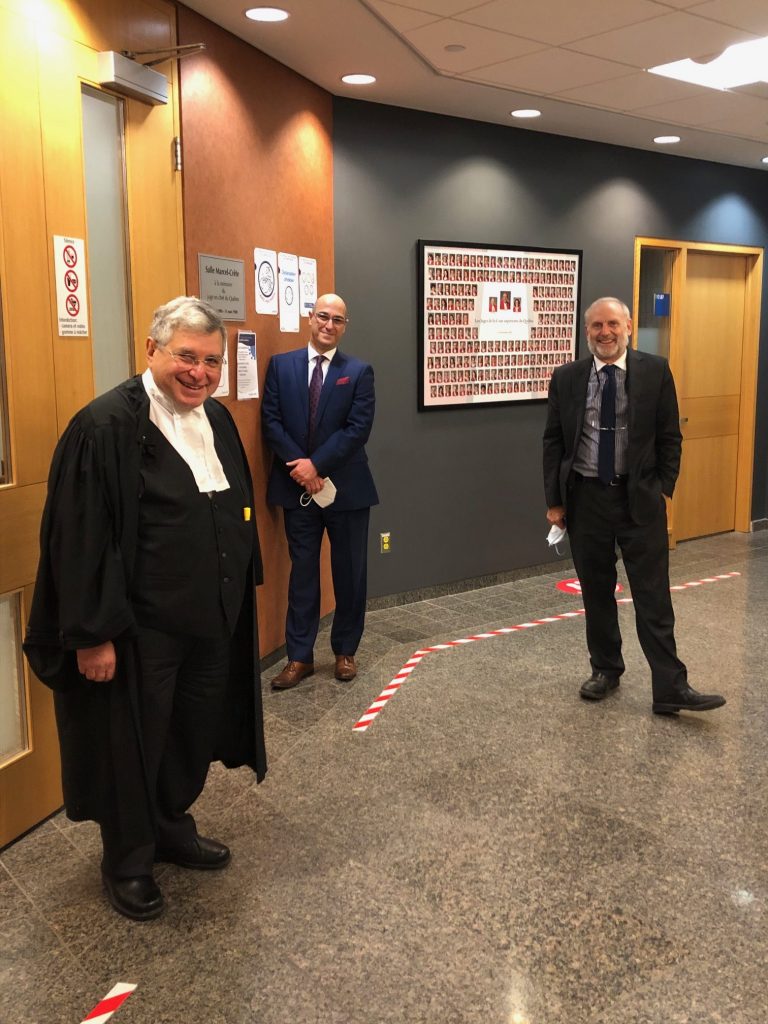
On December 2, 2020, Lord Reading had its opportunity to present oral arguments before the Superior Court of Quebec in the challenge to Bill 21. Our Past President and distinguished member Theodore Goloff represented the Society before the Court with a combination of skill, dignity and honour. Teddy argued the illegality of Bill 21, its disastrous effects and that it ought to be struck down, notwithstanding the invocation of the notwithstanding clauses of the Quebec and Canadian Charters. He also cited the “Hart Act” of 1832 that emancipated Jews in the Province of Quebec, the effects of which cannot be struck down by Bill 21. We congratulate and thank Teddy for his tremendous efforts. Judge Blanchard stated that he would likely not render judgment until the end of February at the earliest. Here is a photo of Teddy at court just after pleading along with immediate Past President Greg Azancot and Human Rights Chair Frank Schlesinger:

On December 3rd, Mtres Robert Steinman and Heather Michelin presented a lunch time members-only talk Of Plagues and Policy: Immigration Law & COVID-19. This was a highly informative and timely lecture, in which they discussed immigration, work permits, business travel, consular services and quarantine related to Canada, the US and abroad.

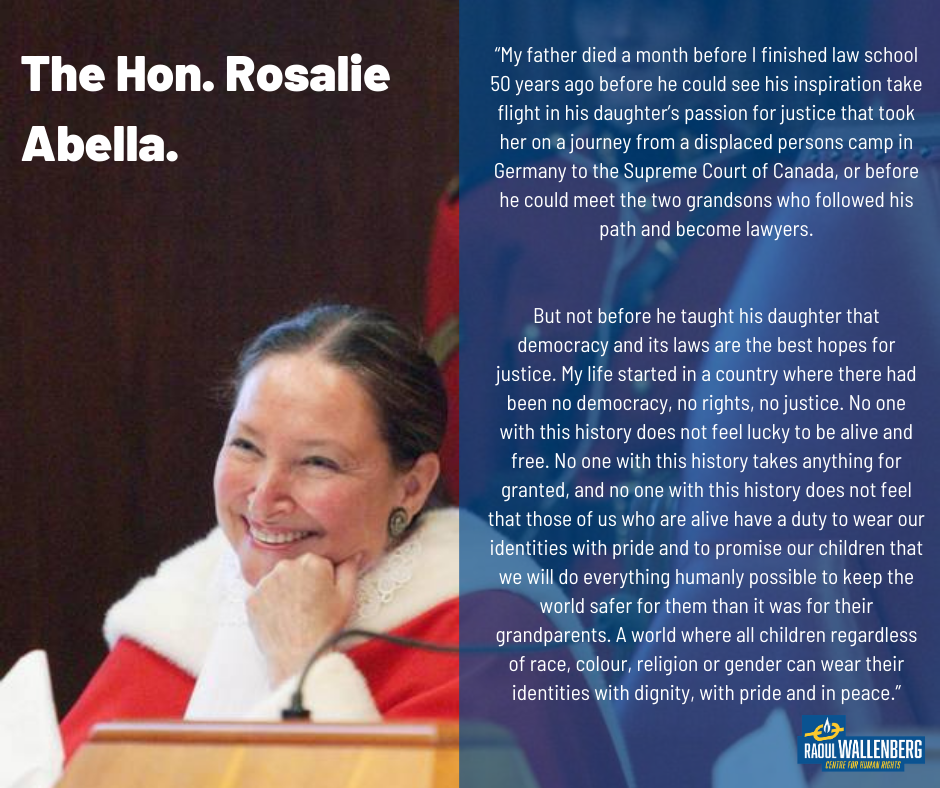
On December 9, 2020, Genocide Prevention Day, we were most fortunate to co-present the Inaugural Elie Wiesel Lectureship in Human Rights alongside the Raoul Wallenberg Center for Human Rights, the McGill University Faculty of Law, the University of Montreal Faculty of Law and the International Bar Association’s Human Rights Institute. The featured speaker was the Honourable Justice Rosalie Abella of the Supreme Court of Canada, who presented an incredibly moving, memorable and important lecture entitled “Reflections on the Legacy of the Holocaust.”

Justice Abella provided a dire warning of our collective failure to prevent genocide since the Holocaust. But she also shared some insight on how we may strengthen international conventions in the field of human rights with laws that are universally shared and enforceable, so that further genocides and mass atrocities may be prevented, and human rights abusers are brought to justice. We encourage anyone who has not seen this most important lecture to view it here: https://youtu.be/23F7W8kWKow

Our next event is this Thursday, January 21st, when we welcome Vancouver-based attorney Robert Laurie, whose practice focuses on commercial business and regulatory issues surrounding cannabis and psychedelic plant medicines. Holder of a Masters (Juris) from the University of Oxford, he sits on the advisory board of the Multidisciplinary Association for Psychedelic Studies (MAPS). His lecture, entitled Psychedelics: An Introduction to the “Rabbit Hole” for Canadian Lawyers, will consider how Canadian law, based on the history and experience of cannabis legalization in Canada, is positioned to meet and address the constitutional and regulatory issues concerning psychedelics. It is sure to be an eye-opener on this unique subject.

On Thursday, February 25, 2021, we are hosting our annual “Student” event, when we will be awarding the annual Lord Reading prizes to top law students from various law faculties in recognition of their academic achievement during the 2019-2020 academic year. Our guest lecturer will be Professor Frederick Schauer, a renowned constitutional law professor at the University of Virginia focusing on the First Amendment to the United States Constitution, which protects freedom of speech, the press, assembly, and the right to petition the Government for a redress of grievances. His talk will cover the current climate in respect of freedom of expression on campuses, online and in public discourse. With President Trump’s recent Twitter ban and the rise of “Cancel Culture”, we look forward to this intriguing event.

As usual, all of these events will be CLE-accredited by the Barreau du Québec and the Chambre des Notaires.

Please stay tuned for other events for March and beyond, which will be announced soon, including more members-only events.

I look forward to seeing all of you (virtually) on January 21st and I encourage you to register if you have not already done so.

I wish everyone the best of health and that you remain in good spirits during these challenging times.

Andrew Kliger, President
Lord Reading Law Society

The Honourable Justice Rosalie Abella: “Reflections on the Legacy of the Holocaust”

Larry Markowitz

On December 9th, the Lord Reading Law Society had the honour of co-presenting, with The Raoul Wallenberg Centre for Human Rights, the inaugural Elie Wiesel Lecture in Human Rights, featuring Canadian Supreme Court Justice Rosalie Abella, with introductory remarks from former Justice Minister Irwin Cotler.

In a powerful and emotionally charged speech delivered from her chambers at the iconic Supreme Court Building in Ottawa, Madam Justice Abella reflected on her upbringing as the child of Holocaust survivors who imbued her with a great respect for justice and human rights.

She forcefully chastised the international community for failing to live up to the precepts of the Convention on the Prevention and Punishment of the Crime of Genocide and the Universal Declaration of Human Rights—documents produced in the wake of the Second World War—and the promise of justice represented by the Nuremberg trials of Nazi war criminals.

Soon after Nuremberg, prosecutions of war criminals waned. The western world became more concerned with fighting communism than trying war criminals.

In the ensuing three-quarters of a century, the international community has repeatedly failed to prevent human rights abuses.

Recalling that the atrocities of the Nazi era all took place legally under German laws, Madam Justice Abella reminded us that we need more than the rule of law; we need rules of justice to promote core democratic values. And those values extend far beyond simply holding elections. They include the right to due process, freedom of expression and freedom of association.

Why is it that international trade laws under the World Trade Organisation quickly became enforceable, while the same cannot be said for international human rights law?

“Why hasn’t the Holocaust created a thirst for enforceable international norms to combat ongoing human rights abuses?” pleaded Justice Abella.

The United Nations was established in the wake of the Holocaust to send the message of “Never Again”, yet atrocities have occurred “again and again”: Forty million people have died in conflicts since the UN was established. More often than not, the perpetrators of modern-day slaughter, abuse and exploitation have not feared—and have not faced—a Nuremberg-like trial. We need more than words of justice; we need justice itself.

We must see the world from the point of view of the vulnerable. Too many rights go unrecognized; too many people are killed; too many go hungry; and too many have lost hope.

In a deeply personal and emotional conclusion to her talk, Justice Abella implored her audience of jurists to give effect to the words of her late father, who had studied law in Poland, but was never able to join the profession in Canada because he was not a citizen. In an important message imparted upon his daughter, he said that democracy and its laws are the best hope for justice.

“My life started in a country where there had been no democracy, no rights, no justice,” said Justice Abella, who was born in a displaced persons camp in Stuttgart, Germany in 1946. “No one with this history does not feel lucky to be alive and free. No one with this history takes anything for granted and no one with this history does not feel that those of us who are alive have a duty to wear our identities with pride and to promise our children that we will do everything humanly possible to keep the world safer for them than it was for their grandparents, a world where all children regardless of race, colour, religion or gender can wear their identities with dignity, with pride and in peace.”

**********

If you missed this important speech, we strongly recommend you set aside some time to listen to it. A recording may be found here:  https://youtu.be/23F7W8kWKow

New York Times Supreme Court Reporter Adam Liptak: A Reporter’s Reflections

Larry Markowitz

On October 20th, on the occasion of our annual Alan B. Gold Advocacy Lecture, we welcomed Adam Liptak, Supreme Court reporter and columnist for the New York Times, for a captivating talk entitled, “The Roberts Court in the Trump Era: A Reporter’s Reflections.”

In his timely address, delivered from his home in Washington, DC only days after the passing of esteemed liberal justice Ruth Bader Ginsburg, Mr. Liptak explored a United States Supreme Court in transition and the unusual role of Chief Justice John Roberts as both the Court’s leader and its ideological fulcrum.

After being introduced by the late Chief Justice Gold’s son, the Honourable Senator Marc Gold, Mr. Liptak provided context on the evolution of the U.S. Supreme Court.

Mr. Liptak lamented a certain lack of diversity on the modern-day Supreme Court, with nearly all current justices being graduates of either Harvard law school or Yale Law School. (Interestingly, the newest justice, Amy Coney Barrett, represents diversity of a sort, as she graduated from the University of Notre Dame).

It is also very common for modern-day justices to have clerked at the Supreme Court.

This lifetime of preparation for the highest court, through choosing the right law school and the seeking the right clerkship, contrasts with the composition of the Supreme Court of previous generations. For instance, the 1954 Court that decided Brown v. Board of Education included a former state governor, two former attorneys general, two former senators and a leading human rights advocate.

Traditionally (and as stipulated in the U.S. Constitution), the judicial branch has been distinct from the executive and legislative branches of government. However, as is evident from the divisive debates surrounding modern-day confirmation hearings, America’s highest court has developed a reputation for being political. This tendency risks undermining the confidence of the American public in their system of justice.

Mr. Liptak also lamented the fact that judges on America’s top court are appointed for life, in contrast with other advanced nations, which have either age limits (e.g., Canada) or term limits (e.g., Germany). Because of this lifetime tenure and the polarization surrounding the nomination process, sitting justices are incentivized to make a political decision in the timing of their resignation. A liberal justice is almost sure to be replaced by another liberal justice if he or she resigns during a Democratic presidency. Justice Ginsburg chose not to resign during the Obama presidency and did not outlive the Trump presidency (which she probably hadn’t anticipated); hence the elevation of conservative appeals court judge Amy Coney Barrett to the highest court by President Trump.

Following our guest’s prepared remarks, a question and answer session was ably moderated by Andrew Kliger, presiding over his first event as Society president. Mr. Liptak’s in-depth, yet succinct responses to numerous incisive questions from our membership demonstrated his talent for explaining complicated legal notions, as well as the interplay between politics and the law in an increasingly politicized court.

Mr. Liptak clearly appreciated his exchanges with the well-informed members of the Lord Reading Law Society, terming our questions “excellent” and remarking what a pleasure it was for him to be talking to us.

Likewise, it was our pleasure to have the opportunity to exchange with such an astute observer of the U.S. justice system.

A set of photos from the evening can be found on our Facebook page

Society Humour

News from the Mispacha

Mazel Tov

  • To Society lifetime member Professor Irwin Cotler who, on November 25, 2020 was named by Prime Minister Trudeau as Canada’s Special Envoy on Preserving Holocaust Remembrance and Combatting Antisemitism. We could not think of a more fitting person to fill this important role and we wish Professor Cotler much success in his new post.
  • To Society Board member Elliot Lifson who, on November 27, 2020, was appointed to the Order of Canada by Her Excellency the Right Honourable Julie Payette, Governor General of Canada “for his leadership and mentorship in the apparel industry, his commitment to Canada’s economic growth, and for his community involvement.” We congratulate Mr. Lifson on this most distinguished honour.
  • To Society Board member and Young Bar chair Elissa Brock  on being named a finalist at the Jeune Barreau de Montréal’s annual “Leaders of Tomorrow” gala, in the Corporate Law category.

Condolences

  • To Society member Jonathan Foldiak on the passing of his mother, Marietta Foldiak.