May 2026

Editors – Allen Mendelsohn, Larry Markowitz and Stephanie Perlis

President’s Message

Alyssa Yufe, President

(cliquez ici pour lire le mot de la présidente en français)

Dear Colleagues, Honourable Judges, Members and Friends of the Society,

It has been quite the year! To close out our season, the Lord Reading Law Society is thrilled to host a historic Cross-Cultural Gala on June 3rd, 2026, organized in collaboration with the Armenian Bar Association (Quebec Chapter), the Association of Italian-Canadian Jurists of Quebec, the Canadian Association of Black Lawyers (Quebec Chapter), and the Hellenic Jurists Association of Quebec.

On behalf of the Society, we are delighted to welcome our colleagues from across Montreal’s legal communities for an evening celebrating excellence in the legal profession, while fostering new relationships, and strengthening community leadership. We have an incredible lineup of judges as guest speakers. To find out more and register, please click here.

I would also like to personally thank all of our sponsors, whose generous support has made this special evening possible. They are prominently featured on our registration page linked above. The Society’s special thanks go to our Platinum Lead Sponsors Goldwater Droit and Spiegel Ryan.

*****

As my term as President comes to an end, I have been reflecting on what has been a deeply meaningful, challenging, and ultimately inspiring year for our Society.

Over the last few years, the Society, like so many Jewish institutions across Canada, has navigated an extraordinarily difficult period marked by rising antisemitism and antizionism. The most recent RCMP reporting and other data show that Jews are the targets of over 70% of hate motivated crimes based on religion in Canada, despite constituting less than 1% of the population. As such, it has become more important than ever for The Lord Reading Law Society to remain not only resilient, but also principled, relevant, and strong.

At the outset of my presidency, I established four principal goals for the year:

  1. To deliver exceptional and substantive programming worthy of the Society’s longstanding reputation for legal excellence;
  2. To engage in honest institutional reflection by examining where we could strengthen ourselves internally before expanding outward;
  3. To support students on campus and ensure they feel connected, supported and proud of who they are; and
  4. To place the Society on the strongest and most sustainable financial footing possible for future generations.

I am proud to say that together, we made meaningful progress on all four fronts.

This year’s programming reflected the very best traditions of the Society: intellectual rigour, thoughtful dialogue, human rights engagement, and meaningful community connection.

We opened our season in October with the Alan B. Gold Advocacy Lecture featuring retired Supreme Court Justice Marshall Rothstein, whose reflections on judicial life, humility, and public service in his talk In Camera, Out Loud: Recollections from a Retired Supreme Court Judge, set the tone for the year.

Our Human Rights Lecture featuring Mark Sandler reminded us of the Society’s enduring responsibility to confront hatred and defend democratic values through principled advocacy and education.

As the calendar turned to 2026, at our Annual Student Dinner, Montréal Bâtonnière and youth protection specialist Valérie Assouline inspired students and practitioners alike with a deeply human and compassionate reflection on youth protection law and the responsibilities of legal practice.

Also in January, the Society carried on the tradition of our young bar members and students gathering at a local pub to watch the Montreal Canadiens at our annual Hockey Night. While the Habs lost that game against Buffalo, a wonderful time was had by all (and the Habs would get revenge in the Playoffs!).

In February, we were honoured to host an extraordinary panel entitled Inside the Federal Courts: Perspectives from Trial, Appeal and Practice. The panel, featuring The Honourable Justice Peter Pamel of the Federal Court of Appeal, The Honourable Justice Alan Diner of the Federal Court, and Me Daniel Grodinsky, offered rare insight into the work of the Federal Courts and the administration of justice.

In addition to our formal dinner lectures, we expanded our programming in new and meaningful ways. In collaboration with StandWithUs Canada, we hosted international lawyer Natasha Hausdorff for a lunch-and-learn and evening lecture on international law and contemporary global issues. We also collaborated on a memorable Kabbalat Shabbat Dinner, featuring peace activist Rowan Osman, whose message of dialogue and coexistence fostered thoughtful and respectful discussion at a time when such conversations are often difficult. We also held a fundraiser, celebrating hip hop and advocacy.

This spring, in collaboration with the Association of English-Speaking Lawyers of Quebec, we were pleased to host a mediation-focused members-only CLE program featuring retired Court of Québec judge Suzanne Handman, at the offices of Borden Ladner Gervais and moderated by Past President Robin Schiller, further reinforcing the Society’s commitment to continuing legal education and practical professional development.

****

Of course, our grandest and most exciting collaboration will take place next week at our inaugural Cross-Cultural Gala. I anticipate that the evening will become a defining tradition for the Society.

Behind the scenes, we also undertook difficult but necessary internal work. We asked ourselves the hard questions and emerged stronger and more focused.

Thanks in large part to the extraordinary efforts of Neil Hazan, the generosity of our Board and the support of donors and friends from both the legal and broader communities, the Society’s financial position was significantly strengthened. Their collective commitment will ensure not only the success of this season, but also the continued vitality of the Society for years to come.

No President accomplishes anything alone. I am profoundly grateful to our Executive, Board members, Past Presidents, volunteers, sponsors, donors, and members whose dedication, wisdom, and support made this year possible. The Lord Reading Law Society remains entirely volunteer-driven, and its continued success is a testament to the remarkable people who care deeply about its mission and future.

It has been one of the greatest honours of my professional life to serve as President of this venerable institution, founded in 1948 during a period when Jewish lawyers in Quebec faced exclusion and discrimination, and which continues today as an important voice for legal excellence, human rights, education, and community.

May the Society continue to go from strength to strength.

Sincerely,

Alyssa Yufe, President 2025-26
The Lord Reading Law Society
president@lordreading.org

Casper Bloom, Society President, 1936-2026

Allen Mendelsohn
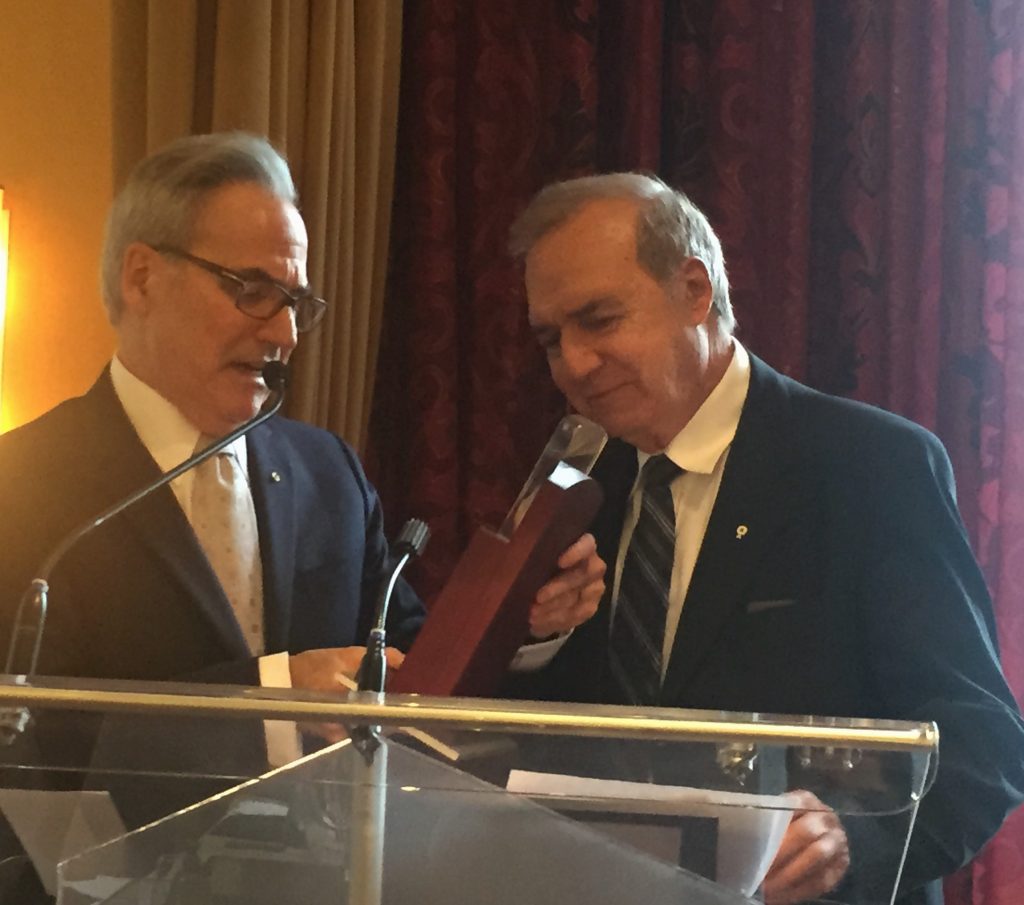
Casper receives the English-Speaking Section of the Bar of Montreal Lifetime Achievement Award from another Lord Reading Past President, Ian Solloway

The Society deeply mourns the loss of Me. Casper Bloom, Q.C. Ad.E., who passed away on March 16. Casper served with distinction as President of the Society for the 1997-1998 season. Casper was a renowned Montreal lawyer whose career spanned decades in labour, public, and administrative law. He became a respected leader in the legal profession, serving as Bâtonnier of the Barreau de Montréal and holding numerous leadership roles within the Canadian and Quebec Bar Associations.

Casper was one of only three individuals to ever receive the English-Speaking Section of the Bar of Montreal’s Lifetime Achievement Award, which was featured in our April 2016 newsletter. Even with his distinguished career, and his stature as a giant in the protection of linguistic and minority rights, Casper always had time to talk to and support young lawyers, including this Co-editor of the the Society’s newsletter, who remembers him and the advice he gave him with great fondness.

The Society expresses its deepest condolences to the Bloom family, and all of Casper’s friends and colleagues.

Reflections on Practice Before the Federal Courts

Stephanie Perlis

On February 11, the Lord Reading Law Society welcomed an esteemed panel to provide firsthand insights from the Federal Courts. We were thrilled to welcome the Honourable Peter Pamel of the Federal Court of Appeal, the Honourable Alan Diner of the Federal Court, and Maître Daniel Grodinsky of Langlois, for a discussion entitled Inside the Federal Courts: Perspectives from Trial, Appeal and Practice.

As the Federal Court system is often outside the everyday practice of many lawyers, including litigators, this panel discussion on Federal Courts offered a timely opportunity to demystify a key pillar of Canada’s legal system.

A Specialized Jurisdiction with Expanding Reach

The Federal Court’s jurisdiction is both precise and expansive. Both the Federal Court and Federal Court of Appeal continue to serve as critical fora for adjudicating matters that fall outside provincial competence. These include maritime law, intellectual property, immigration and refugee claims, administrative law disputes, and national security issues.

As Justice Diner noted, the Federal Courts do not possess inherent jurisdiction in the way that provincial superior courts do. Everything depends on statute, and that fact alone shapes how counsel must approach their cases. The ITO-Int’l Terminal Operators v. Miida Electronics, [1986] 1 S.C.R. 752 case was cited as the landmark decision that created the 3-part test to determine a matter’s jurisdiction between the federal and provincial courts. Beyond a technicality, jurisdiction affects how files are framed at the outset, and how arguments are constructed. As was noted during the panel, jurisdiction is rarely an afterthought in Federal Court litigation. It is often the first, and sometimes, the determinative issue.

Interestingly, not all cases heard before the Federal Court of Appeal come straight from the Federal Court. As Justice Pamel pointed out, only about half of the Federal Court of Appeal cases come from the Federal Court, with the balance coming from the Tax Court along with judicial and statutory review.

Institutional Pressures and Caseload Realities

Perhaps the most well-known area of law that is handled by the Federal Court system is immigration law. Justice Diner shed light on the Federal Court’s workload in immigration and refugee matters, and the scale of the backlog of claims. Backlogs at the administrative level, including before the Immigration and Refugee Board, have reached levels that would have seemed implausible not long ago. Those pressures inevitably find their way to the Federal Court through judicial review applications.

The consequence is not only a question of numbers. It is a question of pace, and of stakes. For the people behind these files, they have life-altering consequences. The system continues to function, but not without strain.

Case Management and Judicial Review as Defining Features of the Federal System

One of the observations that resonated most strongly from the discussion concerned the Federal Court’s approach to case management. Compared to other courts, the panel lauded the Federal Court system’s often a greater degree of judicial engagement with the progression of a file. In many cases, this results in more focused proceedings and, at times, greater efficiency.

As a consequence of this speed and efficiency, the parties must come to court prepared. Strategy cannot remain overly flexible for too long. Files tend to move quickly and lawyers must be ready to meet that pace.

The panel also flagged for counsel, that since the Federal Court is often handling judicial review, the evidentiary record becomes fundamental to a case’s success. On judicial review, there is little opportunity to supplement what has already been put forward. The case, in a real sense, is often won or lost before it ever reaches the courtroom.

Concurrent Jurisdiction and Strategic Forum Selection

 The existence of concurrent jurisdiction in certain areas continues to raise strategic considerations. Lawyers must assess not only the legal merits of a claim, but also the comparative advantages of available forums.

This includes evaluating differences in procedural rules, evidentiary standards, case management practices, and appellate pathways. In disputes with overlapping federal and provincial dimensions—such as those involving intellectual property or regulatory enforcement—the choice of forum can materially affect both process and outcome.

 It was in this context that Justice Diner brought up what he called “the best kept secret” in the Federal Court – the Pilot project on procedural bijuralism. Under this pilot program, lawyers in Federal Court would be able to use Quebec’s Code of Civil Procedure, with the necessary adaptations.

Technology, AI, and Professional Responsibility

Courts are increasingly attentive to issues such as accuracy, disclosure, and accountability in AI-assisted submissions. Lawyers must ensure that any reliance on such tools complies with their duties of competence and candour. In particular, the potential for error or misrepresentation raises the spectre of serious consequences, including findings of contempt in extreme cases. Similar concerns also emerge for self-representing litigants. As courts themselves adapt to technological change, the standards governing acceptable advocacy will continue to develop.

For further evidence of the Federal Court’s efforts to stay up to date on technology, and the use of AI in particular, be sure to watch Justice Alan Diner’s video “Compliance with the Notice on the Use of Artificial Intelligence” from the Federal Court’s official YouTube channel.

A Closing Reflection

From jurisdictional complexity and institutional pressures to technological disruption and procedural reform, the federal litigation environment is becoming increasingly dynamic.

For practitioners, success in this space requires not only substantive expertise, but also strategic awareness of forum selection, procedural discipline, and emerging ethical obligations. As the Federal Court continues to adapt to modern demands, its role as a central pillar of Canada’s administrative and public law framework is likely to grow in both visibility and importance.

As summed up by Maitre Daniel Grodinsky, as lawyers in Montréal, we have the privilege of working in a bijural and bilingual environment. We should be sure to take full advantage of this gift through our practice.

A full set of photos from the evening can be found on our Facebook page

Mediation in Practice – Insights from a Retired Judge and Mediator

Stephanie Perlis

At a recent members-only CLE event hosted jointly by The Lord Reading Law Society and the Association of English-Speaking Lawyers of Quebec, Suzanne Handman, retired judge of the Court of Québec and experienced mediator, shared a series of practical reflections on mediation drawn from years on the bench and in private practice, as interviewed by Society Past President and former Batonnière of the Barreau de Montréeal Me Robin Schiller.

What emerged was a simple but useful reminder: mediation is less predictable than it looks on paper, and small decisions – by counsel, by the mediator, and by the parties – can have a significant impact on the outcome.

Different Mediators, Different Approaches

Not all mediators approach the process the same way. While some remain strictly facilitative, others—particularly with significant experience—may take a more active role in shaping discussions. Suzanne Handman noted that her own approach evolved over her career, as she became more interventionist over time.

In practice, that can mean raising risks, testing assumptions, or questioning whether a party’s expectations align with how a case might unfold at trial. These interventions typically happen in private caucus and are often framed carefully rather than definitively.

For practitioners, the takeaway is straightforward: the mediator’s style can meaningfully influence both the tone and trajectory of the session.

Preparation Is Where the Work Happens

A consistent theme throughout the discussion was the importance of preparation.

From a practical standpoint:

  • the right representatives need to attend – those who understand the file and have authority to settle;
  • clients should arrive with a clear (but flexible) sense of their settlement range;
  • expectations should be grounded in both strengths and risks.

One useful reminder: mediation advocacy differs from trial advocacy. It requires balancing confidence with realism, and positioning a file in a way that invites movement rather than entrenchment.

Looking Beyond the Claim

Although many mediations begin with a monetary demand, resolution often turns on other considerations.

In practice, parties may be more focused on:

  • practical outcomes (e.g., having work redone rather than compensation);
  • explanations or acknowledgment of conduct;
  • preserving confidentiality and avoiding public proceedings.

These interests are not always obvious at the outset. Identifying them early can help shift discussions toward solutions that are more likely to be accepted.

Managing Momentum

Mediation is, at its core, a negotiation – and momentum matters.

Several practical points emerged:

  • starting with less contentious issues can build confidence in the process;
  • initial offers should be credible and signal a willingness to engage;
  • some back-and-forth is necessary—settling too quickly can lead to dissatisfaction on one side or both.

Equally, the way parties respond to proposals matters. Framing responses as questions (rather than outright rejection) can keep discussions constructive and avoid unnecessary escalation.

Virtual vs. In-Person

While in-person mediations can facilitate a different level of interaction, virtual sessions have become a central part of the practice.

They offer flexibility, reduce logistical barriers, and are often more convenient for clients. In many cases, they function just as effectively, provided that the process is managed carefully.

Closing the Loop

When a settlement is reached, it is essential to capture it immediately.

Reducing key terms to writing (ideally finalizing or substantially documenting the agreement before the session ends) helps avoid misunderstandings or post-mediation disputes.

Takeaway

For litigators, mediation requires a shift in mindset. It is not about “winning” in the traditional sense, but about helping clients arrive at a practical and acceptable resolution.

That often means:

  • approaching the process with flexibility;
  • managing expectations carefully;
  • and remaining attentive to how the negotiation is unfolding in real time.

When done well, mediation offers something litigation often cannot: a timely resolution that reflects not only the law, but the interests and realities of the parties involved.

Society Humour

News from the Mishpocha

Condolences

  • To the family of Society past member Judah Wolofsky

April 2026

Events of Interest in April and May

Alyssa Yufe, President

Dear Members and Friends of the Society,

I encourage all of you to attend some or all of these outstanding events coming up!

April 28, 2026: Lecture at the Shaar

Prof. Rosalie Jukier is moderating a panel discussion with Eric Maldoff and others, “Stories That Inspire” at the Society’s home at the Shaar Hashomayim, on April 28 at 7:30 PM.

Thursday, April 30, 2026: Community Event

May 7, 2026: BARREAU DE MONTREAL – Invitation to Montreal Bar Annual General Meeting

  • Invitation à l’assemblée générale annuelle
  • Aux membres du Barreau de Montréal,
  • Nous avons le plaisir de vous aviser que l’assemblée générale annuelle des membres du Barreau de Montréal aura lieu le jeudi 7 mai 2026, à compter de 17 h 30, à la salle 5.15 du Palais de justice de Montréal (10, rue St-Antoine Est).
  • Prendre connaissance de l’avis d’AGA et des documents afférents
  • L’assemblée générale annuelle sera suivie du cocktail des collaborateurs, qui débutera vers 19 h à la Cour d’appel du Québec (Édifice Ernest Cormier – 100, rue Notre-Dame Est). Pour confirmer votre présence à l’AGA et au cocktail, cliquez sur le lien suivant : Confirmer votre présence

May 9, 2026: Community Concert with Justice Carol Cohen

The Lakeshore Concert Band/L’Harmonie du Lakeshore, with guest soloist Léane Teran-Paul of the Orchestre Métropolitain on oboe, will perform at the Vents et Merveilles/Winds and Wonders Gala concert on Saturday evening May 9th, 2026 at 7:30pm.

The Lakeshore Concert Band, which boasts our own Justice Carol Cohen on flute, is a charitable foundation which first performed at Expo 67 and helps raise funds each year for numerous charities and community groups.

Tickets for the gala concert can be purchased here:  GALA 2026: Winds and Wonders

 May 14, 2026: Jewish Public Library Event on Dr. Morgentaler:

As part of the Auteurs de chez nous series at the JPL, join us in person or on Zoom for a discussion with author Michel Viau, who will present his graphic novel Morgentaler: Avec elles.

With rigor and sensitivity, author Michel Viau will present his graphic novel, retracing the journey of a man who became a central figure in the movement for social justice and fundamental rights. Details and registration are here:

Authors from Home: Morgentaler: Avec elles by Michel Viau | Jlive

February 2026

Editors – Allen Mendelsohn, Larry Markowitz and Stephanie Perlis

President’s Message

Alyssa Yufe, President

(cliquez ici pour lire le mot de la présidente en français)

Dear Colleagues, Honourable Judges, Members and Friends of the Society,

As we move into the heart of 2026, and hopefully to warmer temperatures, I want to begin by thanking you for the continued strength, engagement, and collegiality that define our Society. For over 77 years, the Lord Reading Law Society has served as a forum for legal learning, thoughtful dialogue, and principled engagement within Quebec’s legal community. This year promises to continue that tradition in a meaningful and substantive way.

It is therefore my great pleasure to invite you to one of our flagship events of the winter:

Inside the Federal Courts: Perspectives from Trial, Appeal and Practice

We are delighted to welcome an exceptional panel offering rare insight into the inner workings of the Federal Courts of Canada:

  • The Honourable Peter Pamel, Federal Court of Appeal
  • The Honourable Alan Diner, Federal Court
  • Me Daniel Grodinsky, Litigation partner at Langlois Avocats

Together, our speakers will explore the Federal Courts from complementary vantage points. Our three speakers will shed light on trial, appeal, and practice and attendees will leave with a richer understanding of federal jurisdiction, judicial reasoning, and advocacy before these courts.

You can register for this extraordinary event here.

We are deeply grateful to our very generous sponsors whose support make this event possible:

  • Langlois Avocats for being the lead sponsor for the evening
  • BLG for supporting and helping make the evening possible.

I hope you will join us for this very special evening.

Sincerely,

Alyssa Yufe, President 2025-26
The Lord Reading Law Society
president@lordreading.org

Human Rights Updates from the President

Alyssa Yufe

Please note that no member of the Society who is a sitting or supernumerary member of a court or administrative tribunal has participated in any manner in the preparation or adoption of the statements discussed here.

1. Return of Last Hostage

On January 26, 2026, after 843 days, the body of the last hostage held in Gaza since October 7, 2023 was located and retrieved by the Israel Defense Forces. The return of Ran Gvili cannot claim to close this painful chapter in our history. The hostages, survivors, the families of those lost, and all of those whose lives were deeply affected by these events will decide when the page can finally be turned. It is possible the mourning will never cease. Our job should be to offer unwavering support, understanding, and comfort. At the same time, the return of Ran Gvili relieves some of the agony borne by so many who grieved alongside the Gvili family, a family long denied even the most basic form of closure. Ran’s return allows space, at last, for mourning and burial, and for a momentary reprieve from the cruelty that has marked this period for our Jewish brothers and sisters.

Ran Gvili was an injured police officer on medical leave, awaiting shoulder surgery, when he heard about the Hamas invasion and sprang into action on October 7, 2023 to defend Kibbutz Alumim. He stood against assailants who attacked, raped, maimed, and pillaged without restraint. Ran’s actions were not only selfless and heroic but also encapsulate the commandment of Leviticus 19:16, “Do not stand idly by the blood of your neighbour.” This principle, deeply rooted in Jewish philosophy, law, and moral tradition, guided Ran’s final acts. It is a commandment that obligates action when one has the capacity to help, and one that continues to inspire countless acts of courage and solidarity.

This same moral imperative has animated generations of members of the Lord Reading Law Society, many of whom have answered the call to defend human dignity through individual human-rights initiatives, advocacy, and principled public engagement. With the return of the final hostage for burial, we can only hope that peace may yet take root, and that security and prosperity may one day prevail for all decent and peace-seeking communities.

2. A Message in Solidarity with the People of Iran

At this moment of global uncertainty, the Lord Reading Law Society reiterates its continued support for the people of Iran. We pray for, and unequivocally demand, their immediate security, safety, and freedom.

Why Advocacy Still Matters: Lessons from a Youth Protection Lawyer

Larry Markowitz

On January 21st, the Lord Reading Law Society gathered for its Annual Student Dinner, a tradition that brings together law students, lawyers, law professors, and judges not just to celebrate the law, but to reflect on why we practice it. This year’s guest speaker, Maître Valérie Assouline, brought that purpose into sharp focus.

Maître Assouline is the current Bâtonnière and the 160th elected head of the Bar of Montreal, but titles were not what defined her address. Speaking to the future lawyers in the room, she offered something far more lasting: a deeply human look at what it means to stand up for others when they need it most. Her talk, A Family Affair: The Trials and Tribulations of a Youth Protection Lawyer, was as honest as it was inspiring.

She spoke about youth protection as a field shaped by urgency, emotion, and fragility. The cases move quickly, but the consequences last forever. Children and parents often enter the system frightened, overwhelmed, and unsure of what’s happening or why. As she explained, clients may not always understand the law, but they understand loss, stress, and fear. For students preparing to enter the profession, this was a powerful reminder that legal work is never abstract and never detached from human reality.

A recurring theme of her talk was perspective. Early in her career, she learned that not every conflict needs to escalate. Sometimes, a lawyer’s most meaningful work happens quietly, by lowering the temperature and creating space for families to move toward resolution instead of confrontation. When that happens, children stop being the battleground for adult conflict. Justice, she suggested, doesn’t always announce itself loudly.

She also shared stories of a system that, despite good intentions, can lose sight of the people it is meant to protect. She spoke of parents who weren’t believed, mothers reduced to descriptions on paper, and children who slipped into invisibility within institutional processes. Lawyers, she said, are invited into parts of life that most people never see. With that access comes responsibility. If no one speaks up, harm goes unnoticed. If no one steps forward, dignity is lost.

Her message to the law students in the room was clear: don’t stand on the sidelines. Advocacy is not passive. It means speaking up, pushing back, and sometimes making others uncomfortable. Applying the law with humanity isn’t an optional add-on. It is the job. She encouraged future lawyers to question systems that drift away from their purpose and to resist the easy temptation of “this is how it has always been done.”

She also spoke candidly about privilege. Being trusted with another person’s future is not something to take lightly. It requires courage, humility, and constant self-awareness. This is ultimately about dignity.

By the time she finished her talk, earning a standing ovation, it was clear Maître Assouline had struck a chord. For the students in the audience, her words offered a vision of legal practice grounded in empathy, responsibility, and courage. For the wider audience of jurists, it was a reminder of why advocacy matters, and why the law, when practiced at its best, remains a profoundly human profession.

We were delighted to award our student prizes during the evening. Scroll down to see who the winners were!

For a full set of pictures from the event, please click here. 

Congratulations to our Student Award Winners!

As mentioned above, the Lord Reading Law Society had the pleasure of once again hosting its annual Student Dinner on January 21. The evening began with the presentation of the Society’s academic awards to deserving students from the various Civil Law faculties. Congratulations to all the winners!

McGill University: Isabelle Brodeur

Université de Montréal: Esmaya Jilwan

Université de Sherbrooke: Catherine Lambert

Université d’Ottawa: Yanran Elisa Xue

Université du Québec à Montréal: Rachel Chagnon, Xavier Beaurivage

Exciting Events from the Society and More!

Allen Mendelsohn

1.  ESLQ – Backstage at the Palace, online on February 12, 2026

The Association of English-Speaking Lawyers of Québec / Association des avocats anglophones du Québec (ESLQ) is excited to present the return of the Backstage at the Palace Lecture Series, a tribute to the late Honourable Justice Henry Steinberg. On February 12 at 5:30 pm, please join us online for a unique view from former Montreal partner at Heenan Blaikie and founder of MUSE Entertainment, Michael Prupas. Michael will recount his transition from lawyer in the entertainment industry to visionary producer in his talk entitled: “Life after Law: an interview with Michael Prupas, founder of MUSE Entertainment”.

The event is free for ESLQ members. and you can register at Eventbrite. If you are not yet a member and would like to register, please contact the ESLQ at eslq25@gmail.com.

2.  SAVE THE DATE for the Annual Lord Reading Young Bar Hockey Game!

All young bar (and young at heart) hockey players should save Sunday April 12 at 3 PM! We look forward to putting on the pads at the Samuel Moskovitch Arena in Cote St Luc. More details to come. If you would like more information at this time or wish to register or help out, you can contact Lord Reading Young Mar Committee member Jacob Falutz at jacob.ray@videotron.ca.

3. May-June 2026: The Lord Reading Law Society Multicultural Gala

The Lord Reading Law Society will be holding a spring Multicultural Gala, an evening dedicated to celebrating diversity within the legal profession to foster dialogue, solidarity, justice, community and cross-cultural understanding.

We anticipate setting the date in the next few weeks and look forward to providing further details of this unique and exciting event as soon as possible!

Society Humour

News from the Mishpocha

Mazel Tov

  • To Society Past President Ted Goloff on being named to Board of Directors of the International Association for Jewish Lawyers and Jurists
  • To Society member Beryl Wajsman on stepping down as Editor of The Suburban after 18 years to devote his full efforts to Jewish civil rights advocacy as President of the Institute for Public Affairs of Montreal, which he founded 25 years ago
  • To Society Board member Elissa Brock for being named partner at Fasken

Condolences

  • To the family of Society Past President (1984-85) Sidney Cutler, QC. Sid will be fondly remembered by all who knew him, including your newsletter editor Allen who as a young lawyer was always warmly welcomed by Sid and shared many engaging conversations at Lord Reading events.

January 2026

Editors – Allen Mendelsohn, Larry Markowitz and Stephanie Perlis

President’s Message

Alyssa Yufe, President

(cliquez ici pour lire le mot de la présidente en français)

Dear Colleagues, Honourable Judges, Members and Friends of the Society,

On behalf of the Lord Reading Law Society, I am excited to welcome you to 2026!

I hope that you enjoyed a restful holiday season, and we extend our warmest wishes to you and your families for a happy, healthy, and peaceful new year. We have some great events coming up to start 2026.

Our Annual Student Dinner with Valérie Assouline

Next Wednesday, January 21st, on the occasion of our Annual Student Dinner, one of the Society’s most meaningful traditions, we are delighted to welcome Maître Valérie Assouline, youth protection advocate, current Bâtonnière and 160th elected head of the Bar of Montreal, for her talk entitled A Family Affair: The Trials and Tribulations of a Youth Protection Lawyer. More information about our wonderful guest speaker is below.

The Annual Student Dinner is a cornerstone event at which we are delighted to welcome and honour law students and stagiaires. During the evening, the Lord Reading Student Awards will be presented to deserving students from Québec’s law faculties, as well as the Civil Law Section of the University of Ottawa.

For many students, this evening represents their first opportunity to network with members of the legal profession. For lawyers and judges, it is a refreshing and purposeful opportunity to offer guidance, mentorship, and encouragement to the next generation. We encourage all members and friends of the Society to attend and warmly welcome the students and stagiaires who represent the future of our profession and our Society.

Cocktails begin at 6:00 p.m., followed by dinner at 7:00 p.m., at the Shaar Hashomayim Synagogue. You can register online at https://lordreading.org/events/annual-student-dinner-2026.

I would like to thank our very generous Student Dinner sponsors for their support:

  1. Goldwater Droit for being our headline sponsor for the evening; and
  2. Devine Schachter Polak and Robinson Sheppard Shapiro for supporting the evening and making the highly-discounted student and stagiaires tickets possible.

About Maître Valérie Assouline

Maître Assouline is a passionate advocate, community leader, and dedicated public servant whose work bridges justice, compassion, and service to others. Throughout her career, she has worked tirelessly to defend the rights of children and parents, ensuring that vulnerable voices are heard and protected within the youth protection system.

She is deeply engaged in community life, serving as a municipal councillor in Dollard-des-Ormeaux and as a leader in numerous pro bono and charitable initiatives.

We are honoured and truly grateful that Valérie will be delivering the address at our Annual Student Dinner. Her record speaks not only to her professional excellence, but to a rare depth of insight shaped by years of principled advocacy, lived experience, and unwavering service to others.

Maître Assouline leads by example and is an inspiration to all.

REMINDER: Young Bar Cocktail Hockey Watch Party is tonight!

There is still time to register for tonight’s Young Bar hockey night! All Lord Reading Junior members, stagiaires and students are welcome. Snacks and beverages will be provided, compliments of the Society. Please sign up for this free evening here. It’s tonight, Thursday January 15th! Go Habs Go!

*****

We have more wonderful events upcoming, and stay tuned for more more exciting announcements about what’s ahead!

February 11, 2026 – Inside the Federal Courts: Perspectives from Trial, Appeal and Practice

For our next dinner meeting, we are thrilled to welcome the Honourable Peter Pamel of the Federal Court of Appeal, the Honourable Alan Diner of the Federal Court, and Maître Daniel Grodinsky of Langlois. Together, they will explore the work of the Federal Courts and enlighten us all. Registration for this event will open on January 22, 2026.

May-June 2026: The Lord Reading Law Society Multicultural Gala

The Lord Reading Law Society will be holding a spring Multicultural Gala, an evening dedicated to celebrating diversity within the legal profession to foster dialogue, solidarity, justice, community and cross-cultural understanding.

We anticipate setting the date in the next few weeks and look forward to providing further details of this unique and exciting event once they are available.

*****

I want to thank my Executive, Past Presidents and all of our Board members and volunteers who continue to uphold and support the Society. Your time, input and thoughtful contributions are indispensable and greatly appreciated.

I look forward to seeing you next Wednesday!

Sincerely,

Alyssa Yufe, President 2025-26
The Lord Reading Law Society
president@lordreading.org

Human Rights Updates from the President

Alyssa Yufe

Please note that no member of the Society who is a sitting or supernumerary member of a court or administrative tribunal has participated in any manner in the preparation or adoption of the statements discussed here.

1. December Statement on the Bondi Massacre

I would like to draw to your attention our statement from December 2025, extending our deepest condolences to the victims, their families and all of those affected by the horrific massacre at Bondi Beach, Australia during Hanukkah on December 14, 2025 and calling on governments to take robust action to protect their Jewish communities and eradicate the pervasive spread of antisemitism in Canada and around the world.

2. A Message in Solidarity with the People of Iran

At this moment of global uncertainty, the Lord Reading Law Society also wishes to express that our hearts and minds are with the people of Iran. We pray for, and unequivocally demand, their immediate security, safety, and freedom.

As an organization committed to human rights, the rule of law, and the inherent dignity of all people, we call upon our federal and provincial leaders, and all heads of state to take the necessary and meaningful steps to ensure the protection, liberty, and fundamental rights of the Iranian people. Silence in the face of injustice is not an option.

Human Rights Advocate Mark Sandler’s Reflections on Antisemitism Today

Larry Markowitz

Reflecting the Society’s longstanding commitment to the rule of law, our Annual Human Rights Lecture, held on November 26, 2025, featured distinguished Canadian criminal defence lawyer and human rights advocate Mark Sandler, who delivered a lecture entitled Antisemitism Today: The Law, the Community, and the Way Forward: A Canadian Perspective.

Over several decades, Mr. Sandler has been at the forefront of efforts to address hate-motivated crime in Canada. His work has included appearances before courts and parliamentary committees, training for police and prosecutors, and the development of legal tools to respond to hate. He is also the founder and chair of the Alliance of Canadians Combatting Antisemitism (ALCCA), a coalition of more than 65 community organizations committed to coordinated advocacy, education, and respectful dialogue.

The evening opened with reflections on the Society’s own history. Founded at a time when Jewish lawyers in Quebec faced exclusion from professional life, the Society emerged as a vehicle for dignity, solidarity, and access. While overt barriers eventually fell, Mr. Sandler cautioned against complacency. Antisemitism, he argued, has not disappeared. Instead, it has evolved.

A central theme of the lecture was the evolution of antisemitism from overt hostility to more complex forms that often operate through the language of social justice and rights-based discourse. Mr. Sandler noted that while legitimate criticism of Israeli government policies is not antisemitic, antisemitism arises when Jews are held collectively responsible for Israel’s actions, when Israel is uniquely demonized or delegitimized, or when classic antisemitic tropes are repackaged in contemporary terms.

Zionism, Mr. Sandler explained, is simply the belief in a Jewish democratic state in the Jewish people’s historic homeland. Yet anti-Zionism has increasingly become a socially acceptable proxy for antisemitism.

He identified several factors contributing to this shift, including the false redefinition of Zionism as Jewish supremacy; the portrayal of Zionism as colonialism, which resonates within certain ideological frameworks; the amplification of misinformation through social media; and the influence of extremist ideologies that appropriate the language of human rights while promoting exclusion and hatred.

The consequences of these trends are not abstract. Mr. Sandler pointed to data showing that Jews are the targets of over 70% of hate motivated crimes based on religion in Canada, despite constituting a small percentage of the population. These figures, he emphasized, are widely understood to be underreported.

He also described a troubling convergence of online radicalization, lone actor threats, and ideological extremism. Law enforcement, he noted, increasingly views these dynamics as posing serious risks to Jewish communities.

Turning to the law, Mr. Sandler emphasized that Canada’s Criminal Code already contains tools capable of addressing many forms of hate activity, including mischief, intimidation, and offences involving the obstruction of public infrastructure. Too often, however, these provisions are underused due to unfamiliarity.

Drawing on his experience training police and prosecutors, he stressed the importance of consistent enforcement and the use of community impact statements to convey the broader harm caused by hate crimes, including acts such as the desecration of Holocaust memorials.

The lecture also addressed challenges within educational and institutional settings. Mr. Sandler expressed concern about emerging definitions of discrimination that label support for Israel as inherently racist, thereby marginalizing Jewish identity and silencing debate. He contrasted these approaches with the IHRA Working Definition of Antisemitism, which seeks to capture how antisemitism manifests in contemporary contexts, including through attacks on Jewish collective identity.

Looking ahead, Mr. Sandler’s message was one of strategy and responsibility. Antisemitism, he emphasized, is not a challenge faced by one community alone, but a broader societal issue that cannot be addressed in isolation.

He urged lawyers, institutions, and civic leaders to use the tools available to them and to reject selective outrage. Racism, antisemitism, and extremism, he argued, must be confronted together.

Mr. Sandler’s remarks underscored the importance of continued engagement, clarity in the law, and a willingness to work across communities. His reflections offered a reminder that confronting antisemitism, like confronting all forms of hate, requires dialogue, shared responsibility, and sustained commitment.

For a full set of pictures from the event, please click here. 

About the ALCAA

Allen Mendelsohn

On behalf of the Society, we would like to extend our most sincere thanks to Mark Sadler for speaking to us. The Alliance of Canadians Combatting Antisemitism (ALCCA) is a diverse coalition of 65+ community organizations and groups that collaboratively address antisemitism through advocacy, education and respectful dialogue. We invite you to subscribe to the ALCCA mailing list for ALCCA news and action alerts.

Society Humour

News from the Mishpocha

Condolences

  • To the family of past Society Board member Solomon Katz